Not all alcohol use disorder criteria are equally severe: Toward severity grading of individual criteria in college drinkers
- PMID: 30676037
- PMCID: PMC6494471
- DOI: 10.1037/adb0000443
Not all alcohol use disorder criteria are equally severe: Toward severity grading of individual criteria in college drinkers
Abstract
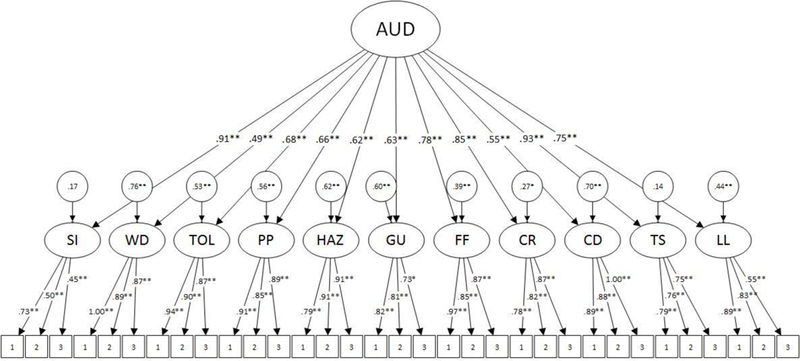
Alcohol use disorder (AUD) diagnosis in the fifth edition of the Diagnostic and Statistical Manual of Mental Disorders (DSM-5; American Psychiatric Association, 2013) contains a severity gradient based on number of criteria endorsed, implicitly assuming criteria are interchangeable. However, criteria vary widely in endorsement rates, implying differences in the latent severity associated with a symptom (e.g., Lane, Steinley, & Sher, 2016) and demonstrating criteria are not interchangeable (Lane & Sher, 2015). We evaluated whether variation in the severity of criteria could be resolved by employing multiple indicators of each criterion varying in item-level severity. We assessed 909 undergraduate students aged 18 years or older with at least 12 drinking occasions in the past year. Participants self-administered questions on alcohol consumption and past year AUD symptoms via an online survey. For each of the 11 AUD criteria, we selected three indicators based on the difficulty values of the one-parameter logistic item response theory model ranging from low to high. We first tested a higher order AUD factor defined by 11 lower order criterion factors, χ2(551) = 2,959.35, p < .0001; root mean square error of approximation = 0.09. The 33 items were used to create severity scores: a criterion count (0-11), symptom count (0-33), and factor scores derived from a bifactor model. Though our new scores resulted in incremental validity over DSM-5 across a range of external validators, when the standardized regression estimates were compared, the new scores did not consistently outperform the DSM-5 suggesting this approach is viable for developing more sensitive diagnostic instruments but needs further refinement. (PsycINFO Database Record (c) 2019 APA, all rights reserved).
Figures
References
-
- American Psychiatric Association. (2013). Diagnostic and statistical manual of mental disorders (5th Ed.). Arlington: VA: American Psychiatric Publishing.
-
- American Psychiatric Association. (1994). Diagnostic and statistical manual of mental disorders (4th Ed.). Washington, DC: Author.
-
- American Psychiatric Association. (1987). Diagnostic and statistical manual of mental disorders (3rd Ed., text rev.). Arlington, VA: Author.
MeSH terms
Grants and funding
LinkOut - more resources
Full Text Sources
Medical
Miscellaneous