


CD73 (Cluster of Differentiation 73) and the Differences Between Mice and Humans
- PMID: 30676071
- PMCID: PMC6446586
- DOI: 10.1161/ATVBAHA.118.311579
CD73 (Cluster of Differentiation 73) and the Differences Between Mice and Humans
Abstract
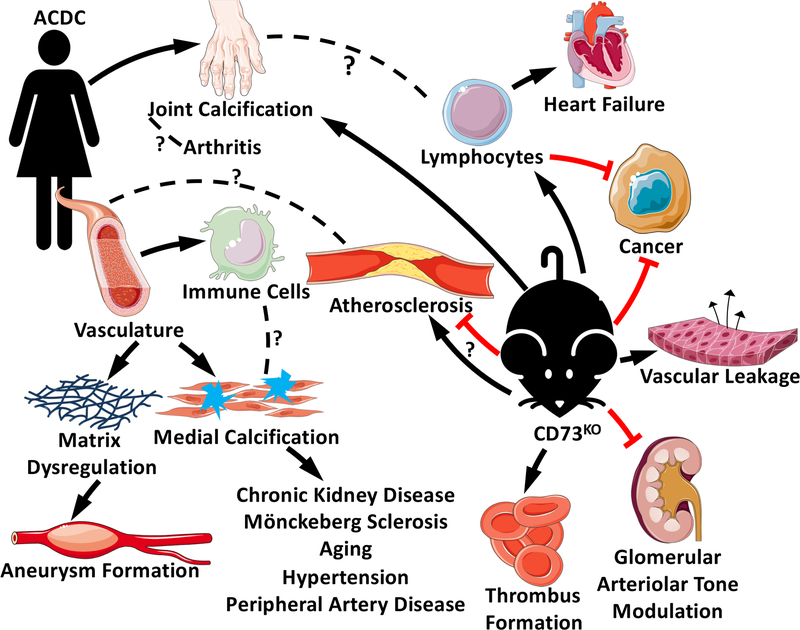
As vascular disease is complex and the various manifestations are influenced by differences in vascular bed architecture, exposure to shear and mechanical forces, cell types involved, and inflammatory responses, in vivo models are necessary to recapitulate the complex physiology and dynamic cellular interactions during pathogenesis. Murine knockout models are commonly used tools for investigators to study the role of a specific gene or pathway in multifaceted disease traits. Although valuable, these models are not perfect, and this is particularly true in regard to CD73 (cluster of differentiation 73), the extracellular enzyme that generates adenosine from AMP. At baseline, CD73-deficient mice do not present with an overt phenotype, whereas CD73-deficient humans present with the complex phenotype of vascular calcification, arteriomegaly and tortuosity, and calcification in small joints. In this review, we highlight the differences between the mouse and human systems and discuss the potential to leverage findings in mice to inform us on the human conditions.
Keywords: adenosine; cardiovascular disease; mice; rare disease; vascular calcification.
Figures
References
-
- Loecker TH, Schwartz RS, Cotta CW, Hickman JR Jr. Fluoroscopic coronary artery calcification and associated coronary disease in asymptomatic young men. J Am Coll Cardiol. 1992;19:1167–1172 - PubMed
Publication types
MeSH terms
Substances
Grants and funding
LinkOut - more resources
Full Text Sources
Medical
Research Materials
Miscellaneous
