


Retrospective Medical Record Review to Describe Use of Repository Corticotropin Injection Among Patients with Uveitis in the United States
- PMID: 30676837
- PMCID: PMC6479238
- DOI: 10.1089/jop.2018.0090
Retrospective Medical Record Review to Describe Use of Repository Corticotropin Injection Among Patients with Uveitis in the United States
Abstract
Introduction: Repository corticotropin injection (RCI) has immune-modulatory and anti-inflammatory effects and is approved for multiple indications, including severe and acute chronic allergic and inflammatory processes involving the eye and adnexa. This study describes patient characteristics, treatment patterns, and physicians' assessments of patients with uveitis treated with RCI.
Methods: This was a retrospective medical record review of US patients. Eligible patients had a diagnosis of uveitis, received RCI in the past 12 months, and had completed or were receiving RCI treatment at the time of data collection. Baseline characteristics and after-treatment clinical data are descriptively reported.
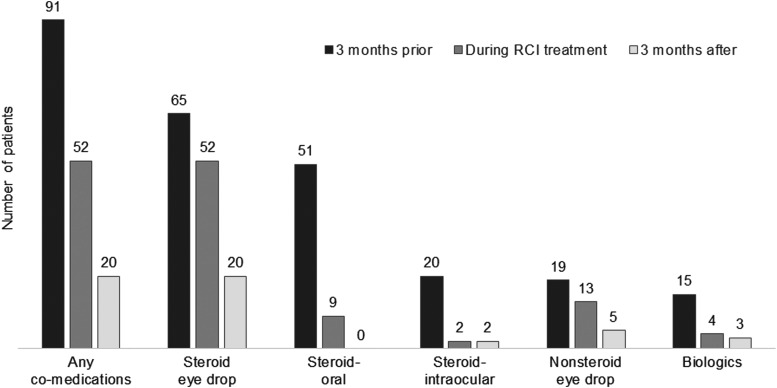
Results: The study included 91 patients (mean age 41 years, 62% female, and mean time since diagnosis 3.98 years). Most patients had moderate (n = 48, 53%) to severe (n = 21, 23%) visual impairment, and none was blind before RCI therapy. Patients used an average of 2.5 medications before RCI. Initial RCI dosing regimens, dose adjustments, and treatment durations were different for each patient. Concomitant medication use and dosages were reduced during RCI; 76 patients (84%) improved, 15 patients (16%) stayed the same, and none worsened; 86% of patients had improvements in vision.
Conclusions: Physicians individualized RCI therapy among patients who suffered uveitis for several years and when previous therapies were inadequate. Most patients improved after initiating RCI, most commonly in vision. The findings support use of RCI for uveitis and provide a better understanding of patient characteristics and practice patterns to guide appropriate use.
Keywords: ACTH; RCI; drug therapy; health care utilization; repository corticotropin injection; uveitis.
Conflict of interest statement
All authors had full access to all of the data in this study. All named authors meet the International Committee of Medical Journal Editors (ICJME) criteria for authorship for this article, take responsibility for the integrity of the work as a whole, and have given approval for this version to be published. W.W.N., A.F.L., J.K., B.O.-O., and G.C. are employees of Mallinckrodt Pharmaceuticals and declare that they have no other conflicts of interest. J.R.G., K.H., and S.C. were research consultants for the study and declare that they have no conflicts of interest.
Figures
References
-
- Mustafa M., Muthusamy P., Hussain S.S., Shimmi S.C., and Sein M.M. Uveitis: pathogenesis, clinical presentations and treatment. IOSR J. Pharm. 4:42–47, 2014
-
- Guly C.M., and Forrester J.V. Investigation and management of uveitis. BMJ 341:c4976, 2010 - PubMed
-
- Acharya N.R., Tham V.M., Esterberg E., Borkar D.S., Parker J.V., Vinoya A.C., and Uchida A. Incidence and prevalence of uveitis: results from the Pacific Ocular Inflammation Study. JAMA Ophthalmol. 131:1405–1412, 2013 - PubMed
Publication types
MeSH terms
Substances
LinkOut - more resources
Full Text Sources
Medical
Miscellaneous
