


Readmission and hospital mortality after ICU discharge of critically ill cancer patients
- PMID: 30677085
- PMCID: PMC6345475
- DOI: 10.1371/journal.pone.0211240
Readmission and hospital mortality after ICU discharge of critically ill cancer patients
Erratum in
-
Correction: Readmission and hospital mortality after ICU discharge of critically ill cancer patients.PLoS One. 2019 Jun 5;14(6):e0218196. doi: 10.1371/journal.pone.0218196. eCollection 2019. PLoS One. 2019. PMID: 31167000 Free PMC article.
Abstract
Background: Intensive care unit (ICU) readmission is generally associated with increased hospital stays and increased mortality. However, there are limited data on ICU readmission in critically ill cancer patients.
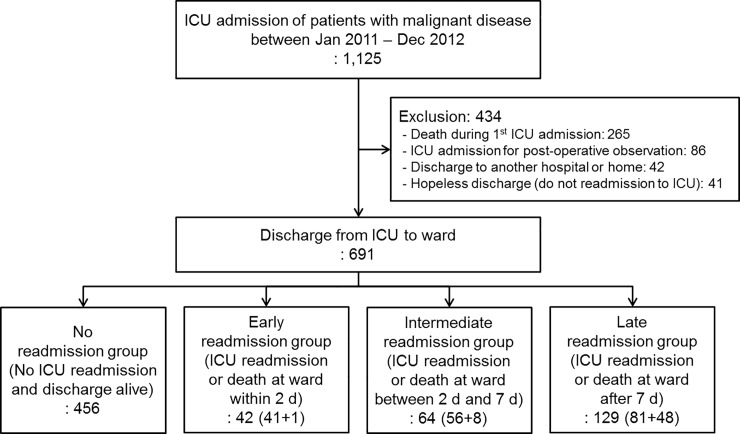
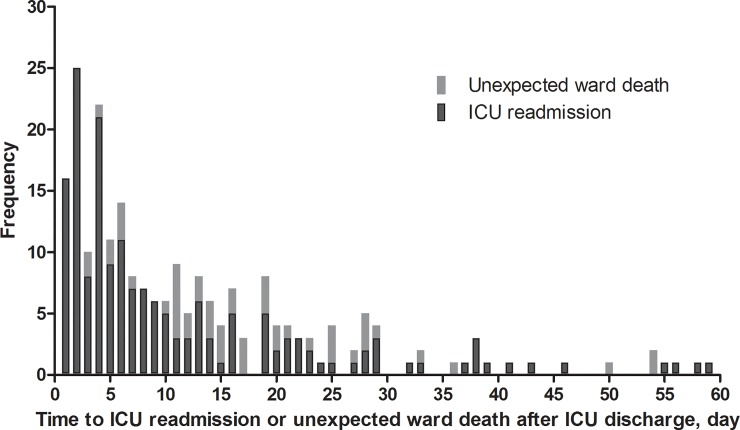
Method: We conducted a retrospective cohort study based on the prospective registry of all critically ill cancer patients admitted to the oncology medical ICU between January 2012 and December 2013. After excluding patients who were discharged to another hospital or decided to end-of-life care, we divided the enrolled patients into four groups according to the time period from ICU discharge to unexpected events (ICU readmission or ward death) as follows: no (without ICU readmission or death, n = 456), early (within 2 days, n = 42), intermediate (between 2 and 7 days, n = 64), and late event groups (after 7 days of index ICU discharge, n = 129). The independent risk factors associated with ICU readmission or unexpected death after ICU discharge were also analyzed using multinomial logistic regression model.
Results: There were no differences in the reasons for ICU readmission across the groups. ICU mortality did not differ among the groups, but hospital mortality was significantly higher in the late event group than in the early event group. Mechanical ventilation during ICU stay, tachycardia, decreased mental status, and thrombocytopenia on the day of index ICU discharge increased the risk of early ICU readmission or unexpected ward death, while admission through the emergency room and sepsis and respiratory failure as the reasons for index ICU admission were associated with increased risk of late readmission or unexpected ward death. Interestingly, recent chemotherapy within 4 weeks before index ICU admission was inversely associated with the risk of late readmission or unexpected ward death.
Conclusion: In critically ill cancer patients, patient characteristics predicting ICU readmission or unexpected ward death were different according to the time period between index ICU discharge and the events.
Conflict of interest statement
The authors have declared that no competing interests exist.
Figures
References
-
- Azoulay E, Mokart D, Pene F, Lambert J, Kouatchet A, Mayaux J, et al. Outcomes of critically ill patients with hematologic malignancies: prospective multicenter data from France and Belgium—a groupe de recherche respiratoire en reanimation onco-hematologique study. J Clin Oncol. 2013; 31:2810–8. 10.1200/JCO.2012.47.2365 - DOI - PubMed
Publication types
MeSH terms
LinkOut - more resources
Full Text Sources
