


Impact of screening on cervical cancer incidence in England: a time trend analysis
- PMID: 30679300
- PMCID: PMC6347909
- DOI: 10.1136/bmjopen-2018-026292
Impact of screening on cervical cancer incidence in England: a time trend analysis
Abstract
Objectives: To better model underlying trends in cervical cancer incidence so as to model past trends, to estimate the impact of cervical screening on cervical cancer rates at different ages and to obtain a counterfactual baseline under a no-screening scenario.
Design: Trend analysis of cancer registry data recorded between 1971 and 2013.
Setting: England.
Participants: 132 493 women aged 20-84 with a diagnosis of cervical cancer.
Outcome measure: Cervical cancer incidence data were modelled using a modified age period cohort model able to capture both increased exposure to human papillomavirus (HPV) as well as changes in the age of exposure to HPV in young cohorts. Observed rates were compared with counterfactual baseline rates under a no-screening scenario to estimate the protective effect of screening.
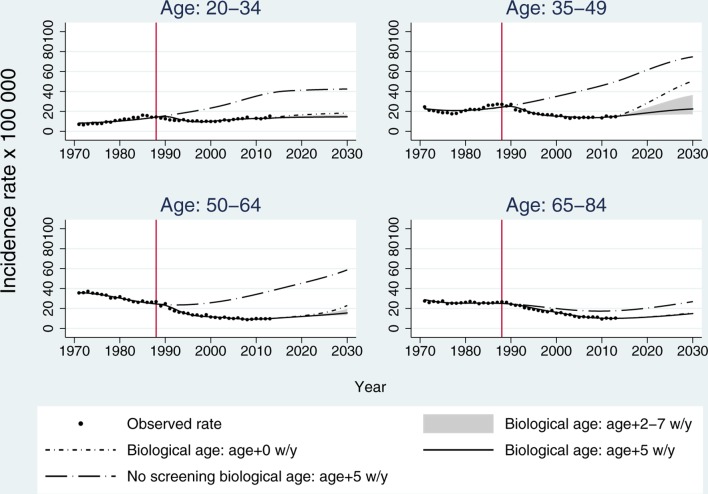
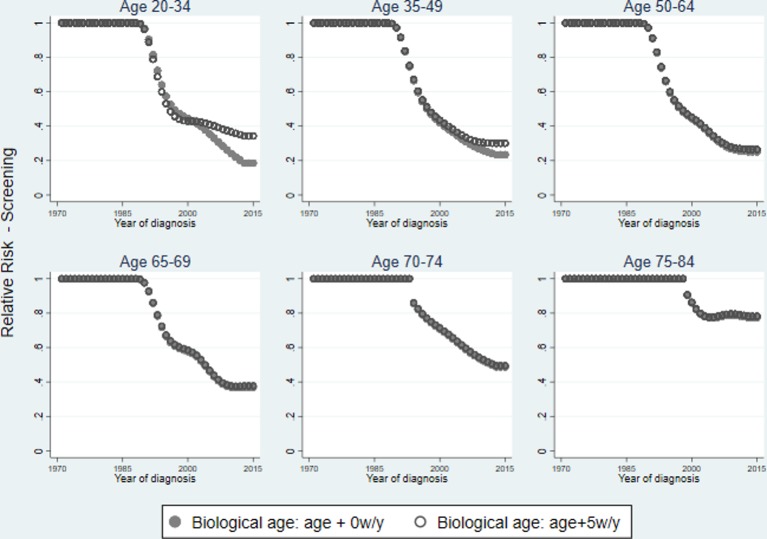
Results: Rates of cervical cancer incidence have been decreasing since the introduction of screening but are projected to increase in the future under the current scenario. Between 1988 and 2013, it was estimated that screening had prevented approximately 65 000 cancers. Moreover, in 2013, the age-standardised rate (ASR) estimated under the no-screening scenario (37.9, 95% CI 37.4 to 38.3) was threefold higher among women aged 20-84 than the observed ASR (12.8, 95% CI 12.3 to 13.3). We estimate that the age of first HPV exposure has decreased by about 1 year every decade since the early 1970s (women born in 1955 onwards).
Conclusions: Our results corroborated the importance of screening in preventing cervical cancer and indicated future rates are dependent on age at HPV exposure. Estimated future rates can be used for healthcare planning while the counterfactual baseline to quantify the impact of HPV vaccination in microsimulations.
Keywords: adult oncology; public health.
© Author(s) (or their employer(s)) 2019. Re-use permitted under CC BY. Published by BMJ.
Conflict of interest statement
Competing interests: None declared.
Figures
References
-
- IARC Working Group on Cervical Cancer Screening. Efficacy of Screening chapter. Screening for Cancer of the Uterine Cervix IARC Scientific Publications N 76. Hakama MMA, Day NE, Lyon: IARC, 1986.
Publication types
MeSH terms
Substances
Grants and funding
LinkOut - more resources
Full Text Sources
Medical
Molecular Biology Databases
Miscellaneous
