. 2019 Jan 24;9(1):476.
doi: 10.1038/s41598-018-36604-9.

Ice-Templated W-Cu Composites with High Anisotropy

Affiliations

Ice-Templated W-Cu Composites with High Anisotropy

André Röthlisberger et al. Sci Rep. .

Abstract

Controlling anisotropy in self-assembled structures enables engineering of materials with highly directional response. Here, we harness the anisotropic growth of ice walls in a thermal gradient to assemble an anisotropic refractory metal structure, which is then infiltrated with Cu to make a composite. Using experiments and simulations, we demonstrate on the specific example of tungsten-copper composites the effect of anisotropy on the electrical and mechanical properties. The measured strength and resistivity are compared to isotropic tungsten-copper composites fabricated by standard powder metallurgical methods. Our results have the potential to fuel the development of more efficient materials, used in electrical power grids and solar-thermal energy conversion systems. The method presented here can be used with a variety of refractory metals and ceramics, which fosters the opportunity to design and functionalize a vast class of new anisotropic load-bearing hybrid metal composites with highly directional properties.


Conflict of interest statement

The authors declare no competing interests.

Figures
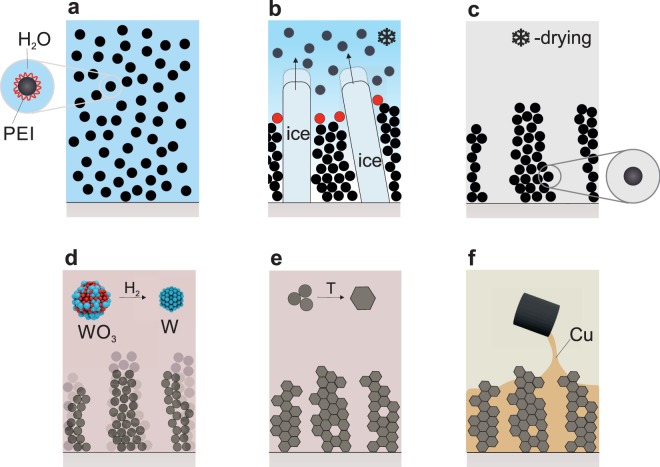
Figure 1
Figure 1
Schematic of the ice-templating process to create the anisotropic tungsten lamellar scaffold for melt-infiltration. The process steps involve (a) slurry formation by dispersing the ceramic powder (WO3) in water using PEI as surfactant, (b) formation of an anisotropic composite by ice-templating, particles (red) are captured between the ice-walls, i.e. lamellar dendrites (c) sublimation of ice to yield a loosely-bound WO3 scaffold with directional porosity, (d) reduction of the (WO3) scaffold yielding a metallic tungsten scaffold and (e) sintering of the porous tungsten. Significant volume shrinkage is associated with densification upon reduction (ceramic to metal) and sintering (closing of interparticle porosity). (f) Melt infiltration of the tungsten scaffold with liquid copper followed by solidification.
Figure 2
Figure 2
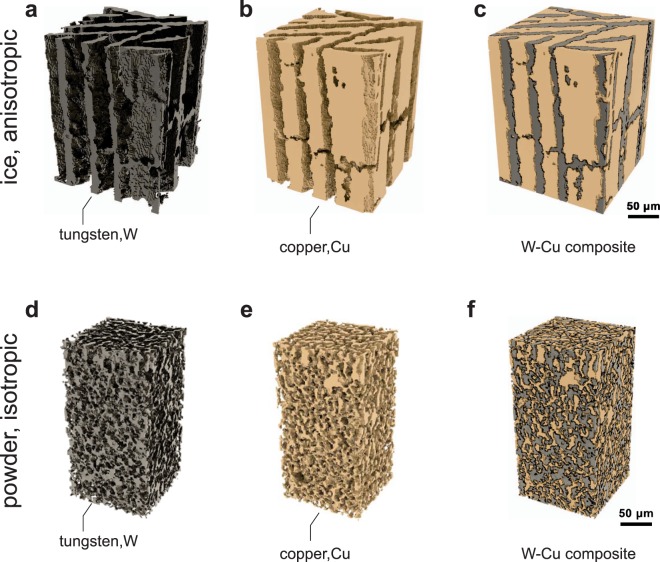
Composite Architecture. Three-dimensional X-ray computed tomographic reconstructions of W-Cu composites. (ac) Show the Cu (a) and W (b) phases of an anisotropic lamellar composite produced by freeze-casting and reduction of a WO3 precursor, sintering and Cu infiltration; the volume fraction of W is 57% W/Cu. Panels (d–f) show the different phases of an isotropic W-Cu composite (65 vol.% W) produced by partial sintering of W powders followed by Cu infiltration. For both reconstructions the voxel size is 1.3 μm.
Figure 3
Figure 3
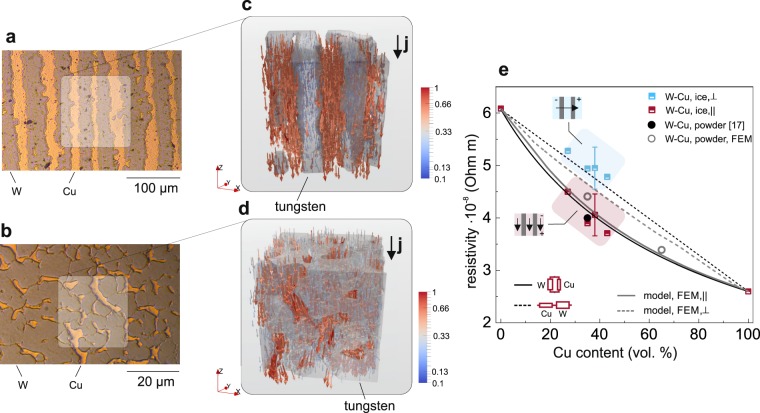
Electronic Transport. Panels (a and b) show polished cross-sections of ice-templated and powder-metallurgy templated W-Cu acquired using light microscopy. The electronic transport properties are modelled using FEM on a subset of the measured XCT data. Panels (c and d) present the simulated local current flow (arrows) and normalized current density distribution (arrow colour) within an ice-templated (c) and powder-metallurgy (d) W-Cu composite. The high resistivity regions, i.e. the W-phase (grey), correlate with regions of low current flow. (e) Comparison of the anisotropic, i.e. ice-templated, composite resistivity observed in experiments with theoretical predictions based on the FEM model illustrated in panels (c and d) and a parallel ([φ/ρCu+(1φ)/ρW]1) or linear (ϕρCu + (1 − ϕ)ρW) combination of two resistors. Here, ϕ is the volume fraction of the Cu-phase and ρ the resistivity. In addition, the resistivity of the used powder based composite taken from ref. (black circle) is compared to the resistivity determined by the FEM model for a powder-based structure (open-grey circles).
Figure 4
Figure 4
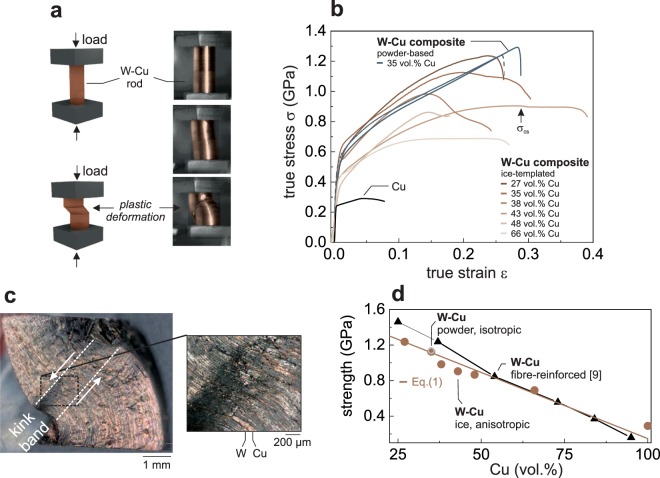
Mechanical behavior. Compressive properties of ice-templated and powder-metallurgy W-Cu composites under compression. Panel (a) shows a schematic illustration and photographs of the compressive tests of an ice-templated W-Cu composite with 43 vol.% Cu. (b) Experimental stress-strain curves of W-Cu composites with various Cu volume fractions. All ice-templated composites, measured with lamellae parallel to the applied stress, feature a region of plastic instability after the yield strength is reached. The compressive strength is labelled σcs as an example for a composite with 43 vol.% Cu. (c) Optical micrograph image of an ice-templated W-Cu composite (66 vol.% Cu) after compressive testing affirming kink band formation as failure mode. The zoomed-in view highlights the nearly uniform misorientation of the composite within the kink band. Panel (d) compares the measured compressive strength of (Fig. 4)b with theoretical predictions based on a simple rule of mixture (Eq. 1) and compressive strength measured for fibre-reinforced W-Cu composite tested in the fiber direction, from ref..

References

    1. Routschka, G. & Granitzki, K.-E. Refractory Ceramics, 10.1002/14356007.a23_001 (Wiley-VCH Verlag GmbH & Co. KGaA, 2000).
    1. Zhu, D., Chen, J., Zhou, Z., Yan, R. & Ding, R. Behaviors of full compositional W/Cu functionally gradient materials exposed to the edge plasma of ht-7 tokamak. Journal of Nuclear Materials435, 107–111, 10.1016/j.jnucmat.2012.12.044 (2013).
    1. Lassner, S. W.-D. Erik. Tungsten: Properties, Chemistry, Technology of the Element, Alloys, and Chemical Compounds (Springer US, 1999).
    1. Ilic O, et al. Tailoring high-temperature radiation and the resurrection of the incandescent source. Nature Nanotechnology. 2016;11:320–324. doi: 10.1038/nnano.2015.309. - DOI - PubMed
    1. Zweben C. Metal-matrix composites for electronic packaging. JOM. 1992;44:15–23. doi: 10.1007/BF03222270. - DOI