


doi: 10.1038/s41598-018-37205-2.
Potential Spatial Distribution of the Newly Introduced Long-horned Tick, Haemaphysalis longicornis in North America
Affiliations
- PMID: 30679711
- PMCID: PMC6346113
- DOI: 10.1038/s41598-018-37205-2
Item in Clipboard
Potential Spatial Distribution of the Newly Introduced Long-horned Tick, Haemaphysalis longicornis in North America
Sci Rep.
.
Abstract
The North American distributional potential of the recently invaded tick, Haemaphysalis longicornis, was estimated using occurrence data from its geographic range in other parts of the world and relevant climatic data sets. Several hundred candidate models were built using a correlative maximum entropy approach, and best-fitting models were selected based on statistical significance, predictive ability, and complexity. The median of the best-fitting models indicates a broad potential distribution for this species, but restricted to three sectors-the southeastern United States, the Pacific Northwest, and central and southern Mexico.
Conflict of interest statement
The authors declare no competing interests.
Figures
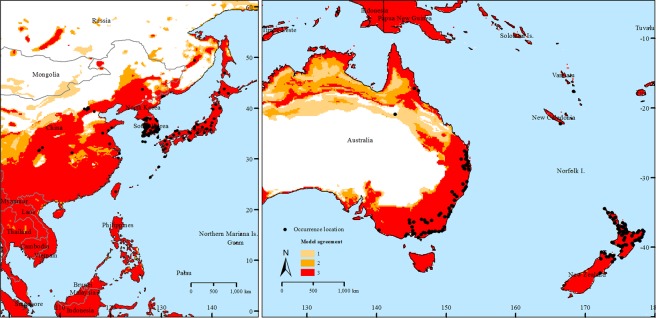
Known occurrence locations (black dots) of Haemaphysalis longicornis, used for niche modeling and partial geographic suitability in its native range.
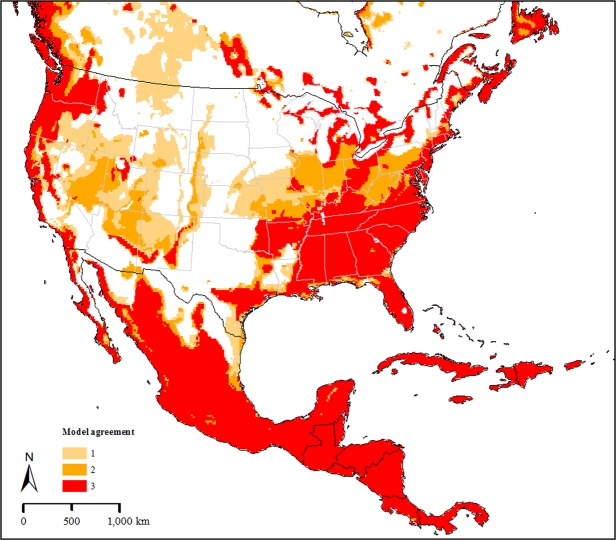
Predicted suitable areas for Haemaphysalis longicornis across North America. 1, 2, and 3 represent areas that were predicted to be suitable for the establishment of H. longicornis in North America by one, two and three models, respectively. Darker areas represent progressively higher agreement between the models.
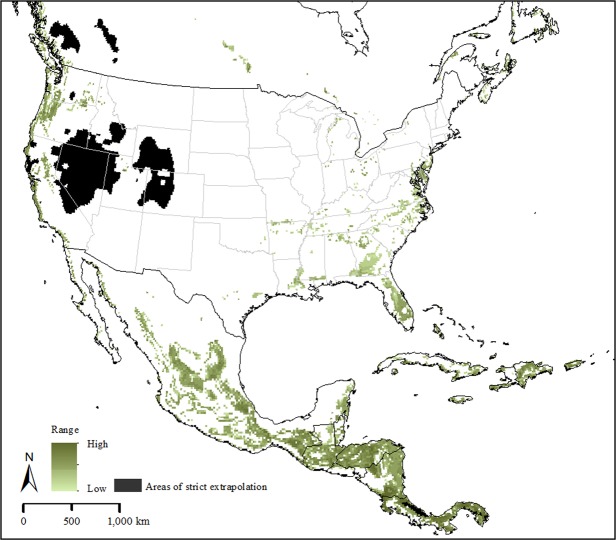
Uncertainty associated with the predicted suitable areas of Haemaphysalis longicornis across North America. Area in black represent uncertainty due to model extrapolation based on mobility-oriented pathway analysis; and, areas in light to darker shades of green indicate progressively higher uncertainty based on the range (maximum – minimum) of predicted probability for H. longicornis in the study region.
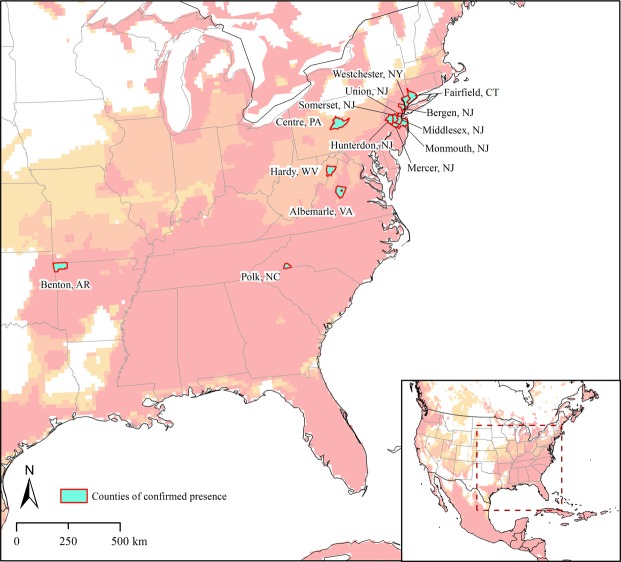
Counties in the United States in which the Haemaphysalis longicornis has been positively confirmed as of September, 2018. Colours in the background show areas that are predicted suitable for the establishment of H. longicornis in North America; darker shades indicate higher degree of agreement among models.
References
-
- Hoogstraal, H., Roberts, F. H. S., Kohls, G. M. & Tipton, V. J. Review of Haemaphysalis (Kaiseriana) longicornis Neumann (resurrected) of Australia, New Zealand, New Caledonia, Fiji, Japan, Korea, and northeastern China and USSR, and its parthenogenetic and bisexual populations (Ixodoidea, Ixodidae). J. Parasitol. 54, 1197–1213, 1192 pp, 10.2307/3276992 (1968). - PubMed
-
- Peterson AT. Ecological niche conservatism: a time-structured review of evidence. Journal of Biogeography. 2011;38:817–827. doi: 10.1111/j.1365-2699.2010.02456.x. - DOI
-
- Peterson AT, Papeş M, Eaton M. Transferability and model evaluation in ecological niche modeling: a comparison of GARP and Maxent. Ecography. 2007;30:550–560. doi: 10.1111/j.2007.0906-7590.05102.x. - DOI
MeSH terms
LinkOut - more resources
Full Text Sources
