


Optimization of HER3 expression imaging using affibody molecules: Influence of chelator for labeling with indium-111
- PMID: 30679757
- PMCID: PMC6345776
- DOI: 10.1038/s41598-018-36827-w
Optimization of HER3 expression imaging using affibody molecules: Influence of chelator for labeling with indium-111
Abstract
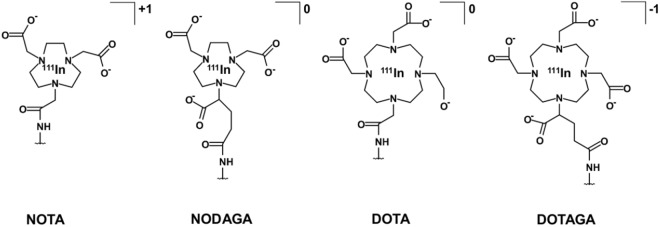
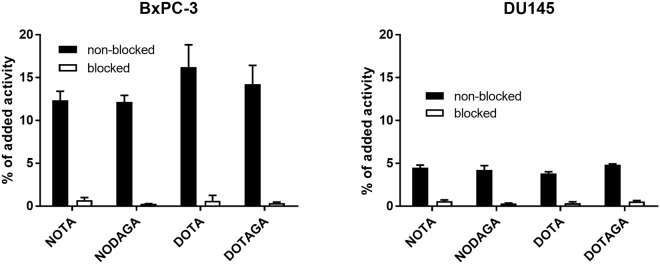
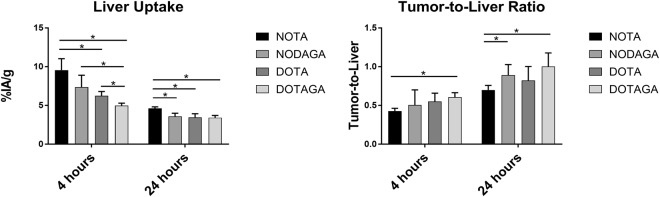
Radionuclide molecular imaging of human epidermal growth factor receptor 3 (HER3) expression using affibody molecules could be used for patient stratification for HER3-targeted cancer therapeutics. We hypothesized that the properties of HER3-targeting affibody molecules might be improved through modification of the radiometal-chelator complex. Macrocyclic chelators NOTA (1,4,7-triazacyclononane-N,N',N''-triacetic acid), NODAGA (1-(1,3-carboxypropyl)-4,7-carboxymethyl-1,4,7-triazacyclononane), DOTA (1,4,7,10-tetraazacyclododecane-1,4,7,10-tetraacetic acid), and DOTAGA (1,4,7,10-tetraazacyclododececane,1-(glutaric acid)-4,7,10-triacetic acid) were conjugated to the C-terminus of anti-HER3 affibody molecule Z08698 and conjugates were labeled with indium-111. All conjugates bound specifically and with picomolar affinity to HER3 in vitro. In mice bearing HER3-expressing xenografts, no significant difference in tumor uptake between the conjugates was observed. Presence of the negatively charged 111In-DOTAGA-complex resulted in the lowest hepatic uptake and the highest tumor-to-liver ratio. In conclusion, the choice of chelator influences the biodistribution of indium-111 labeled anti-HER3 affibody molecules. Hepatic uptake of anti-HER3 affibody molecules could be reduced by the increase of negative charge of the radiometal-chelator complex on the C-terminus without significantly influencing the tumor uptake.
Conflict of interest statement
S.S., V.T. and A.O. own stock in Affibody A.B. S.S.R., C.D.L., M.R., T.Z.B., A.K.G., J.L. declare no potential conflict of interest.
Figures


References
-
- Wang, Z. ErbB Receptors and Cancer. ErbB Receptor Signaling, in Methods In Molecular Biology (ed. Wang, Z.) 3–35 (Humana Press, 2017). - PubMed
Publication types
MeSH terms
Substances
LinkOut - more resources
Full Text Sources
Research Materials
