Review
. 2019 Feb;10(2):191-204.
doi: 10.3892/mco.2018.1792. Epub 2018 Dec 11.

Androgen receptor and soy isoflavones in prostate cancer

Affiliations
Review

Androgen receptor and soy isoflavones in prostate cancer

Monika Kmetová Sivoňová et al. Mol Clin Oncol. 2019 Feb.

Abstract

Androgens and androgen receptor (AR) play a critical role not only in normal prostate development, but also in prostate cancer. For that reason, androgen deprivation therapy (ADT) is the primary treatment for prostate cancer. However, the majority of patients develop castration-resistant prostate cancer, which eventually leads to mortality. Novel therapeutic approaches, including dietary changes, have been explored. Soy isoflavones have become a focus of interest because of their positive health benefits on numerous diseases, particularly hormone-related cancers, including prostate and breast cancers. An important strategy for the prevention and/or treatment of prostate cancer might thus be the action of soy isoflavones on the AR signaling pathway. The current review article provides a detailed overview of the anticancer potential of soy isoflavones (genistein, daidzein and glycitein), as mediated by their effect on AR.

Keywords: androgen receptor; daidzein; genistein; glycitein; prostate cancer; soy isoflavones; steroids.


Figures
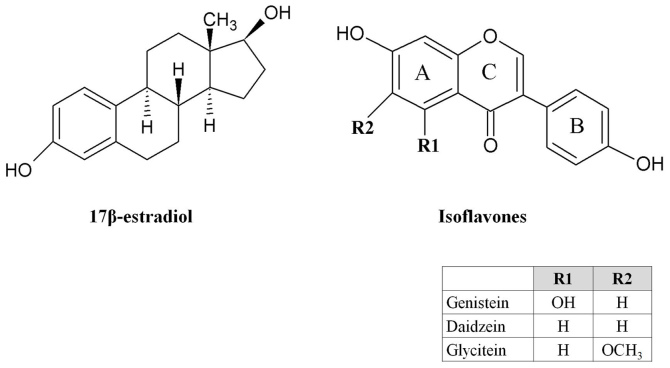
Figure 1.
Figure 1.
Chemical structures of 17β-estradiol and isoflavones genistein, daidzein and glycitein.
Figure 2.
Figure 2.
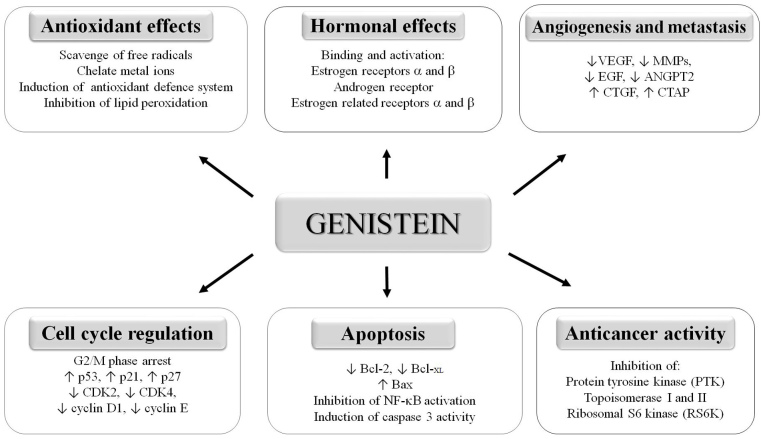
Overview of biological activities affected by genistein. Genistein is involved in cell proliferation, regulation of cell cycle, apoptosis, angiogenesis and tumor cell metastasis. Antitumorigenic effects of genistein occur mainly via interaction with estrogen receptors. It also exerts an antioxidant effect. ↑ indicates upregulation, ↓ indicates downregulation. VEGF, vascular endothelial growth factor; MMP, matrix metalloproteinase; EGF, epidermal growth factor; ANGPT2, angiopoietin 2; CTGF, connective tissue growth factor; CTAP, connective tissue activation peptide; CDK, cyclin-dependent kinase; NF-κB, nuclear factor-κB.
Figure 3.
Figure 3.
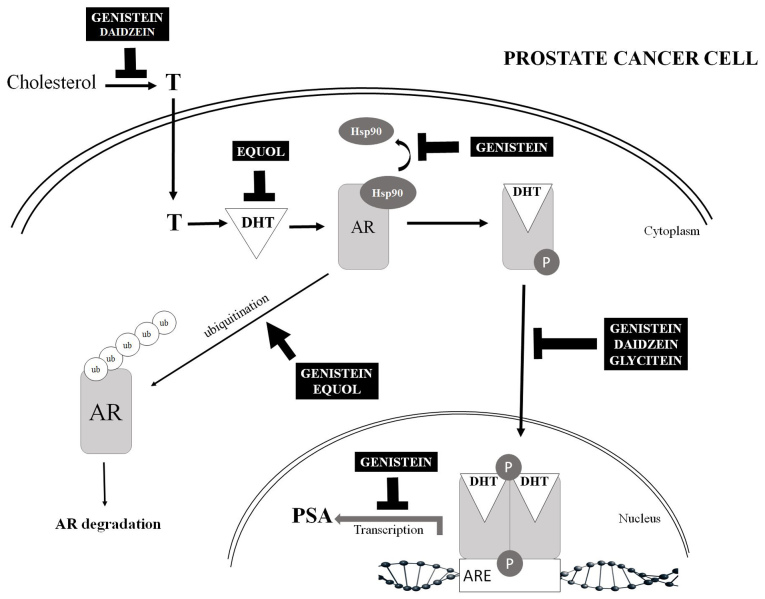
AR signaling pathway and the possible effect of soy isoflavones. Several possible mechanisms have been proposed to explain the mechanism by which isoflavone activity affects AR. Possible mechanism include the transcriptional regulation of AR, the induction of AR degradation by the proteasomal pathway and the inhibition of ligand-AR complex translocation to the nucleus, leading to the possible inhibition of nuclear AR binding to ARE and thereby triggering an effect on the transcription of androgen-dependent genes (e.g., PSA). Indirect effects of isoflavones on AR may also be mediated by affecting the synthesis of testosterone, its conversion to DHT and the sequestration of DHT from binding AR, thereby reducing prostate cancer risk. ↑ indicates induction; ⊥ indicates inhibition. AR, androgen receptor; ARE, androgen response element; DHT, dihydrotestosterone; Hsp90, heat-shock protein 90; PSA, prostatic-specific antigen; ub, ubiquitin; T, testosterone.

References

    1. Pernar CH, Ebot EM, Wilson KM, Mucci LA. The epidemiology of prostate cancer. Cold Spring Harb Perspect Med. 2018;8(pii):a030361. doi: 10.1101/cshperspect.a030361. - DOI - PMC - PubMed
    1. Mitsuzuka K, Arai Y. Metabolic changes in patients with prostate cancer during androgen deprivation therapy. Int J Urol. 2018;25:45–53. doi: 10.1111/iju.13473. - DOI - PubMed
    1. Grasso CS, Wu YM, Robinson DR, Cao X, Dhanasekaran SM, Khan AP, Quist MJ, Jing X, Lonigro RJ, Brenner JC, et al. The mutational landscape of lethal castration-resistant prostate cancer. Nature. 2012;487:239–243. doi: 10.1038/nature11125. - DOI - PMC - PubMed
    1. Sung B, Prasad S, Yadav VR, Lavasanifar A, Aggarwal BB. Cancer and diet: How are they related? Free Radic Res. 2011;45:864–879. doi: 10.3109/10715762.2011.582869. - DOI - PMC - PubMed
    1. Zhang HY, Cui J, Zhang Y, Wang ZL, Chong T, Wang ZM. Isoflavones and prostate cancer: A review of some critical issues. Chin Med J (Engl) 2016;129:341–347. doi: 10.4103/0366-6999.174488. - DOI - PMC - PubMed