


Differentiating PTSD from anxiety and depression: Lessons from the ICD-11 PTSD diagnostic criteria
- PMID: 30681235
- PMCID: PMC6548615
- DOI: 10.1002/da.22881
Differentiating PTSD from anxiety and depression: Lessons from the ICD-11 PTSD diagnostic criteria
Abstract
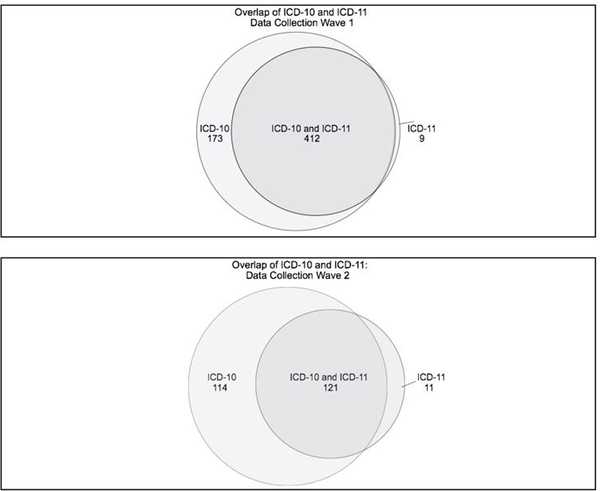
Objective: Posttraumatic stress disorder (PTSD) is frequently associated with depression and anxiety, but the nature of the relationship is unclear. By removing mood and anxiety diagnostic criteria, the 11th edition of the International Classification of Diseases (ICD-11) aims to delineate a distinct PTSD phenotype. We examined the effect of implementing ICD-11 criteria on rates of codiagnosed depression and anxiety in survivors with recent PTSD.
Method: Participants were 1,061 survivors of traumatic injury admitted to acute care centers in Israel. ICD-10 and ICD-11 diagnostic rules were applied to the Clinician-Administered PTSD Scale for DSM-IV. Co-occurring disorders were identified using the Structured Clinical Interview for DSM-IV (SCID). Depression severity was measured by the Beck Depression Inventory-II (BDI-II). Assessments were performed 0-60 ("wave 1") and 90-240 ("wave 2") days after trauma exposure.
Results: Participants identified by ICD-11 PTSD criteria were equally or more likely than those identified by the ICD-10 alone to meet depression or anxiety disorder diagnostic criteria (for wave 1: depressive disorders, OR [odds ratio] = 1.98, 95% CI [confidence interval] = [1.36, 2.87]; anxiety disorders, OR = 1.04, 95% CI = [0.67, 1.64]; for wave 2: depressive disorders, OR = 1.70, 95% CI = [1.00, 2.91]; anxiety disorders, OR = 1.04, 95% CI = [0.54, 2.01]). ICD-11 PTSD was associated with higher BDI scores (M = 23.15 vs. 17.93, P < 0.001 for wave 1; M = 23.93 vs. 17.94, P < 0.001 for wave 2). PTSD symptom severity accounted for the higher levels of depression in ICD-11 PTSD.
Conclusions: Despite excluding depression and anxiety symptom criteria, the ICD-11 identified equal or higher proportion of depression and anxiety disorders, suggesting that those are inherently associated with PTSD.
Keywords: anxiety disorders; comorbidity; depressive disorders; nosology; posttraumatic stress disorder.
© 2019 Wiley Periodicals, Inc.
Figures
References
-
- Beck AT, Steer RA, & Brown GK (1996). Manual for the Beck Depression Inventory-II. Paper presented at the Psychological Corporation, San Antonio, TX.
-
- Blake DD, Weathers FW, Nagy LM, Kaloupek DG, Gusman FD, Charney DS, & Keane TM (1995). The development of a Clinician-Administered PTSD Scale. J Trauma Stress, 8(1), 75–90. - PubMed
