


Antagonist muscle activity during reactive balance responses is elevated in Parkinson's disease and in balance impairment
- PMID: 30682098
- PMCID: PMC6347183
- DOI: 10.1371/journal.pone.0211137
Antagonist muscle activity during reactive balance responses is elevated in Parkinson's disease and in balance impairment
Abstract
Background: Abnormal antagonist leg muscle activity could indicate increased muscle co-contraction and clarify mechanisms of balance impairments in Parkinson's disease (PD). Prior studies in carefully selected patients showed PD patients demonstrate earlier, longer, and larger antagonist muscle activation during reactive balance responses to perturbations.
Research question: Here, we tested whether antagonist leg muscle activity was abnormal in a group of PD patients who were not selected for phenotype and most of whom had volunteered for exercise-based rehabilitation.
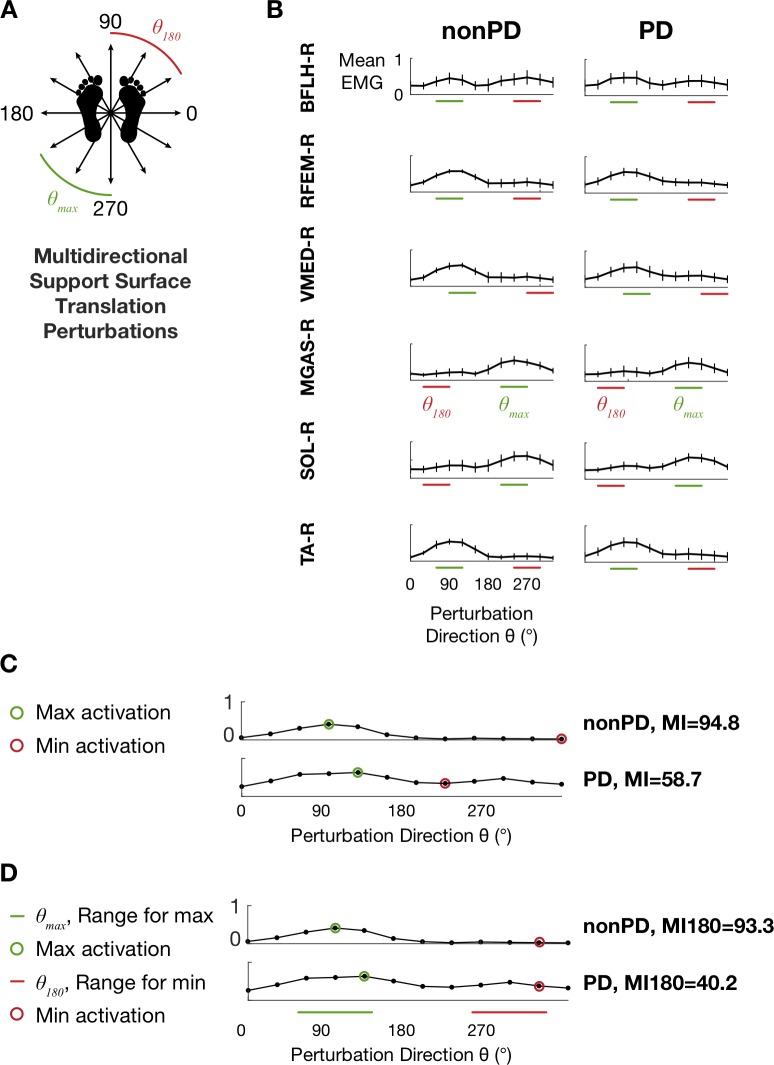
Methods: We compared antagonist activation during reactive balance responses to multidirectional support-surface translation perturbations in 31 patients with mild-moderate PD (age 68±9; H&Y 1-3; UPDRS-III 32±10) and 13 matched individuals (age 65±9). We quantified modulation of muscle activity (i.e., the ability to activate and inhibit muscles appropriately according to the perturbation direction) using modulation indices (MI) derived from minimum and maximum EMG activation levels observed across perturbation directions.
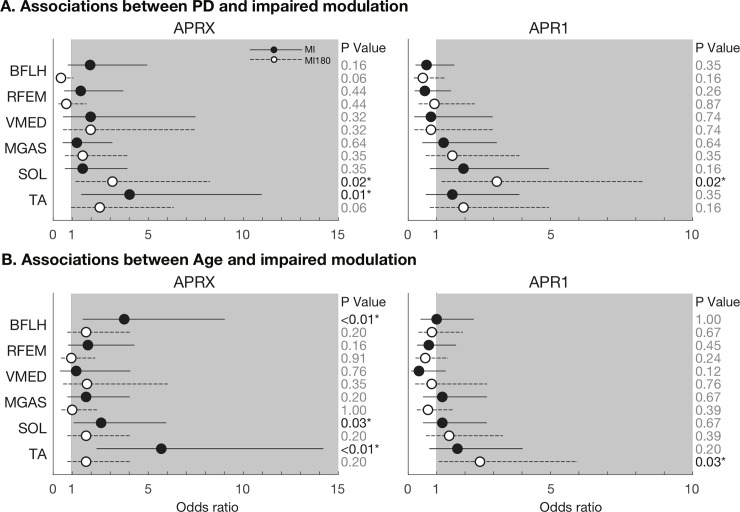
Results: Antagonist leg muscle activity was abnormal in unselected PD patients compared to controls. Linear mixed models identified significant associations between impaired modulation and PD (P<0.05) and PD severity (P<0.01); models assessing the entire sample without referencing PD status identified associations with balance ability (P<0.05), but not age (P = 0.10).
Significance: Antagonist activity is increased during reactive balance responses in PD patients who are not selected on phenotype and are candidates for exercise-based rehabilitation. This activity may be a mechanism of balance impairment in PD and a potential rehabilitation target or outcome measure.
Conflict of interest statement
The authors have declared that no competing interests exist.
Figures
References
-
- Hortobagyi T, DeVita P. Muscle pre- and coactivity during downward stepping are associated with leg stiffness in aging. J Electromyogr Kinesiol. 2000;10(2):117–26 - PubMed
-
- Hortobagyi T, Devita P. Mechanisms responsible for the age-associated increase in coactivation of antagonist muscles. Exerc Sport Sci Rev. 2006;34(1):29–35 - PubMed
Publication types
MeSH terms
Grants and funding
LinkOut - more resources
Full Text Sources
Medical
