


Predictions of Alzheimer's disease treatment and care costs in European countries
- PMID: 30682120
- PMCID: PMC6347248
- DOI: 10.1371/journal.pone.0210958
Predictions of Alzheimer's disease treatment and care costs in European countries
Abstract
Background: Given the increasing lifespan of the elderly and the higher proportion of older people in the global population, the incidence rate of neurodegenerative diseases is increasing. The aim of this study is to evaluate, by means of computer simulations, developments in the costs of treating and caring for people suffering from Alzheimer's disease (AD) in the EU 28 by 2080, while assuming the introduction of drug administrations at various disease stages.
Methods: Impact analysis leverages a mathematical model that compares five different population development scenarios when introducing different types of drugs to the scenarios but without changing the treatment. Changes in the economic burden are considered as of 2023, when new drugs are expected to enter the market.
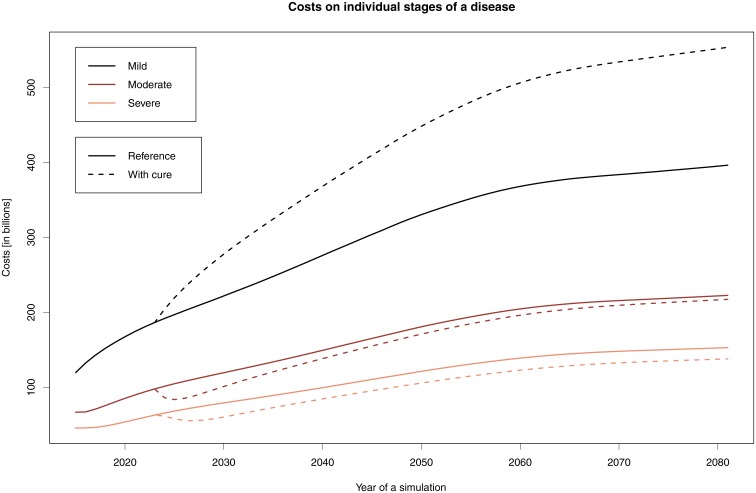
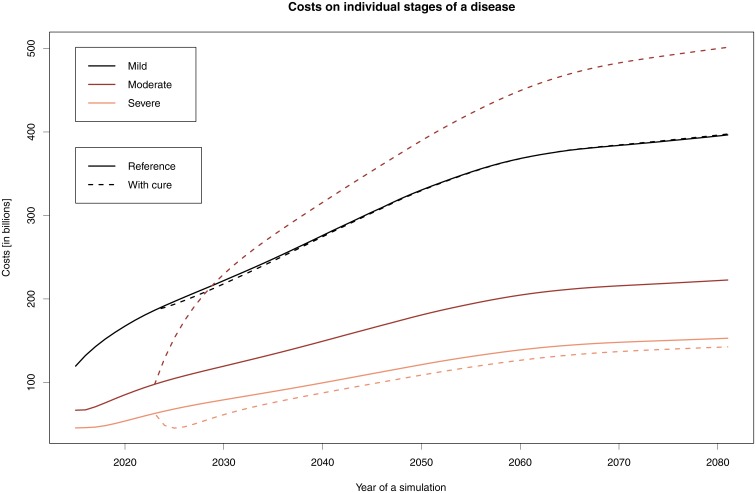
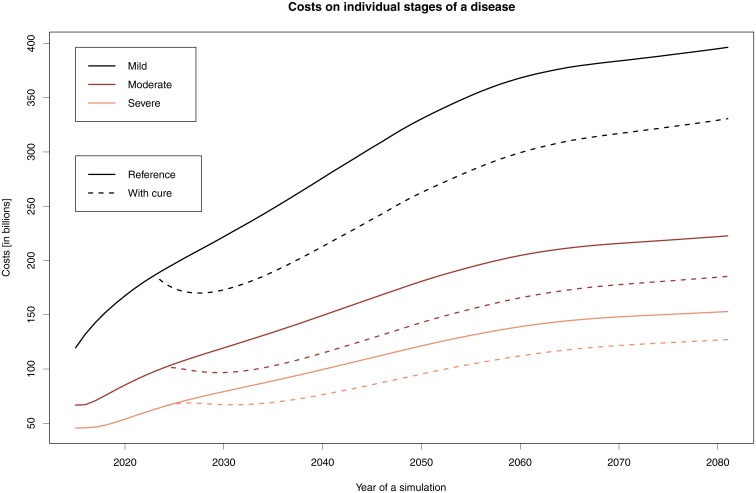
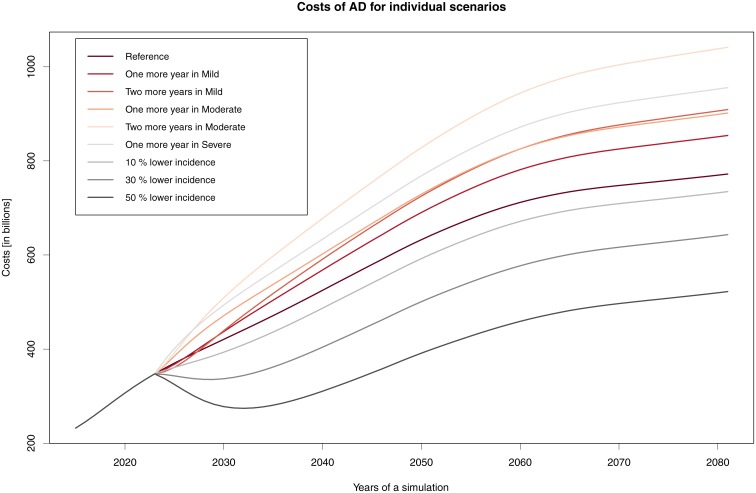
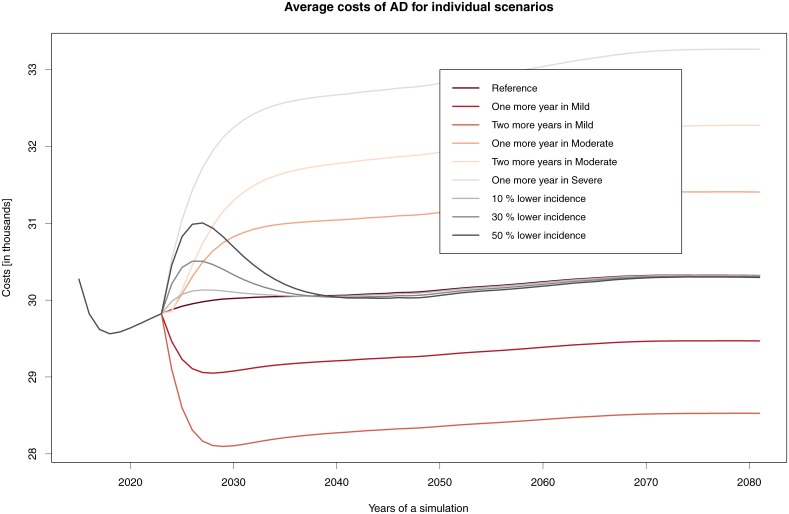
Findings: The results of the simulations show that by prolonging the length of a person's 'stay' in the Mild, Moderate, or Severe stage, the total cost of care for all persons with AD will increase by 2080. For individual scenarios, the percentage of patients and costs increased as follows: Mild by one year, by 10.61%; Mild by two years, by 17.73%; Moderate by one year, by 16.79%; Moderate by two years, by 34.88%; and Severe by one year, by 23.79%. The change in cost development when prolonging the stay in the Mild cognitive impairment stage (by lowering the incidence by 10%, 30%, or 50%) reduced the cost (by 4.88%, 16.78% and 32.48%, respectively).
Interpretation: The results unambiguously show that any intervention prolonging a patient's stay in any stage will incur additional care costs and an increase in the number of persons with AD. Therefore, extending lifespan is important in terms of improving the quality of life of patients, and the introduction of new drugs must consider the additional costs imposed upon society.
Conflict of interest statement
The authors have declared that no competing interests exist.
Figures
References
-
- Boada M, Pena-Casanova J, Bermejo F, Guillen F, Hart W, Espinosa C, et al. Costs of health care resources of ambulatory-care patients diagnosed with Alzheimer’s disease in Spain. Medicina clinica. 1999;113(18):690–695. - PubMed
Publication types
MeSH terms
Substances
LinkOut - more resources
Full Text Sources
Medical
