


A cholera outbreak in a rural north central Nigerian community: an unmatched case-control study
- PMID: 30683078
- PMCID: PMC6347749
- DOI: 10.1186/s12889-018-6299-3
A cholera outbreak in a rural north central Nigerian community: an unmatched case-control study
Abstract
Background: Cholera remains a disease of public health importance in Nigeria associated with high morbidity and mortality. In November 2014, the Nigeria Field Epidemiology and Laboratory Training Programme (NFELTP) was notified of an increase in suspected cholera cases in Gomani, Kwali Local Government Area. NFELTP residents were deployed to investigate the outbreak with the objectives of verifying the diagnosis, identifying risk factors and instituting appropriate control measures to control the outbreak.
Methods: We conducted an unmatched case-control study. We defined a cholera case as any person aged ≥5 years with acute watery diarrhea in Gomani community. We identified community controls. A total of 43 cases and 68 controls were recruited. Structured questionnaires were administered to both cases and controls. Four stool samples from case-patients and two water samples from the community water source were collected for laboratory investigation. We performed univariate and bivariate analysis using Epi-Info version 7.1.3.10.
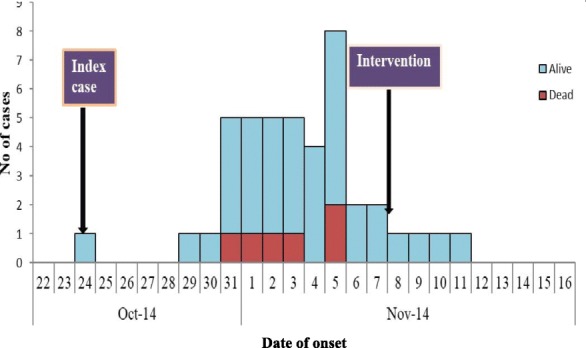
Results: The mean age of cases and controls was 20.3 years and 25.4 respectively (p value 0.09). Females constituted 58.1% (cases) and 51.5%(controls). The attack rate was 4.3% with a case fatality rate of 13%. Four stool (100%) specimen tested positive for Vibrio cholerae. The water source and environment were polluted by indiscriminate defecation. Compared to controls, cases were more likely to have drank from Zamani river (OR 14.2, 95% CI: 5.5-36.8) and living in households(HH) with more than 5 persons/HH (OR 5.9, 95% CI: 1.3-27.2). Good hand hygiene was found to be protective (OR 0.3, 95% CI: 0.1-0.7).
Conclusion: Vibrio cholerae was the cause of the outbreak in Gomani. Drinking water from Zamani river, living in overcrowded HH and poor hand hygiene were significantly associated with the outbreak. We initiated hand hygiene and water treatment to control the outbreak.
Keywords: Cholera outbreak; Hand hygiene; Nigeria; Unmatched case control study.
Conflict of interest statement
Authors’ information
DNC- Graduate of Nigerian Field Epidemiology and Laboratory Training Programme
UO - Graduate of Nigerian Field Epidemiology and Laboratory Training Programme
OP- Graduate of Nigerian Field Epidemiology and Laboratory Training Programme
SG -Deputy National Coordinator National Stop Transmission of Polio Programme African Field Epidemiology Network (AFENET)/Programme supervisor NFELTP
AB - Program Advisor /Lead HIV/AIDS Programs African Field Epidemiology Network (AFENET)/ Programme supervisor NFELTP
NPa -Senior Resident Advisor Nigerian Field Epidemiology and Laboratory Training Programme
NPe - Medical Epidemiologist Global Public Health Solutions, Atlanta, USA
Ethics approval and consent to participate
Ethics approval was waived by Federal Capital Territory Health Research Ethics Committee due to the exigencies of the response. Permission was obtained from the department of public health Kwali Local Government Area (LGA) during the response and all the respondents consented verbally and we documented the respondent’s agreement to participate in the study by ticking yes on the introduction/consent section of the questionnaire.
Consent for publication
The authors consent to Editorial Board of the journal BMC to publish the paper.
The authors accept responsibility for publishing this material in his/her own name, as well as on behalf of all co-authors, if any.
Competing interests
The authors declare that they have no competing interests.
Publisher’s Note
Springer Nature remains neutral with regard to jurisdictional claims in published maps and institutional affiliations.
Figures
References
-
- Yamai S, Okitsu T, Shimada T, Katsube Y. Distribution of serogroups of Vibrio cholerae non-O1 non-O139 with specific reference to their ability to produce cholera toxin and addition of novel serogroups. J Japan Assoc Infect Dis. 1994;71:1037–1045. - PubMed
MeSH terms
LinkOut - more resources
Full Text Sources
Medical
