


Interventions to develop collectivistic leadership in healthcare settings: a systematic review
- PMID: 30683089
- PMCID: PMC6347820
- DOI: 10.1186/s12913-019-3883-x
Interventions to develop collectivistic leadership in healthcare settings: a systematic review
Abstract
Background: Collective or shared leadership approaches have been associated with team performance outcomes in several sectors. Based on this evidence, there have been calls for more inclusive approaches to leadership in healthcare settings, but guidance on how to achieve collective leadership is lacking. This study synthesised knowledge of interventions to introduce collectivistic leadership in healthcare settings.
Methods: The databases of PubMed, PsychInfo, ABI Inform, Cochrane and CINAHL and three grey literature databases were searched. Studies from any country were included if they reported on the development and evaluation and/or implementation of training/interventions to develop collectivistic leadership and reported individual and/or team-level outcomes. Results were synthesised using a narrative approach.
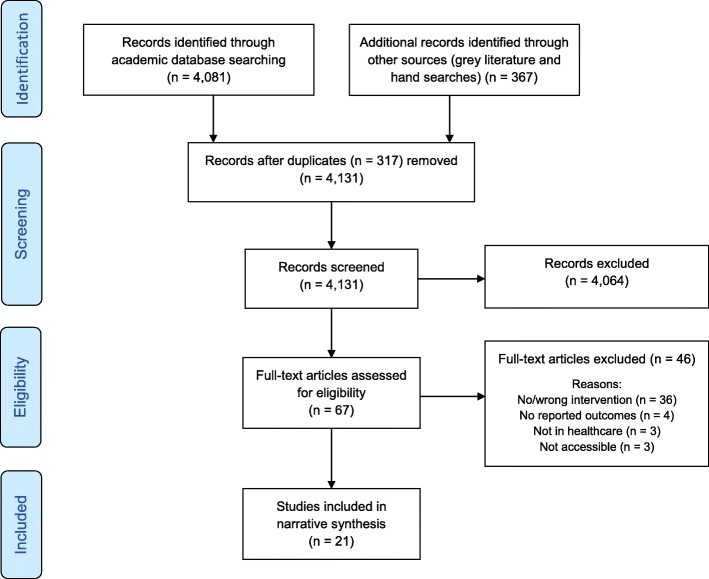
Results: The searches yielded 4448 records of which 21 met the eligibility criteria and were reviewed. Studies used a variety of interventions; eleven employed a team training approach, four described co-leadership, three explored service improvement, two detailed co-design approaches and one described an individual team development intervention. Most demonstrated moderate to good success in enabling collectivistic leadership, with benefits reported in staff engagement, satisfaction, and team performance.
Conclusions: Whilst collectivistic leadership interventions have demonstrated positive outcomes, there is a need for more rigor and consistency in the evaluation of interventions aimed at developing collectivistic leadership approaches in health settings.
Keywords: Collective leadership; Collectivistic leadership; Healthcare; Shared leadership; Systematic review.
Conflict of interest statement
Ethics approval and consent to participate
Not applicable.
Consent for publication
Not applicable.
Competing interests
The authors declare that they have no competing interests.
Publisher’s Note
Springer Nature remains neutral with regard to jurisdictional claims in published maps and institutional affiliations.
References
-
- Yammarino FJ, Salas E, Serban A, Shirreffs K, Shuffler ML. Collectivistic leadership approaches: putting the “we” in leadership science and practice. Ind Organ Psychol. 2012;5(4):382–402. doi: 10.1111/j.1754-9434.2012.01467.x. - DOI
-
- Hunter ST, Bedell-Avers KE, Mumford MD. The typical leadership study: assumptions, implications, and potential remedies. Leadersh Q. 2007;18(5):435–446. doi: 10.1016/j.leaqua.2007.07.001. - DOI
-
- Hoffman BJ, Woehr DJ, Maldagen-Youngjohn R, Lyons BD. Great man or great myth? A quantitative review of the relationship between individual differences and leader effectiveness. J Occup Organ Psychol. 2011;84(2):347–381. doi: 10.1348/096317909X485207. - DOI
-
- Gibb CA. Leadership. In: Lindzey G, editor. Handbook of social psychology. Reading: Addison-Wesley; 1954. pp. 877–917.
Publication types
MeSH terms
Grants and funding
LinkOut - more resources
Full Text Sources
Medical
Molecular Biology Databases
Miscellaneous
