


Comparing two dry needling interventions for plantar heel pain: a protocol for a randomized controlled trial
- PMID: 30683124
- PMCID: PMC6347763
- DOI: 10.1186/s13018-019-1066-4
Comparing two dry needling interventions for plantar heel pain: a protocol for a randomized controlled trial
Abstract
Background: Both manual therapy techniques and dry needling have shown to be effective treatment options for the treatment of plantar heel pain; however, in recent years, other techniques based on dry needling (DN), such as percutaneous needle electrolysis (PNE), have also emerged. Currently, PNE is being used in clinical practice to manage myofascial trigger points, despite the lack of studies comparing the effects of this technique over dry needling. Therefore, the aim of this randomized controlled study is to compare the effectiveness of DN versus PNE for improving the level of pain experienced by patients suffering from plantar heel pain provoked by myofascial trigger points.
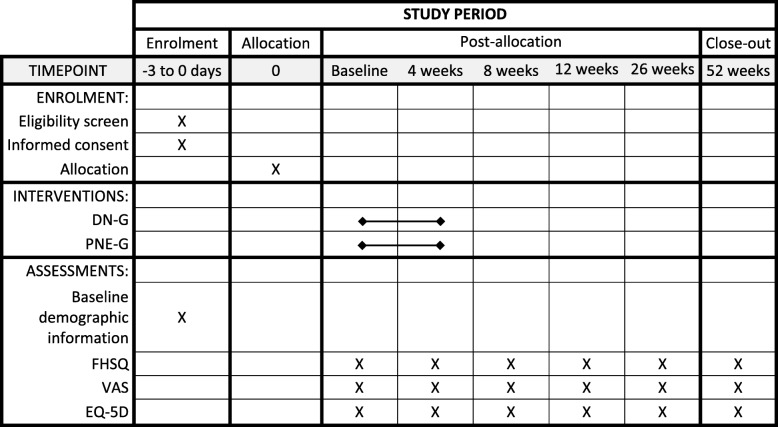
Methods: A randomized controlled trial will be conducted with blinded participants and outcome assessors. A sample of 94 patients with a medical diagnosis of plantar heel pain will be recruited and divided into two treatment groups. Eligible participants will be randomly allocated to either (a) treatment group with DN and a self-stretching home program or (b) treatment group with PNE and a self-stretching home program. Each group will receive one treatment session per week over a period of 4 weeks. The primary outcome measure will be the pain subscale of the Foot Health Status Questionnaire. The secondary outcome measures will be a visual analogue scale for pain (average and highest level of pain experienced during the previous 48 h; level of pain immediately after the treatment session) and health-related quality of life (assessed using the EuroQoL-5 dimensions). Cost-effectiveness data will be extracted based on the EuroQoL-5 dimensions. Follow-up measurements will take place at baseline and at 4, 8, 12, 26, and 52 weeks.
Discussion: The justification for this trial is the need to improve current understanding regarding the effectiveness of treatments targeting the rehabilitation of plantar heel pain. This study will be the first randomized controlled trial to directly compare the effectiveness of DN and PNE combined with a specific stretching program for the treatment of plantar heel pain provoked by myofascial trigger points.
Trial registration: Clinical Trials NCT03236779. Registered at clinicaltrials.gov 2 August 2017.
Keywords: Cost-effectiveness; Dry needling; Myofascial trigger points; Percutaneous needle electrolysis; Plantar heel pain; Self-stretching protocol.
Conflict of interest statement
Ethics approval and consent to participate
The study design, procedures and informed consent procedure were approved by the Ministry of Health in the state of Kuwait. Consent to participate will be obtained from the participants.
Consent for publication
Not applicable
Competing interests
The authors declare that they have no competing interests.
Publisher’s Note
Springer Nature remains neutral with regard to jurisdictional claims in published maps and institutional affiliations.
Figures

References
-
- Martin RL, Davenport TE, Reischl SF, McPoil TG, Matheson JW, Wukich DK, et al. Heel pain-plantar fasciitis: clinical practice guidelines linked to the International Classification of Functioning, Disability and Health from the Orthopaedic Section of the American Physical Therapy Association. J Orthop Sports Phys Ther. 2014;44(11):A1–A33. doi: 10.2519/jospt.2014.0303. - DOI - PubMed
-
- McPoil TG, Martin RL, Cornwall MW, Wukich DK, Irrgang JJ, Godges JJ. Heel pain--plantar fasciitis: clinical practice guidelines linked to the international classification of function, disability, and health from the orthopaedic section of the American Physical Therapy Association. J Orthop Sports Phys Ther. 2008;38(4):A1–A18. doi: 10.2519/jospt.2008.0302. - DOI - PubMed
Publication types
MeSH terms
Associated data
Grants and funding
LinkOut - more resources
Full Text Sources
Medical
