. 2019 Mar 22;294(12):4667-4681.
doi: 10.1074/jbc.RA118.006704. Epub 2019 Jan 25.

Deimmunizing substitutions in Pseudomonas exotoxin domain III perturb antigen processing without eliminating T-cell epitopes

Affiliations

Deimmunizing substitutions in Pseudomonas exotoxin domain III perturb antigen processing without eliminating T-cell epitopes

Daniel L Moss et al. J Biol Chem. .

Abstract

Effective adaptive immune responses depend on activation of CD4+ T cells via the presentation of antigen peptides in the context of major histocompatibility complex (MHC) class II. The structure of an antigen strongly influences its processing within the endolysosome and potentially controls the identity of peptides that are presented to T cells. A recombinant immunotoxin, comprising exotoxin A domain III (PE-III) from Pseudomonas aeruginosa and a cancer-specific antibody fragment, has been developed to manage cancer, but its effectiveness is limited by the induction of neutralizing antibodies. Here, we observed that this immunogenicity is substantially reduced by substituting six residues within PE-III. Although these substitutions targeted T-cell epitopes, we demonstrate that reduced conformational stability and protease resistance were responsible for the reduced antibody titer. Analysis of mouse T-cell responses coupled with biophysical studies on single-substitution versions of PE-III suggested that modest but comprehensible changes in T-cell priming can dramatically perturb antibody production. The most strongly responsive PE-III epitope was well-predicted by a structure-based algorithm. In summary, single-residue substitutions can drastically alter the processing and immunogenicity of PE-III but have only modest effects on CD4+ T-cell priming in mice. Our findings highlight the importance of structure-based processing constraints for accurate epitope prediction.

Keywords: CD4+ T cells; T cell; T-helper cells; antibody; antigen presentation; antigen processing; cancer; deimmunization; immunotoxin; protein stability; protein structure; proteolysis; proteomics; vaccine.


Conflict of interest statement

The authors declare that they have no conflicts of interest with the contents of this article

Figures
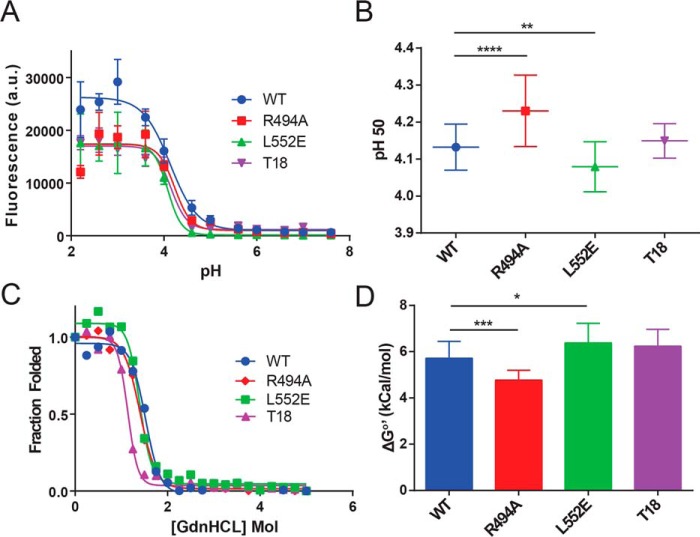
Figure 1.
Figure 1.
Deimmunizing mutations alter the folding stability of PE-III. A, acid-induced denaturation of PE-III reported by Bis-ANS fluorescence (n = 3). B, analysis of best-fit pH 50 values; error bars indicate standard error; asterisks indicate significance by one-way ANOVA (*, p < 0.05; **, p < 0.01; ***, p < 0.001; ****, p < 0.0001). C, chemical denaturation of PE-III using GdnHCl and reported by intrinsic tryptophan fluorescence (representative of n = 3). The ratio of the intensity at a given [GdnHCl] to that at zero [GdnHCl] was plotted for each concentration, and the data were fitted to equations that solve for the free energy of unfolding at zero [GdnHCl] (ΔG0′). D, analysis of ΔG0′ values determined in C. Error bars indicate standard error, and asterisks indicate significance by one-way ANOVA.
Figure 2.
Figure 2.
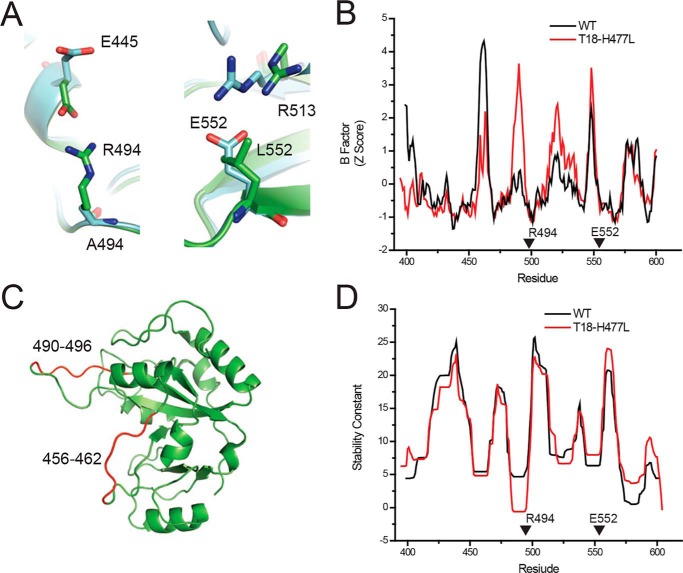
Deimmunizing mutations alter the structure of PE-III. A, orientation of residues at the 494 and 552 positions in the WT (green, PDB code 1XK9) and T18-H477L (cyan, PDB code 6EDG) structures. B, Comparison of the crystallographic B-factors from the WT and T18-H477L structures. Arrows indicate locations of the R494A and L552E mutations. C, approximate locations of the proteinase K cleavage sites within the WT PE-III structure. D, COREX stability constants of the WT and T18-H477L structures. Arrowheads indicate locations of the R494A and L552E mutations.
Figure 3.
Figure 3.
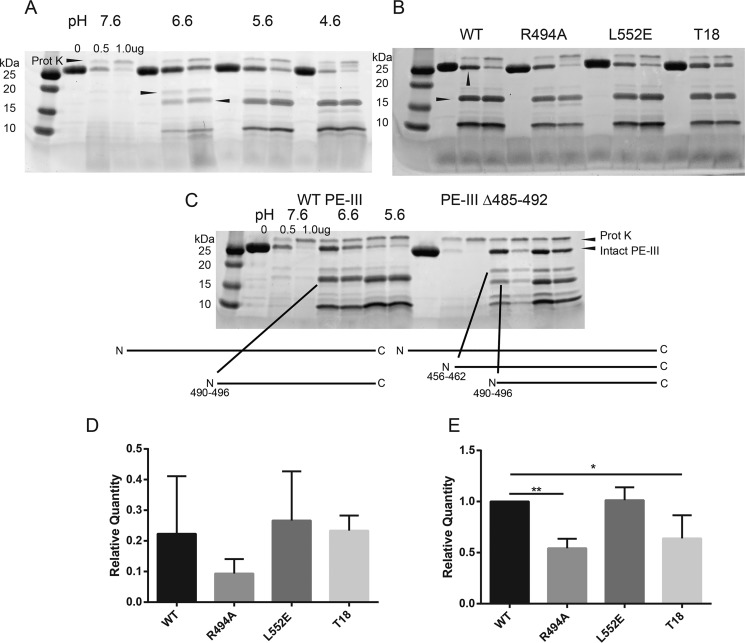
Limited proteolysis of PE-III variants demonstrates folding stability influences proteolytic susceptibility. A, limited proteolysis of WT PE-III with proteinase K (Prot K). The indicated amount of protease was incubated with WT PE-III for 15 min at 37 °C at the indicated pH prior to analysis by SDS-PAGE and Coomassie staining. Arrowheads indicate the fragments selected for analysis by MS. B, limited proteolysis of PE-III variants with proteinase K at pH 5.6. Arrowheads indicate the bands analyzed in D (top) and E (bottom). C, limited proteolysis of WT and Δ485–492 PE-III with proteinase K at the indicated pH. Arrowheads indicate locations of proteinase K cleavage sites in either variant detected by MS. D, mean relative quantity of the intact PE-III variant after proteolysis with 0.5 μg of proteinase K as compared with the undigested lane. Error bars indicate standard deviation (n = 3). E, mean relative quantity of the major 15-kDa fragment of PE-III variant after proteolysis with 0.5 μg of proteinase K, as compared that of WT PE-III. Error bars indicate standard deviation, and asterisks indicate significance by one-way ANOVA (n = 3).
Figure 4.
Figure 4.
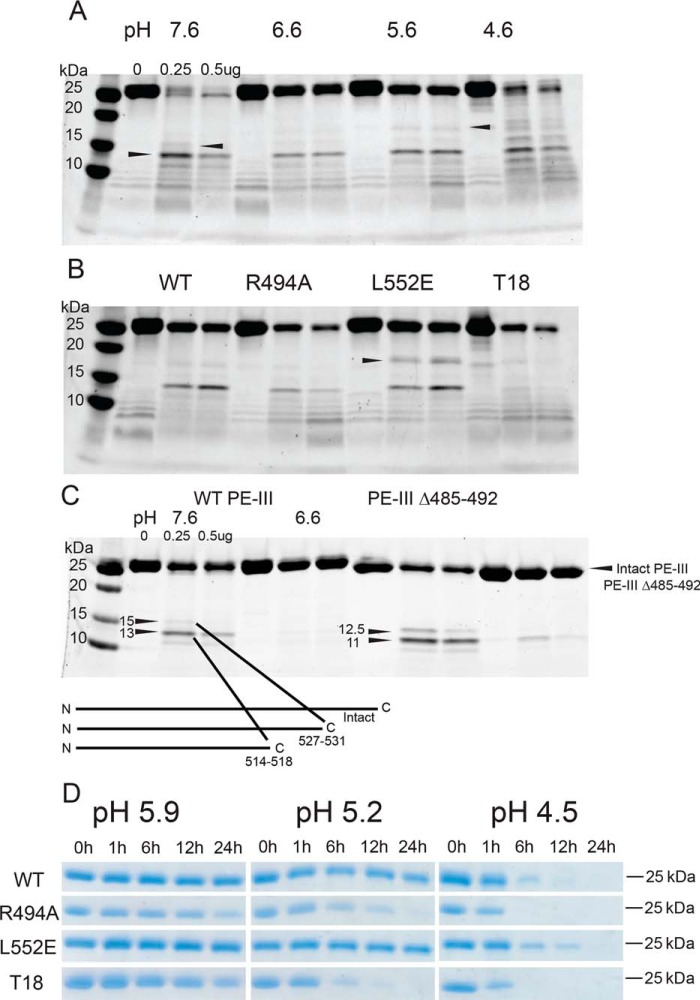
Destabilized PE-III variants are more susceptible to proteolysis by lysosomal proteases. A, indicated amount of cathepsin S was incubated with WT PE-III for 3 h at 37 °C at the indicated pH prior to analysis by SDS-PAGE and Coomassie staining. Arrowheads indicate fragments selected for analysis by MS. B, limited proteolysis of PE-III variants by cathepsin S at pH 5.6 for 3 h at 37 °C. C, C-terminal cleavage sites were confirmed by limited proteolysis of a PE-III variant lacking the 490s loop mentioned above. Schematic showing the locations of the cathepsin S cleavage sites within the primary structure of PE-III is placed below the gel. D, proteolysis of the PE-III variants using lysosomal extracts at different pH values analyzed by SDS-PAGE and Coomassie staining.
Figure 5.
Figure 5.
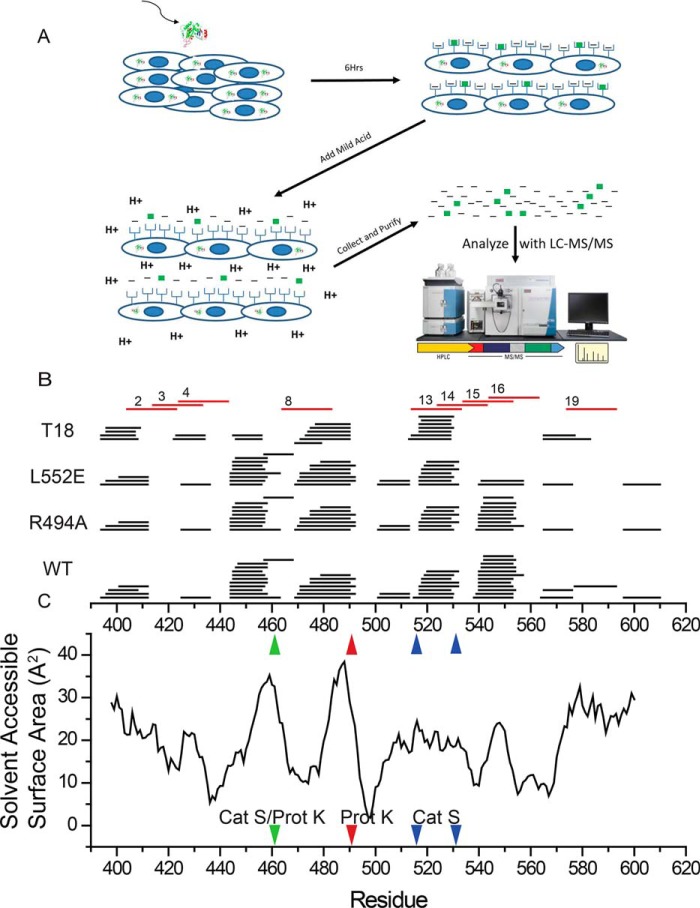
In vitro processing and presentation of PE-III variants generate nested clusters of peptides. A, schematic for the mild acid elution workflow. Antigen-presenting cells are incubated with PE-III protein for 6 h before peptides are eluted with acid and analyzed by LC-MS/MS. B, eluted peptides detected by MS aligned to the PE-III sequence (black lines). Numbered red lines indicate PE-III epitopes reported here. C, solvent-accessible surface area determined from the WT PE-III structure (PDB code 1XK9) variant aligned to the graph in B. Red arrowhead indicates approximate locations of proteinase K cleavage site; blue arrowheads indicate approximate locations of cathepsin S cleavage sites, and the green arrowhead indicates a shared proteinase K (Prot K) and cathepsin S (Cat S) cleavage site.
Figure 6.
Figure 6.
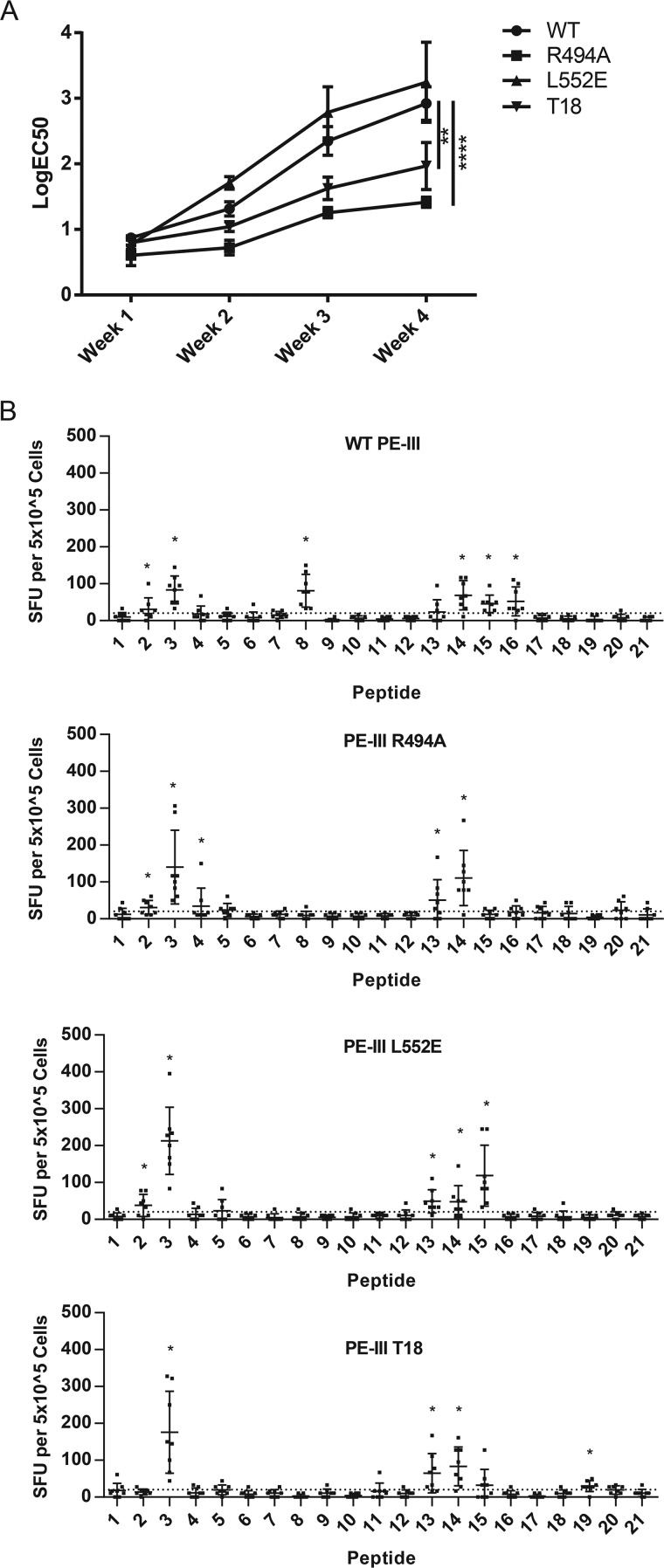
Deimmunized PE-III variants induce lower antibody titers but effectively prime CD4+ T cells. A, BALB/c mice were immunized i.v. for 4 weeks, and serum samples were taken 4 days after each immunization. PE-III–specific antibodies were detected by direct ELISA. Each line indicates average titer as logEC50 determined by nonlinear regression. Error bars indicate standard error; asterisks indicate significance by one-way ANOVA (n = 8 per group). Data are representative of three independent experiments. B, BALB/c mice were immunized once intranasally with PE-III and dmLT. Spleens were isolated, and splenocytes were restimulated with peptides spanning the sequence of WT PE-III with mutant peptides substituted as necessary in duplicate. Bars show average spot-forming units (SFU) per 5 × 10⁵ cells. Error bars indicate standard deviation; asterisks indicate significance by the Wilcoxon signed-rank test, and a mean SFU greater than 20. Dashed line indicates an SFU value 2 S.D. over background.
Figure 7.
Figure 7.
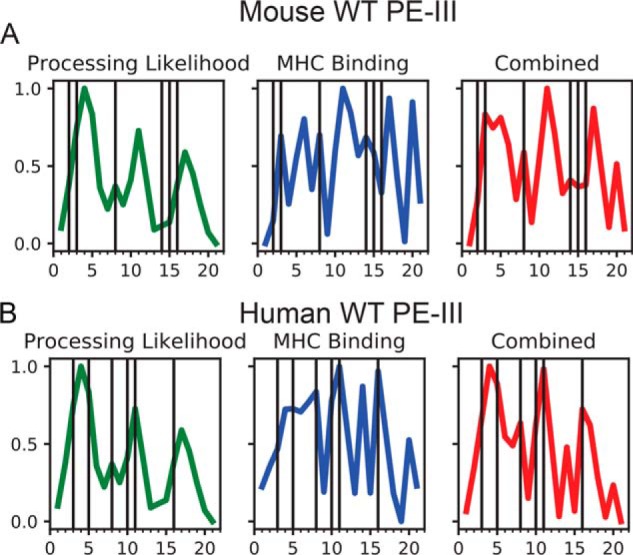
Dominant mouse and human PE-III epitopes are well-predicted by a structure-based epitope prediction algorithm. A, prediction of mouse PE-III epitopes using structure-based processing likelihood (15), MHC-binding prediction for the I-Ad MHCII molecule, and their combination. B, prediction of human PE-III epitopes using structure-based processing likelihood, MHC-binding prediction, and their combination. Vertical lines indicate positions of experimentally mapped epitopes. Bottom tic marks represent 20 residue peptides detailed in Table S3.

References

    1. Wang P., Sidney J., Dow C., Mothé B., Sette A., and Peters B. (2008) A systematic assessment of MHC class II peptide binding predictions and evaluation of a consensus approach. PLoS Comput. Biol. 4, e1000048 - PMC - PubMed
    1. Jensen K. K., Andreatta M., Marcatili P., Buus S., Greenbaum J. A., Yan Z., Sette A., Peters B., and Nielsen M. (2018) Improved methods for predicting peptide binding affinity to MHC class II molecules. Immunology 154, 394–406 10.1111/imm.12889 - DOI - PMC - PubMed
    1. Watts C. (2001) Antigen processing in the endocytic compartment. Curr. Opin. Immunol. 13, 26–31 10.1016/S0952-7915(00)00177-1 - DOI - PubMed
    1. Latek R. R., and Unanue E. R. (1999) Mechanisms and consequences of peptide selection by the I-Ak class II molecule. Immunol. Rev. 172, 209–228 10.1111/j.1600-065X.1999.tb01367.x - DOI - PubMed
    1. Blum J. S., Wearsch P. A., and Cresswell P. (2013) Pathways of antigen processing. Annu. Rev. Immunol. 31, 443–473 10.1146/annurev-immunol-032712-095910 - DOI - PMC - PubMed

Publication types