. 2019 Feb 12;116(7):2545-2550.
doi: 10.1073/pnas.1811360116. Epub 2019 Jan 25.

Structure-based development of new RAS-effector inhibitors from a combination of active and inactive RAS-binding compounds

Affiliations

Structure-based development of new RAS-effector inhibitors from a combination of active and inactive RAS-binding compounds

Abimael Cruz-Migoni et al. Proc Natl Acad Sci U S A. .

Abstract

The RAS gene family is frequently mutated in human cancers, and the quest for compounds that bind to mutant RAS remains a major goal, as it also does for inhibitors of protein-protein interactions. We have refined crystallization conditions for KRAS169Q61H-yielding crystals suitable for soaking with compounds and exploited this to assess new RAS-binding compounds selected by screening a protein-protein interaction-focused compound library using surface plasmon resonance. Two compounds, referred to as PPIN-1 and PPIN-2, with related structures from 30 initial RAS binders showed binding to a pocket where compounds had been previously developed, including RAS effector protein-protein interaction inhibitors selected using an intracellular antibody fragment (called Abd compounds). Unlike the Abd series of RAS binders, PPIN-1 and PPIN-2 compounds were not competed by the inhibitory anti-RAS intracellular antibody fragment and did not show any RAS-effector inhibition properties. By fusing the common, anchoring part from the two new compounds with the inhibitory substituents of the Abd series, we have created a set of compounds that inhibit RAS-effector interactions with increased potency. These fused compounds add to the growing catalog of RAS protein-protein inhibitors and show that building a chemical series by crossing over two chemical series is a strategy to create RAS-binding small molecules.

Keywords: RAS; antibody; cancer; drugs; intracellular antibody.


Conflict of interest statement

The authors declare no conflict of interest.

Figures

Fig. 1.
Fig. 1.
KRAS169Q61H structure analysis using new crystallization conditions. KRAS169Q61H protein was crystallized with bound GTP-analog GppNHp. (A) Surface representation of the asymmetric unit containing the six KRAS169Q61H proteins in different colors with different chains, labeled A–F. (B) Ribbon representation of KRAS169Q61H showing an overlay of the six chains, of the asymmetric unit. The switch regions of five proteins (B–F) are identical (depicted in dark gray), and one (chain A) has a stabilized switch I and switch II (depicted in blue) due to interactions with neighboring protein molecules in the crystal lattice. Residue H61 and GppNHp are indicated and one Mg atom (shown as a magenta sphere) was identified per chain. C and D show ribbon representation overlays of the KRAS169Q61H (chain A) structure with KRAS188G12V (C, switch I and switch II depicted in green) and KRAS188G12D (D, switch I and switch II depicted in brown), highlighting structural conservation across RAS mutations.
Fig. 2.
Fig. 2.
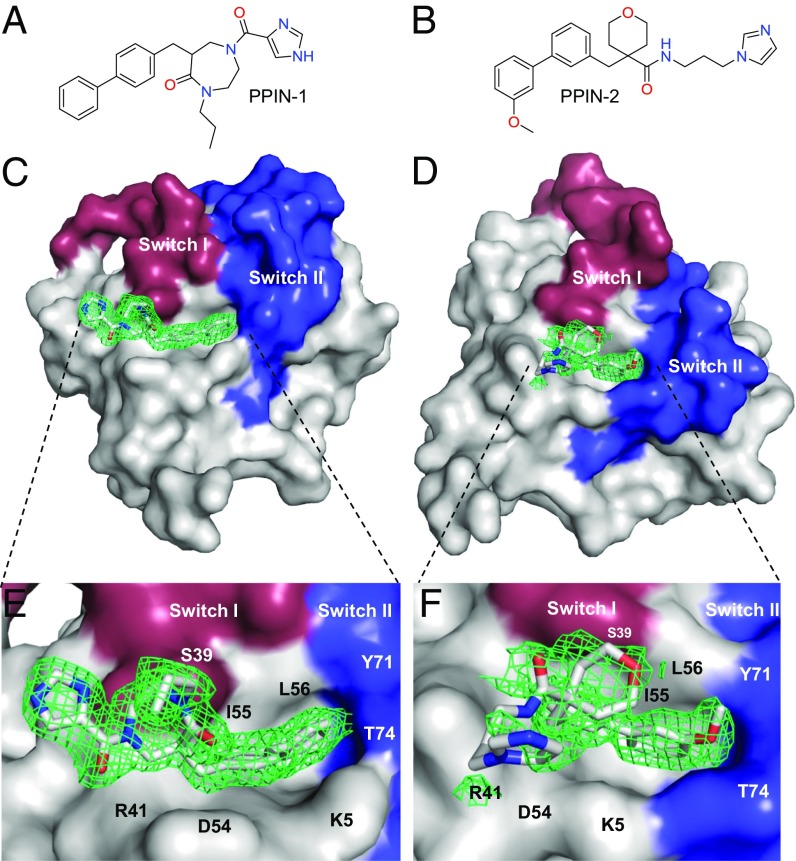
Crystal structure of PPIN-1 and PPIN-2 bound to KRAS169Q61H-GppNHp. The crystal structure of KRAS169Q61H with PPIN-1 and PPIN-2 was derived by crystal soaking with the compounds (their structures are shown in A and B, respectively). (C and D) Surface representations of the binding of PPIN-1 and PPIN-2 into pocket I close to the switch regions I (red) and II (blue). Good 2mFo-DFc electron density (green mesh) was found for the whole of PPIN-1 and for the biphenyl head group of PPIN-2 (green mesh) but less contiguous for the rest of the molecule. (E and F) Expanded views of the interactions of PPIN-1 and PPIN-2 with KRAS with the following residues in contact: K5, L6, V7, S39, Y40, R41, D54, I55, L56, Y71, and T74.
Fig. 3.
Fig. 3.
Abd and PPI-net compound alignment and cross-over compound crystallography. Alignments were carried out with the computational chemistry suite FORGE. (A) Abd-7 and PPIN-1 with alignments. (B) Abd-7 and PPIN-2. Three cross-over compounds were synthesized after the alignments, which are shown in C (Left, Ch-1; Middle, Ch-2; Right Ch-3). These compounds were soaked into KRAS169Q61H-GppNHp crystals. (D) A surface representation of the binding of Ch-1 (Left), Ch-2 (Middle), and Ch-3 (Right) in KRAS pocket I, close to the switch regions I (red) and II (blue). Full electron density (2Fo-Fc) was found for the three compounds, all depicted as a green mesh. (E) An expanded view of the interaction of the compounds with KRAS with the following residues in contact: K5, L6, V7, S39, R41, R41, D54, I55, L56, Y71, and T74.
Fig. 4.
Fig. 4.
Compound Ch-3 disrupts RAS-effector interactions. Assessment of the inhibition of RAS protein–protein interactions in cells by the chemical series compounds Ch-1, Ch-2, and Ch-3 using different BRET-based RAS biosensor expression vectors. (AC) Data from BRET assays using RLuc8-KRASG12D with either anti-RAS VHY6-GFP2 (A) with dematured anti-RAS VHY6dm-GFP2 (B) or with full-length CRAFFL-GFP2 (C). (D) Data from BRET assay using a negative control BRET-based biosensor LMO2/VH576dm. The VH576dm is a dematured anti-LMO2 VH. The data are computed relative to cells treated with DMSO vehicle only (open bar) or with Ch-1, Ch-2, or Ch-3 (shaded bars). (E and F) The effect of the Ch-3 compound on mutant KRASG12X (E) and NRASQ61H and HRASG12V (F) interactions with CRAFFL. (GI) The effect of Ch-3 on the interaction of KRASG12D (G), NRASQ61H (H), and HRASG12V (I) with various RAS effector domains (PI3Kα, PI3Kγ, CRAF, and RALGDS). The range of concentration of the compounds was 5, 10, and 20 μM. Each experiment was repeated at least twice (biological replicates). Statistical analyses were performed using a one-way ANOVA followed by Dunnett’s posttests (*P < 0.05, **P < 0.01, ***P < 0.001, ****P < 0.0001). Error bars correspond to mean values ± SD of biological repeats. RLuc8-KRAS, NRAS, and HRAS all comprised full-length RAS components.
Fig. 5.
Fig. 5.
Activity of compounds in a mutant KRAS human cancer cell. The new chemical series compounds Ch-1, -2, and -3 were assessed in two cell-based assays. (AC) Western blot analysis of EGF-stimulated DLD-1 cells treated with 5, 10, and 20 μM of Abd-2 or Abd-7 (A), PPIN-2 or Ch-1 (B), and Ch-2 or Ch-3 (C). Cell extracts were fractionated by SDS/PAGE and transferred to PVDF membranes that were incubated with antibodies detecting the indicated proteins. These data are quantitated in SI Appendix, Fig. S5. (D) DLD-1 cell viability 72 h after treatment with a single application of compound at the indicated concentrations. Viability was determined using the CellTitreGlo method and carried out in triplicate. The data are plotted as normalized cell viability mean with error bars showing SDs.

References

    1. Cox AD, Fesik SW, Kimmelman AC, Luo J, Der CJ. Drugging the undruggable RAS: Mission possible? Nat Rev Drug Discov. 2014;13:828–851. - PMC - PubMed
    1. Prior IA, Lewis PD, Mattos C. A comprehensive survey of Ras mutations in cancer. Cancer Res. 2012;72:2457–2467. - PMC - PubMed
    1. Simanshu DK, Nissley DV, McCormick F. RAS proteins and their regulators in human disease. Cell. 2017;170:17–33. - PMC - PubMed
    1. Gutierrez L, Magee AI, Marshall CJ, Hancock JF. Post-translational processing of p21ras is two-step and involves carboxyl-methylation and carboxy-terminal proteolysis. EMBO J. 1989;8:1093–1098. - PMC - PubMed
    1. Wittinghofer A, Nassar N. How Ras-related proteins talk to their effectors. Trends Biochem Sci. 1996;21:488–491. - PubMed

Publication types

MeSH terms

Substances