


Cerebral White Matter Hyperintensities, Kidney Function Decline, and Recurrent Stroke After Intensive Blood Pressure Lowering: Results From the Secondary Prevention of Small Subcortical Strokes ( SPS 3) Trial
- PMID: 30686103
- PMCID: PMC6405594
- DOI: 10.1161/JAHA.118.010091
Cerebral White Matter Hyperintensities, Kidney Function Decline, and Recurrent Stroke After Intensive Blood Pressure Lowering: Results From the Secondary Prevention of Small Subcortical Strokes ( SPS 3) Trial
Abstract
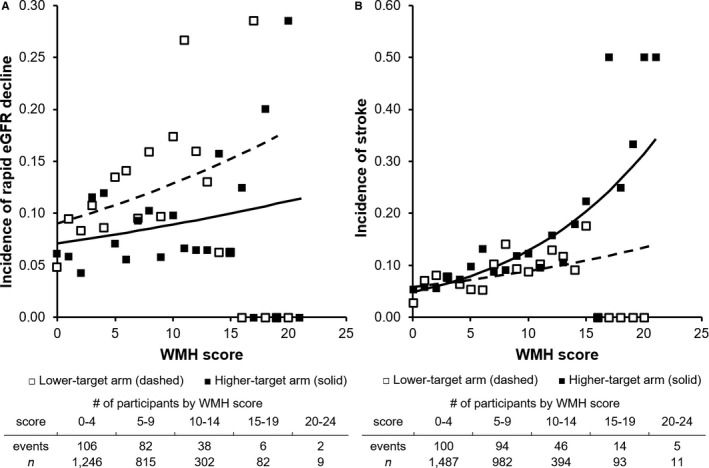
Background We aimed to determine whether cerebral white matter hyperintensities ( WMHs ) can distinguish stroke survivors susceptible to rapid kidney function decline from intensive blood pressure ( BP ) lowering. Methods and Results The SPS3 (Secondary Prevention of Small Subcortical Strokes) trial randomized participants with recent lacunar stroke to systolic BP targets of 130 to 149 and <130 mm Hg. We included 2454 participants with WMH measured by clinical magnetic resonance imaging at baseline and serum creatinine measured during follow-up. We tested interactions between BP target and WMH burden on the incidence of rapid kidney function decline (≥30% decrease from baseline estimated glomerular filtration rate at 1-year follow-up) and recurrent stroke. Rapid kidney function decline incidence was 11.0% in the lower- BP -target arm and 8.1% in the higher-target arm (odds ratio=1.40; 95% CI=1.07-1.84). Odds ratio for rapid kidney function decline between lower- and higher-target groups ranged from 1.26 in the lowest WMH tertile (95% CI , 0.80-1.98) to 1.71 in the highest tertile (95% CI , 1.05-2.80; P for interaction=0.65). Overall incidence of recurrent stroke was 7.9% in the lower-target arm and 9.6% in the higher-target arm (hazard ratio=0.80; 95% CI , 0.63-1.03). Hazard ratio for recurrent stroke in the lower-target group was 1.13 (95% CI , 0.73-1.75) within the lowest WMH tertile compared with 0.73 (95% CI , 0.49-1.09) within the highest WMH tertile ( P for interaction=0.04). Conclusions Participants with higher WMH burden appeared to experience greater benefit from intensive BP lowering in prevention of recurrent stroke. By contrast, intensive BP lowering increased the odds of kidney function decline, but WMH burden did not significantly distinguish this risk. Clinical Trial Registration URL : http://www.clinicaltrials.gov . Unique identifier: NCT 00059306.
Trial registration: ClinicalTrials.gov NCT00059306.
Keywords: blood pressure; creatinine; estimated glomerular filtration rate; kidney; lacunar stroke; secondary prevention of small subcortical strokes; white matter disease.
Figures
References
-
- Whelton PK, Carey RM, Aronow WS, Casey DE Jr, Collins KJ, Dennison Himmelfarb C, DePalma SM, Gidding S, Jamerson KA, Jones DW, MacLaughlin EJ, Muntner P, Ovbiagele B, Smith SC Jr, Spencer CC, Stafford RS, Taler SJ, Thomas RJ, Williams KAS, Williamson JD, Wright JT Jr. 2017 ACC/AHA/AAPA/ABC/ACPM/AGS/APhA/ASH/ASPC/NMA/PCNA guideline for the prevention, detection, evaluation, and management of high blood pressure in adults: executive summary: a report of the American College of Cardiology/American Heart Association Task Force on Clinical Practice Guidelines. Hypertension. 2017;71:1269–1324. - PubMed
-
- ACCORD Study Group , Cushman WC, Evans GW, Byington RP, Goff DC Jr, Grimm RH Jr, Cutler JA, Simons‐Morton DG, Basile JN, Corson MA, Probstfield JL, Katz L, Peterson KA, Friedewald WT, Buse JB, Bigger JT, Gerstein HC, Ismail‐Beigi F. Effects of intensive blood‐pressure control in type 2 diabetes mellitus. N Engl J Med. 2010;362:1575–1585. - PMC - PubMed
-
- SPRINT Research Group , Wright JT Jr, Williamson JD, Whelton PK, Snyder JK, Sink KM, Rocco MV, Reboussin DM, Rahman M, Oparil S, Lewis CE, Kimmel PL, Johnson KC, Goff DC Jr, Fine LJ, Cutler JA, Cushman WC, Cheung AK, Ambrosius WT. A randomized trial of intensive versus standard blood‐pressure control. N Engl J Med. 2015;373:2103–2116. - PMC - PubMed
-
- Peralta CA, McClure LA, Scherzer R, Odden MC, White CL, Shlipak M, Benavente O, Pergola P. Effect of intensive versus usual blood pressure control on kidney function among individuals with prior lacunar stroke: a post hoc analysis of the Secondary Prevention of Small Subcortical Strokes (SPS3) randomized trial. Circulation. 2016;133:584–591. - PMC - PubMed
