


Understanding Rapid Adjustments to Diverse Forcing Agents
- PMID: 30686845
- PMCID: PMC6334512
- DOI: 10.1029/2018GL079826
Understanding Rapid Adjustments to Diverse Forcing Agents
Abstract
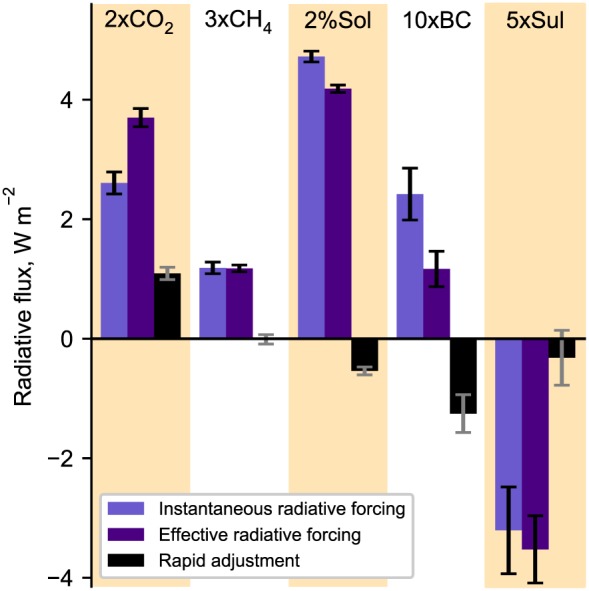
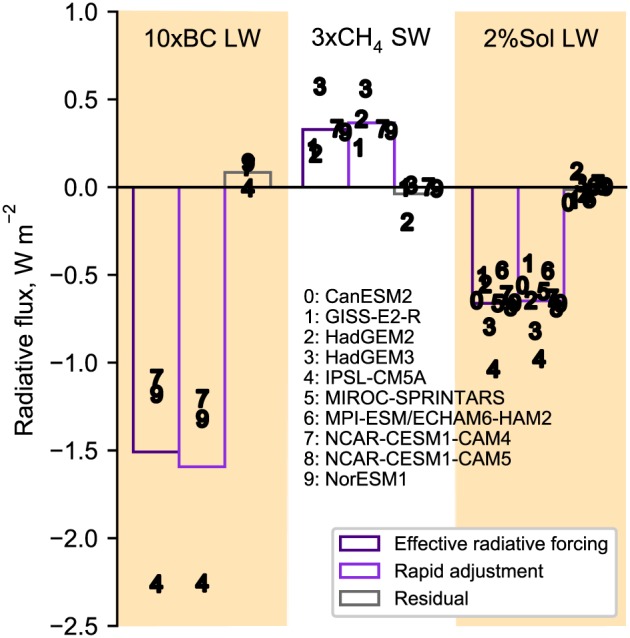
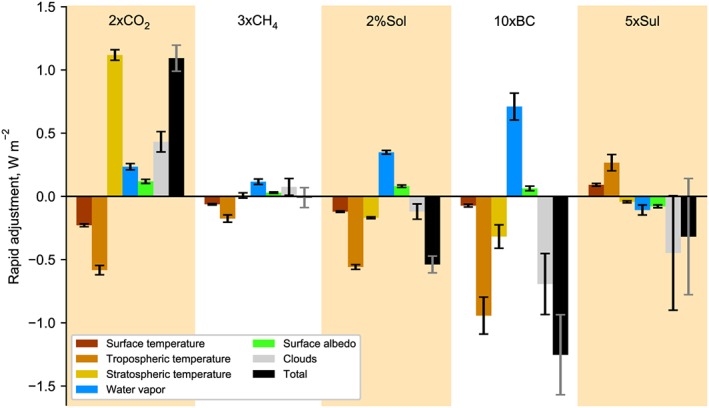
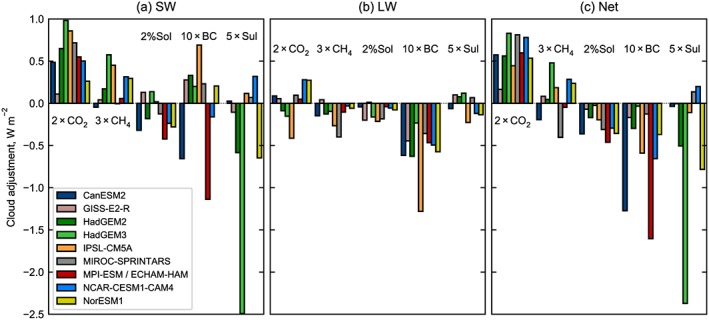
Rapid adjustments are responses to forcing agents that cause a perturbation to the top of atmosphere energy budget but are uncoupled to changes in surface warming. Different mechanisms are responsible for these adjustments for a variety of climate drivers. These remain to be quantified in detail. It is shown that rapid adjustments reduce the effective radiative forcing (ERF) of black carbon by half of the instantaneous forcing, but for CO2 forcing, rapid adjustments increase ERF. Competing tropospheric adjustments for CO2 forcing are individually significant but sum to zero, such that the ERF equals the stratospherically adjusted radiative forcing, but this is not true for other forcing agents. Additional experiments of increase in the solar constant and increase in CH4 are used to show that a key factor of the rapid adjustment for an individual climate driver is changes in temperature in the upper troposphere and lower stratosphere.
Keywords: PDRMIP; kernels; radiative forcing; rapid adjustments.
Figures
References
-
- Andrews, T. , & Forster, P. M. (2008). CO2 forcing induces semi‐direct effects with consequences for climate feedback interpretations. Geophysical Research Letters, 35, L04802 10.1029/2007GL032273 - DOI
-
- Block, K. , & Mauritsen, T. (2013). Forcing and feedback in the MPI‐ESM‐LR coupled model under abruptly quadrupled CO2 . Journal of Advances in Modeling Earth Systems, 5, 691–696.
-
- Bodas‐Salcedo, A. , Webb, M. J. , Bony, S. , Chepfer, H. , Dufresne, J.‐L. , Klein, S. A. , Zhang, Y. , Marchand, R. , Haynes, J. M. , Pincus, R. , & John, V. O. (2011). COSP: Satellite simulation software for model assessment. Bulletin of the American Meteorological Society, 92(8), 1023–1043. 10.1175/2011BAMS2856.1 - DOI
LinkOut - more resources
Full Text Sources