Review
. 2019 Jan 10:9:1883.
doi: 10.3389/fphys.2018.01883. eCollection 2018.

Mitochondria as a Target for Mitigating Sarcopenia

Affiliations
Review

Mitochondria as a Target for Mitigating Sarcopenia

Paul M Coen et al. Front Physiol. .

Abstract

Sarcopenia is the loss of muscle mass, strength, and physical function that is characteristic of aging. The progression of sarcopenia is gradual but may be accelerated by periods of muscle loss during physical inactivity secondary to illness or injury. The loss of mobility and independence and increased comorbidities associated with sarcopenia represent a major healthcare challenge for older adults. Mitochondrial dysfunction and impaired proteostatic mechanisms are important contributors to the complex etiology of sarcopenia. As such, interventions that target improving mitochondrial function and proteostatic maintenance could mitigate or treat sarcopenia. Exercise is currently the only effective option to treat sarcopenia and does so, in part, by improving mitochondrial energetics and protein turnover. Exercise interventions also serve as a discovery tool to identify molecular targets for development of alternative therapies to treat sarcopenia. In summary, we review the evidence linking mitochondria and proteostatic maintenance to sarcopenia and discuss the therapeutic potential of interventions addressing these two factors to mitigate sarcopenia.

Keywords: aging; exercise; mitochondria; sarcopenia; skeletal muscle; treatment.


Figures
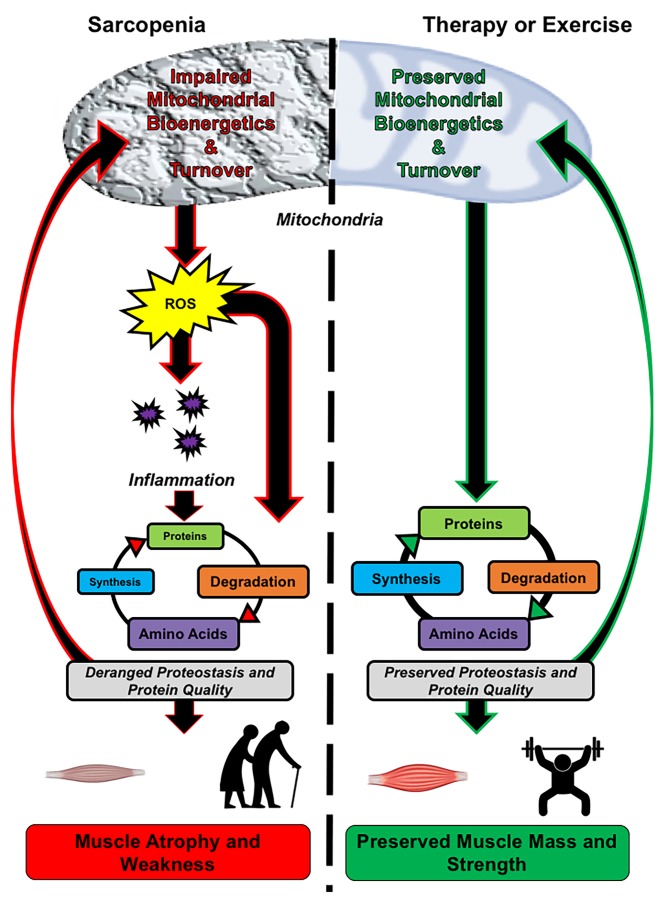
Figure 1
Figure 1
Role of mitochondrial bioenergetics and proteostasis in mediating skeletal muscle quality in older adults. Left panel, Sarcopenia is associated with mitochondrial dysfunction, which encompasses impaired bioenergetics and turnover. The impairment results in increased reactive oxygen species (ROS) generation and chronic low-grade inflammation, leading to impaired muscle proteostasis. The derangement in proteostasis impedes mitochondrial turnover, resulting in an accumulation of dysfunctional mitochondria and further exacerbation of organelle and tissue dysfunction. Right panel, Targeting mitochondrial bioenergetics and turnover by therapeutics and exercise impedes the age-associated rise in ROS and systemic inflammation, which results in the maintenance of muscle proteostasis. The maintained protein turnover allows for the removal of damaged proteins, such as dysfunctional mitochondria and damaged contractile proteins, while also synthesizing new functional proteins. Collectively, this leads to preservation of mitochondrial quality, muscle mass, and strength.

References

    1. Adhihetty P. J., O’Leary M. F. N., Chabi B., Wicks K. L., Hood D. A. (2007). Effect of denervation on mitochondrially mediated apoptosis in skeletal muscle. J. Appl. Physiol. 102, 1143–1151. 10.1152/japplphysiol.00768.2006, PMID: - DOI - PubMed
    1. Amthor H., Macharia R., Navarrete R., Schuelke M., Brown S. C., Otto A., et al. (2007). Lack of myostatin results in excessive muscle growth but impaired force generation. Proc. Natl. Acad. Sci. USA. 104, 1835–1840. 10.1073/pnas.0604893104 - DOI - PMC - PubMed
    1. Anker S. D., Morley J. E., Haehling von S. (2016). Welcome to the ICD-10 code for sarcopenia. J. Cachexia Sarcopenia Muscle 7, 512–514. 10.1002/jcsm.12147 - DOI - PMC - PubMed
    1. Aucello M., Dobrowolny G., Musarò A. (2009). Localized accumulation of oxidative stress causes muscle atrophy through activation of an autophagic pathway. Autophagy 5, 527–529. 10.4161/auto.5.4.7962 - DOI - PubMed
    1. Ayyadevara S., Balasubramaniam M., Suri P., Mackintosh S. G., Tackett A. J., Sullivan D. H., et al. . (2016). Proteins that accumulate with age in human skeletal-muscle aggregates contribute to declines in muscle mass and function in Caenorhabditis elegans. Aging 8, 3486–3497. 10.18632/aging.101141, PMID: - DOI - PMC - PubMed
