Review
. 2019 Jan 9:9:3096.
doi: 10.3389/fimmu.2018.03096. eCollection 2018.

The Coordination Between B Cell Receptor Signaling and the Actin Cytoskeleton During B Cell Activation

Affiliations
Review

The Coordination Between B Cell Receptor Signaling and the Actin Cytoskeleton During B Cell Activation

Jingwen Li et al. Front Immunol. .

Abstract

B-cell activation plays a crucial part in the immune system and is initiated via interaction between the B cell receptor (BCR) and specific antigens. In recent years with the help of modern imaging techniques, it was found that the cortical actin cytoskeleton changes dramatically during B-cell activation. In this review, we discuss how actin-cytoskeleton reorganization regulates BCR signaling in different stages of B-cell activation, specifically when stimulated by antigens, and also how this reorganization is mediated by BCR signaling molecules. Abnormal BCR signaling is associated with the progression of lymphoma and immunological diseases including autoimmune disorders, and recent studies have proved that impaired actin cytoskeleton can devastate the normal activation of B cells. Therefore, to figure out the coordination between the actin cytoskeleton and BCR signaling may reveal an underlying mechanism of B-cell activation, which has potential for new treatments for B-cell associated diseases.

Keywords: B cell; B cell activation; BCR signaling; actin; membrane-associated antigen.


Figures
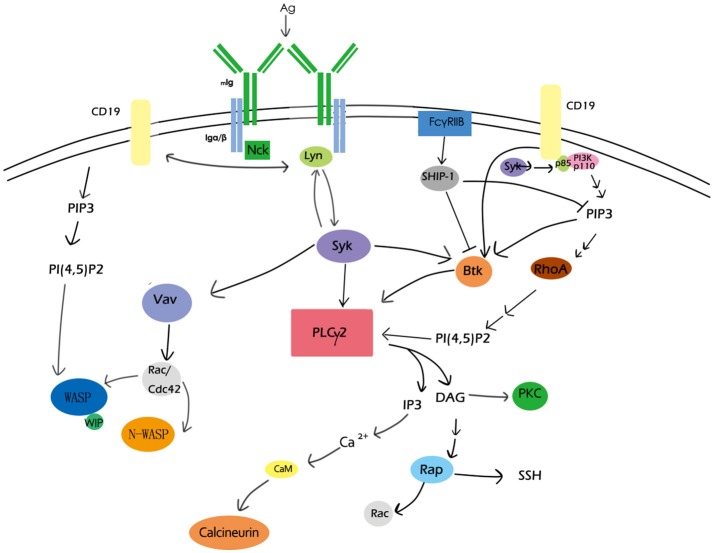
Figure 1
Figure 1
Overview of BCR signaling molecules involved in actin remodeling. CD19, PIP2, PLCγ2,PKC, the Rho family, and Rap GTPase, Btk, calcium, and WASP are major BCR signaling molecules involved in actin remodeling. These signaling molecules as well as their regulators form a network to participate in actin-cytoskeleton reorganization during B-cell activation.
Figure 2
Figure 2
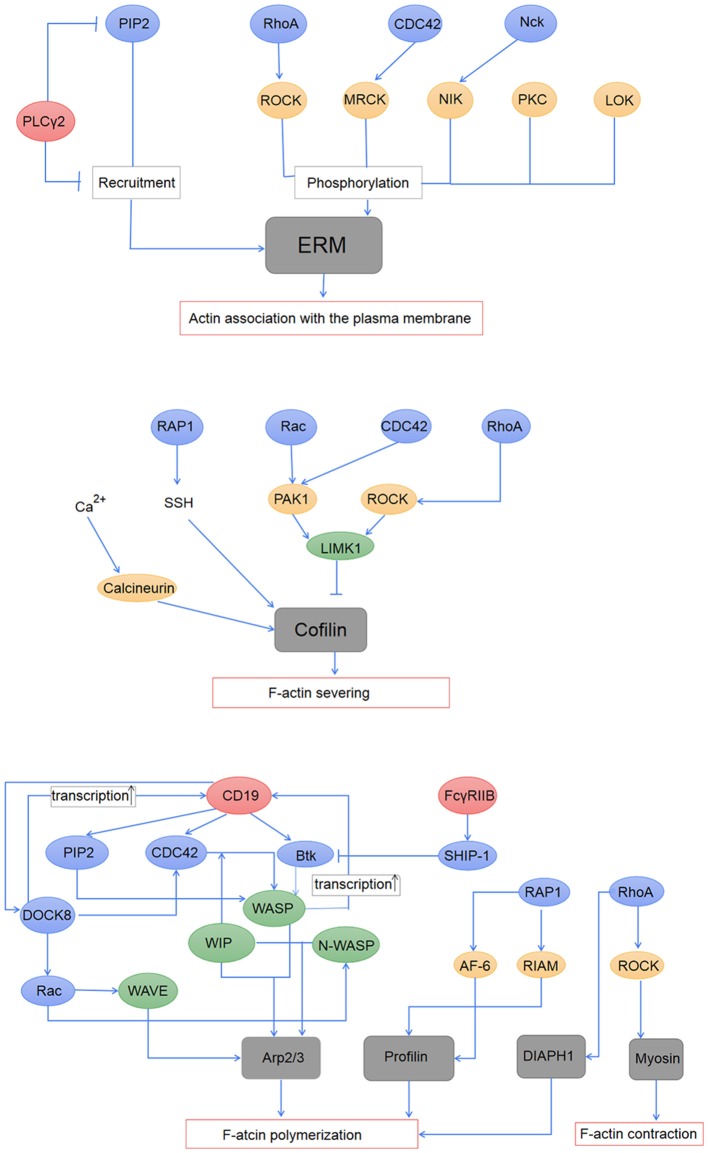
Regulation of BCR signaling on the actin cytoskeleton. The association of the actin cytoskeleton with the plasma membrane is mediated by activated ERM proteins. The ERM proteins are first recruited to the plasma membrane by PIP2, and then phosphorylated by PKC, LOK, and effector proteins of RhoA, CDC42, and Nck. PLCγ2 induced inactivation of the ERM proteins through its down-regulation on PIP2. Activation of cofilin induces F-actin severing, which is regulated by the Rho family and Rap1 GTPase, and also intracellular calcium. BCR signaling regulates actin polymerization mainly through the actin-nucleation promotion factor WASP and WAVE, both of which can promote the nucleation effect of Arp2/3. Profilin and DIAPH1, which are regulated by RAP1 and RhoA, respectively, are suggested to participate in actin polymerization during B-cell activation. BCR signaling also influences contraction of the actin cytoskeleton through the regulation of RhoA on myosin.

References

    1. Rajewsky K. Clonal selection and learning in the antibody system. Nature (1996) 381:751–8. 10.1038/381751a0 - DOI - PubMed
    1. Mitchison NA. T-cell-B-cell cooperation. Nat Rev Immunol. (2004) 4:308–12. 10.1038/nri1334 - DOI - PubMed
    1. Barr TA, Gray M, Gray D. B cells: programmers of CD4 T cell responses. Infect Disord Drug Targets (2012) 12:222–31. 10.2174/187152612800564446 - DOI - PubMed
    1. Venkitaraman AR, Williams GT, Dariavach P, Neuberger MS. The B-cell antigen receptor of the five immunoglobulin classes. Nature (1991) 352:777–81. 10.1038/352777a0 - DOI - PubMed
    1. Reth M. Antigen receptor tail clue. Nature (1989) 338:383–4. 10.1038/338383b0 - DOI - PubMed

Publication types

LinkOut - more resources