


Neuroplasticity in visual impairments
- PMID: 30687464
- PMCID: PMC6322049
- DOI: 10.4081/ni.2018.7326
Neuroplasticity in visual impairments
Abstract
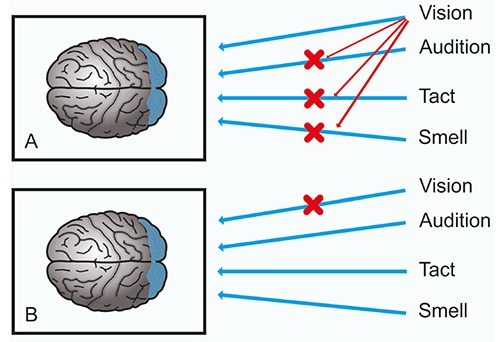
The visual acuity loss enables the brain to access new pathways in the quest to overcome the visual limitation and this is wellknown as neuroplasticity which have mechanisms to cortical reorganization. In this review, we related the evidences about the neuroplasticity as well as cortical anatomical differences and functional repercussions in visual impairments. We performed a systematic review of PUBMED database, without date or status publication restrictions. The findings demonstrate that the visual impairment produce a compensatory sensorial effect, in which non-visual areas are related to both cross (visual congenital) and multimodal (late blind) neuroplasticity.
Keywords: Neuroplasticity; central nervous system; vision; visual impairments.
Conflict of interest statement
Conflict of interest: the authors declare no potential conflict of interest.
Figures


References
-
- Mariotti S, Pascolini D. Visual Impairment, Vision Loss and Blindness 2010 global estimates, and VI and blindness causes. Global Data on Visual Impairments 2010, WHO 2010.
-
- Bavelier D, Neville HJ. Cross-modal plasticity: where and how? Nat Rev Neurosci 2002;3:443-42. - PubMed
-
- Muthusamy A, Gajendran R, Rao B. Mid-latency Auditory Evoked Potential Response Revealed as an Evidence of Neural Plasticity in Blind Individuals. Indian J Physiol Pharmacol 2014;58: 113-9. - PubMed
-
- Brodmann K. Vergleichende Lokalisationslehre der Grosshirnrinde. Leipzig: Johann Ambrosius Bart, 1909
-
- Bach-Y-Rita P. Brain plasticity as a basis for recovery of function in humans. Neuropsychologia 1990;28:547-54. - PubMed
LinkOut - more resources
Full Text Sources