


Assessing the Relationship between Performance on the University of California Performance Skills Assessment (UPSA) and Outcomes in Schizophrenia: A Systematic Review and Evidence Synthesis
- PMID: 30687553
- PMCID: PMC6327277
- DOI: 10.1155/2018/9075174
Assessing the Relationship between Performance on the University of California Performance Skills Assessment (UPSA) and Outcomes in Schizophrenia: A Systematic Review and Evidence Synthesis
Abstract
Objective: To perform a systematic review of the published literature to evaluate how functional capacity, as measured by the University of California at San Diego (UCSD) Performance-based Skills Assessment (UPSA), relates to other functional measures and real-world outcomes among individuals with schizophrenia.
Methods: The MEDLINE® and Embase® databases were searched to identify joint evaluations with UPSA and key functional outcomes (functional scale measures; generic or disease-specific, health-related quality of life [HRQoL]; or real-world outcomes [residential status; employment status]) in patients with schizophrenia. Pearson correlations were estimated between UPSA scores, HRQoL, other functional scale measures, and real-world outcomes, for outcomes described in at least six studies.
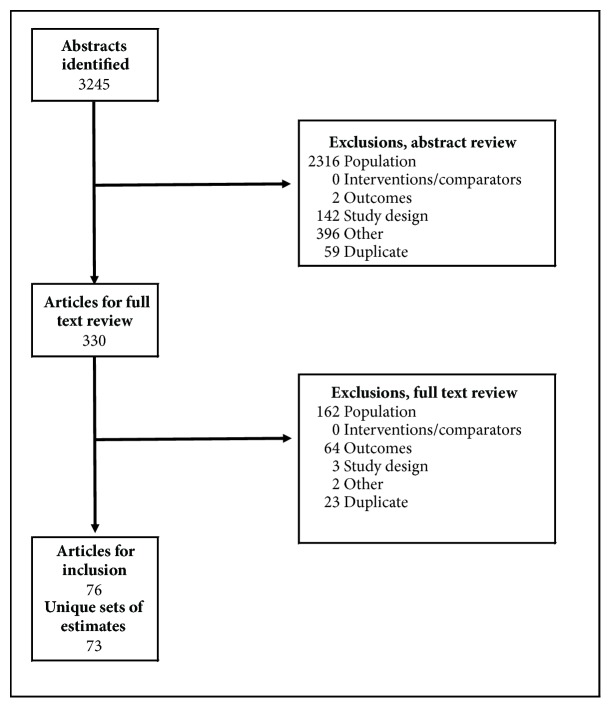
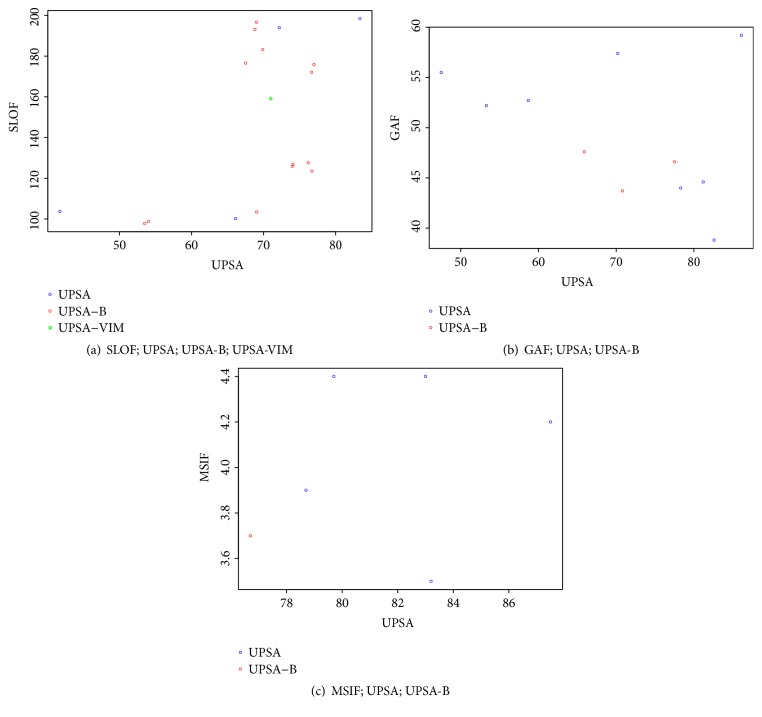
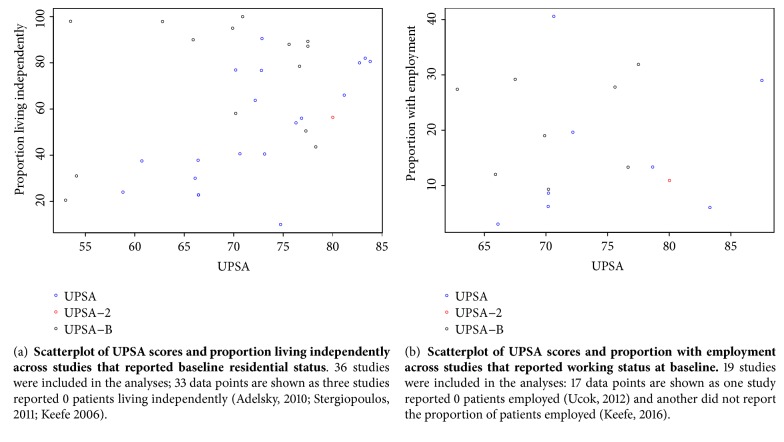
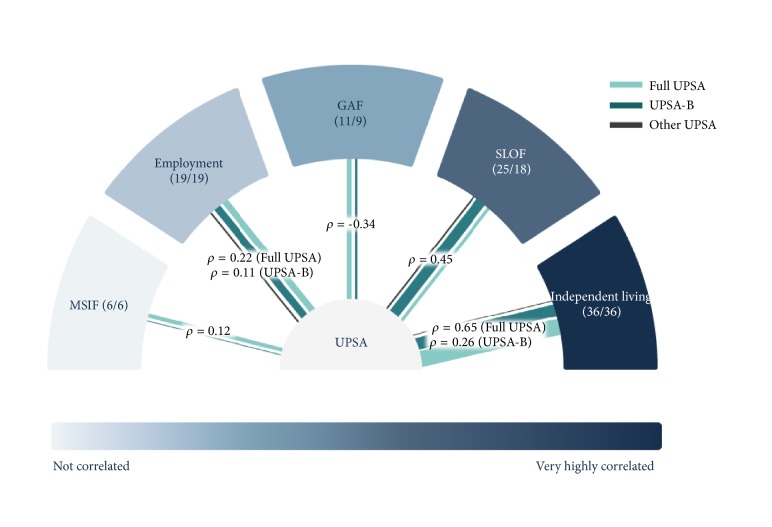
Results: The synthesis included 76 studies that provided 73 unique data sets. Quantitative assessment between the Specific Level of Function (SLOF) (n=18) scores and UPSA scores demonstrated a moderate borderline-significant correlation (0.45, p=0.06). Quantitative analysis of the relationship between the Global Assessment of Functioning (GAF) (n=11) and the Multidimensional Scale of Independent Functioning (MSIF) (n=6) scales revealed moderate and small nonsignificant Pearson correlations of -0.34 (p=0.31) and 0.12 (p=0.83), respectively. There was a small borderline-significant correlation between UPSA score and residential status (n=36; 0.31; p=0.08), while no correlation was found between UPSA score and employment status (n=19; 0.04; p=0.88).
Conclusion: The SLOF was the most often used functional measure and had the strongest observed correlation with the UPSA. Although knowledge gaps remain, evidence from this review indicates that there is a quantitative relationship between functional capacity and real-world outcomes in individuals with schizophrenia.
Figures
References
-
- Reilly J. L., Sweeney J. A. Generalized and specific neurocognitive deficits in psychotic disorders: Utility for evaluating pharmacological treatment effects and as intermediate phenotypes for gene discovery. Schizophrenia Bulletin. 2014;40(3):516–522. doi: 10.1093/schbul/sbu013. - DOI - PMC - PubMed
-
- Bowie C. R., Reichenberg A., McClure M. M., Leung W. L., Harvey P. D. Age-associated differences in cognitive performance in older community dwelling schizophrenia patients: Differential sensitivity of clinical neuropsychological and experimental information processing tests. Schizophrenia Research. 2008;106(1):50–58. doi: 10.1016/j.schres.2007.10.026. - DOI - PMC - PubMed
Publication types
LinkOut - more resources
Full Text Sources
