Review
. 2019 Jan 9:6:176.
doi: 10.3389/fcell.2018.00176. eCollection 2018.

A Comprehensive Review on the Interaction Between the Host GTPase Rab11 and Influenza A Virus

Affiliations
Review

A Comprehensive Review on the Interaction Between the Host GTPase Rab11 and Influenza A Virus

Maria João Amorim. Front Cell Dev Biol. .

Abstract

This year marks the 100th anniversary of one of the deadliest pandemic outbreaks, commonly referred as the Spanish Flu, that was caused by influenza A virus (IAV). Since then, IAV has been in governmental agendas worldwide, and a lot of effort has been put into understanding the pathogen's lifecycle, predict and mitigate the emergence of the strains that provoke yearly epidemics and pandemic events. Despite decades of research and seminal contributions there is still a lot to be investigated. In particular for this review, IAV lifecycle that takes place inside the host cell is not fully understood. Two steps that need clarification include genome transport to budding sites and genome assembly, the latter a complex process challenged by the nature of IAV genome that is divided into eight distinct parts. Assembly of such segmented genome is crucial to form fully infectious viral particles but is also critical for the emergence of viruses with pandemic potential that arise when avian and human IAV strains co-infect a host. The host GTPase Rab11 was separately implicated in both steps, and, interestingly these processes are beginning to emerge as being intimately related. Rab11 was initially proposed to be involved in the budding/release of IAV virions. It was subsequently shown to transport progeny genome, and later proposed to promote assembly of viral genome, but the underlying bridging mechanism the two is far from clear. For simplicity, this Rab11-centric review provides an initial separate account of Rab11 involvement in genome transport and in assembly. IAV genome assembly is a complicated molecular biology process, and therefore earned a dedicated section on how/if the viral genome forms a genomic supramolecular complex. Both topics present intricate challenges, outstanding questions, and unique controversies. At the end of the review, I will explore possible mechanisms intertwining IAV vRNP transport and genome assembly. Importantly, Rab11 has recently emerged as a key factor subverted by evolutionary unrelated viral families (Paramyxo, Bunya, and Orthomyxoviruses, among many others) and bacteria (Salmonella and Shigella) relevant to human health. This review provides a framework to identify common biological principles among the lifecycles of these pathogens.

Keywords: Rab11 GTPase; influenza A virus; influenza supramolecular genomic complex; viral assembly; viral inclusion.


Figures
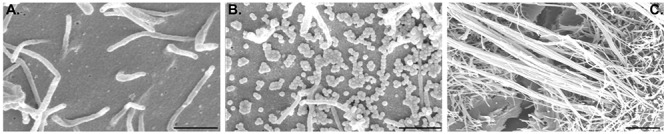
Figure 1
Figure 1
Apical surface of A549 lung epithelial cells healthy (A) or infected with influenza A/Puerto Rico/8/34 (B) or a reassortant of this virus with segment 7 A/Udorn/301/72 (C). This figure aims to show the different morphologies of influenza A virion budding from cells [spherical (B) and filamentous (C)]. Scale bar is 1 μm.
Figure 2
Figure 2
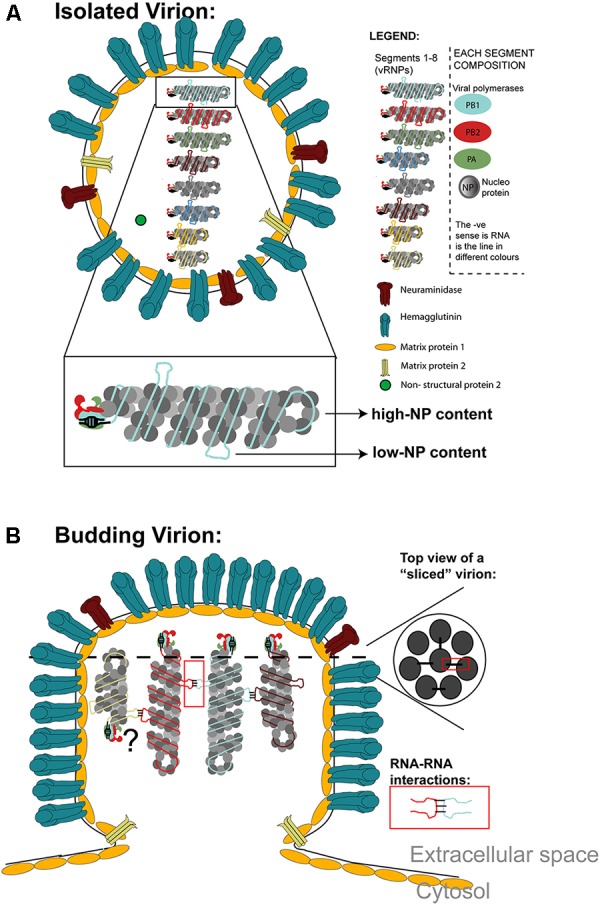
(A) Schematics of a virion containing the plasma-membrane derived envelope containing the three transmembrane proteins: M2, HA, and NA. Beneath the plasma membrane, the M1 protein forms a tight layer and the virion core contains the 8 vRNP segments that constitute its genome and very small amounts of NS2. vRNPs are magnified to illustrate their structure with the heterotrimeric RNA dependent RNA polymerase constituted by PB1, PB2, and PA docking at the panhandle structure, and NP coating RNA forming a double-helical hairpin structure, with a loop at one end. There are regions of high and low NP content. Low NP content regions are available to establish RNA–RNA interactions among the different vRNP types. Note that cellular proteins are omitted from this model. (B) Schematics of a budding virion is shown. The vRNP distribution inside virions is shown on lateral- or top-view sliced sections, the latter showing the vRNP arrangement “7+1.” vRNPs bind to the top of the virion and have been reported to adopt parallel and anti-parallel orientations, the latter being still controversial (hence the question mark). vRNPs should establish RNA-RNA interactions within different vRNPs (displayed in the red square).
Figure 3
Figure 3
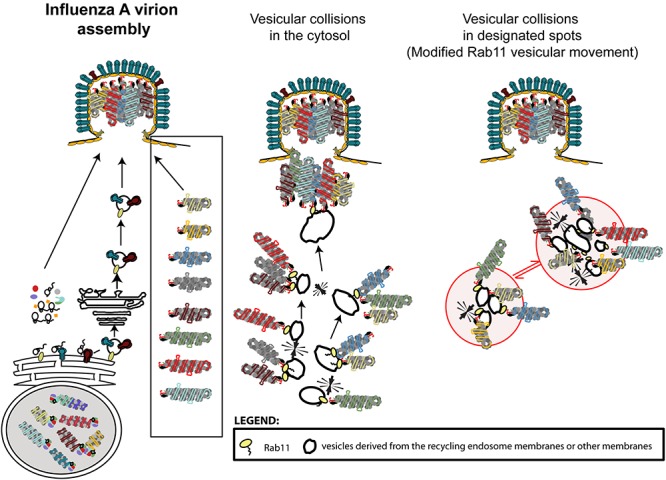
Influenza A virion assembly schematics. Virion components must reach the apical side of the plasma membrane. Proteins including M1 are translated in the cytosol and bind the transmembrane proteins at the cell surface. Transmembrane proteins are translated in the rough ER and reach the lipid membrane using the classic secretory pathway. vRNPs are found inside virions displaying a 7+1 arrangement and forming a complex. Current models suggest that the genomic complex is formed before reaching the cell surface by the establishment of RNA–RNA interactions promoted as vesicles transporting vRNPs collide throughout the cytosol (dispersed vesicular collision model) or in designated locations (compartmentalized model, with the compartment shown as red circles on the left). Note that formation of designated locations would require alterations in vesicular transport and development of structures where material exchange between the cytosol and viral inclusions could occur. The models presented are an over-simplification and, in both cases, additional steps could be included. Host proteins, with the exception of Rab11 have been omitted from the model.
Figure 4
Figure 4
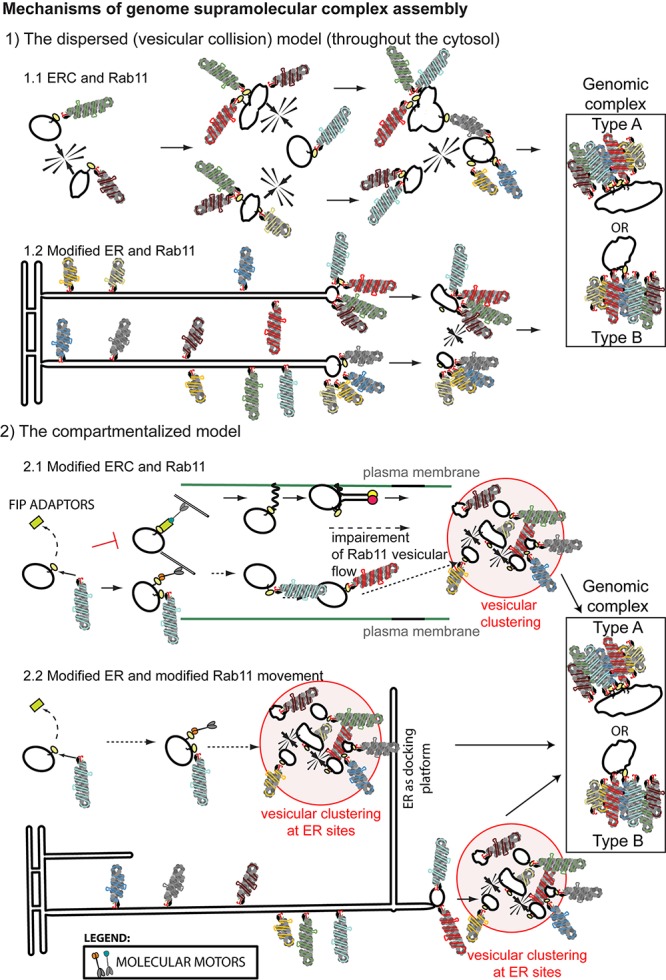
Bridging influenza A vRNP transport with genome assembly. (1) The dispersed (vesicular collision) model predicts that genomic complex formation could occur coupled to vRNP transport on Rab11-containing-vesicles. Establishment of inter-segment interactions would take place sequentially during transitory vesicular collision events leading to formation of sub-bundles until the genome complex is completed (with eight different segments). Vesicles could fuse (leading the genomic complex type A) or vRNPs could be transferred from one vesicle to the next upon vesicular “kissing” events (genomic complex type B). Note that type A and B differs in the number of molecules of Rab11 (with type A having at least 8) and the size of the vesicles (type A having enlarged structures). Several mechanisms are proposed based on the literature: (1.1) Collision of ERC vesicles containing Rab11 and vRNPs could take place in the entire cytosol. (1.2) Collision of vesicles containing vRNPs and Rab11 but derived from a modified ER would take place close to the plasma membrane. (2) The compartmentalized model predicts that viral infection would induce the re-routing or impairment of Rab11 pathway and lead to compartmentalization of the different vRNPs inside viral inclusions as a mechanism to facilitate viral assembly (2.1) in multiple docking platforms or (2.2) at precise cellular spots defined by the ER. Viral inclusions could be formed if vRNPs are transported: (a) on ERC vesicles to the ER or (b) attached to the ER and subsequently released attached to Rab11 vesicles routed to the plasma membrane.

References

    1. Aikawa Y., Lynch K. L., Boswell K. L., Martin T. F. (2006). A second SNARE role for exocytic SNAP25 in endosome fusion. Mol. Biol. Cell. 17 2113–2124. 10.1091/mbc.e06-01-0074 - DOI - PMC - PubMed
    1. Alenquer M., Vale-Costa S., Sousa A. L., Etibor T. A., Ferreira F., Amorim M. -J. (2018). Influenza A virus ribonucleoproteins form liquid organelles at endoplasmic reticulum exit sites. bioRxiv [Preprint]. 10.1101/410373 - DOI - PMC - PubMed
    1. Amorim M. J., Bruce E. A., Read E. K., Foeglein A., Mahen R., Stuart A. D., et al. (2011). A Rab11- and microtubule-dependent mechanism for cytoplasmic transport of influenza A virus viral RNA. J. Virol. 85 4143–4156. 10.1128/JVI.02606-10 - DOI - PMC - PubMed
    1. Amorim M. J., Kao R. Y., Digard P. (2013). Nucleozin targets cytoplasmic trafficking of viral ribonucleoprotein-rab11 complexes in influenza a virus infection. J. Virol. 87 4694–4703. 10.1128/JVI.03123-12 - DOI - PMC - PubMed
    1. Archetti I. (1955). Appearances associated with filamentous forms of influenza viruses. Arch. Gesamte Virusforsch 6 29–35. 10.1007/BF01242050 - DOI - PubMed

LinkOut - more resources