Review
. 2019 May;14(5):749-756.
doi: 10.4103/1673-5374.249218.

Mitophagy links oxidative stress conditions and neurodegenerative diseases

Affiliations
Review

Mitophagy links oxidative stress conditions and neurodegenerative diseases

Ulfuara Shefa et al. Neural Regen Res. 2019 May.

Abstract

Mitophagy is activated by a number of stimuli, including hypoxia, energy stress, and increased oxidative phosphorylation activity. Mitophagy is associated with oxidative stress conditions and central neurodegenerative diseases. Proper regulation of mitophagy is crucial for maintaining homeostasis; conversely, inadequate removal of mitochondria through mitophagy leads to the generation of oxidative species, including reactive oxygen species and reactive nitrogen species, resulting in various neurodegenerative diseases, such as Alzheimer's disease, Parkinson's disease, Huntington's disease, and amyotrophic lateral sclerosis. These diseases are most prevalent in older adults whose bodies fail to maintain proper mitophagic functions to combat oxidative species. As mitophagy is essential for normal body function, by targeting mitophagic pathways we can improve these disease conditions. The search for effective remedies to treat these disease conditions is an ongoing process, which is why more studies are needed. Additionally, more relevant studies could help establish therapeutic conditions, which are currently in high demand. In this review, we discuss how mitophagy plays a significant role in homeostasis and how its dysregulation causes neurodegeneration. We also discuss how combating oxidative species and targeting mitophagy can help treat these neurodegenerative diseases.

Keywords: Alzheimer's disease; Huntington's disease; Parkinson's disease; amyotrophic lateral sclerosis; central nervous system; mitophagy; nerve regeneration; oxidative species; reactive nitrogen species; reactive oxygen species.


Conflict of interest statement

None

Figures
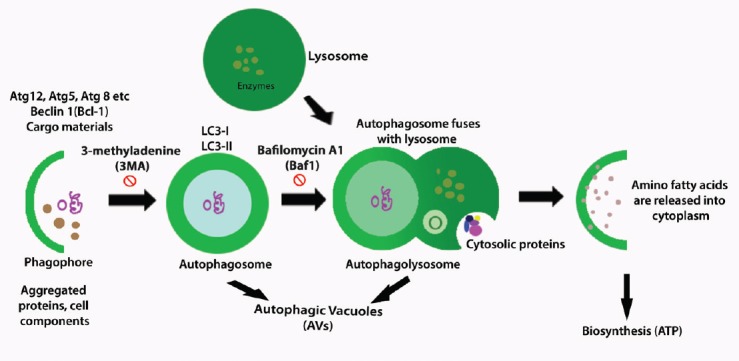
Figure 1
Figure 1
General process of autophagy. At the begining of this process, cup-shaped phagophore is formed around the folded or aggregated proteins and with other cellular components, this is called nucleation. In the first step, the autophagic proteins (Atgs) such as Atg12, Atg 5, Atg 8, Beclin-1 (Bcl-1) and cargo materials are brought about through the ubiquitin-like conjugation systems Atg12-Atg5-Atg16L and Atg8 (LC3)-phosphatidylethanolamine (PE). In the second step, the expansion and maturation of the cup-shaped structure become rounded one and form autophagolysosomes which are double membraned vesicles with presence of LC3-I, LC3-II where the 3-methyladenine (3-MA) plays an inhibitatory role. In the third step, with an inhibitiory effect of bafilomycin A1 (Baf1), autophagosome is fused with lysosome and form single membraned autophagolysosome and this step is called fusion and autophagic vacuoles (AVs) and cytosolic proteins are seen. In the last step, the degradation of the autophagolysosome, with hyrolytic enzymes contributes to degradation of sequestered material, release of amino or fatty acids, and maintaineance of biogenesis.
Figure 2
Figure 2
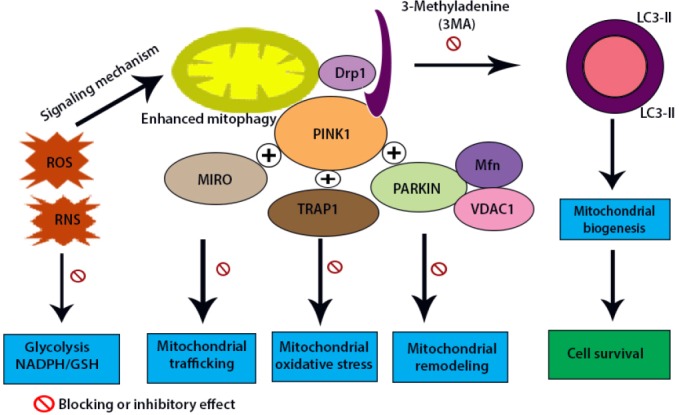
Protective roles of mitophagy. Reactive oxygen species such as reactive oxygen species (ROS) and reactive nitrogen species (RNS) acts as a signaling mechanism to induce autophagy or mitophagy which has a role in bioenergetic pathway and protective roles in cell survival. On the other hand, an increase in mitochondrial fusion protects mitochondria through mitophagy. The PTEN-induced putative kinase protein 1 (PINK1) of mitochondria is destabilized by presenilin rhomboid like (PARL) and cytosolic E3 ubiquitin ligase PARKIN (PARKIN) ubiquitinates mitofusion (Mfn), voltage dependent protein channel 1 (VDAC1) etc. that results in elevated mitophagy. PINK1 with different proteins such as mitochondrial RhoGTase (MIRO), tumor necrosis factor receptor associated protein 1 (TRAP1), PARKIN combined with Mfn and voltage dependent anion channel 1 (VDAC1) has different inhibitory roles such as mitochondrial trafficking and mitochondrial remodeling. Clearance of damaged mitochondria by mitophagy enhances mitochondrial biogenesis and increases the rate of cell survival.
Figure 3
Figure 3
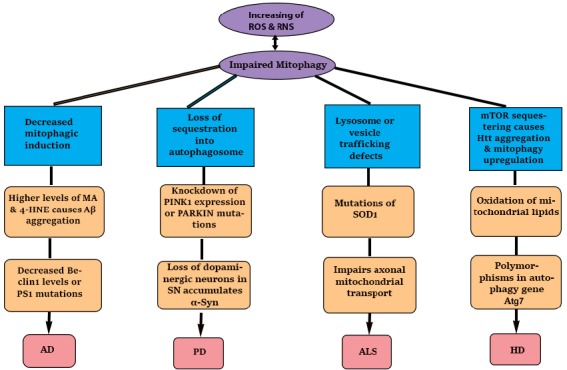
Correlation of mitophagy and neurodegenerative diseases. Upregulation or downregulation of autophagic and mitophagic function has a role in the development of many neurodegenerative diseases such as Alzheimer’s disease (AD), Parkinson’s disease (PD), Hungtington’s disease (HD), and amyotrophic lateral sclerosis (ALS). AD is caused by decreased mitophagic induction which causes higher levels of malondehyde (MA), 4-hydroxynonela (4-HNE), and Beclin-1 (Bcl-1), and increases amyloid beta (Aβ) aggregation and presenilin (PS1) mutations. PD is caused by loss of sequestration into autophagosome which causes loss of dopaminergic neurons in substantia nigra (SN) as well as knockdown of PINK1 expression or PARKIN mutations. ALS is caused by decreased lysosome or vesicle trafficking defects that result in formation of SOD1 formation and inpair axonal mitochondrial transport. HD is caused by mechanistic target of rapamycin (mTOR) sequestering into huntingtin protein (Htt) aggregates and oxidation of mitochondrial lipids which inhibits signaling that results in upregulation of mitophagy and polymorphism of autophagy related protein 7 (Atg7). It is shown that the dysfunction of mitochondria is responsible for generation of reactive oxygen species (ROS) and reactive nitrogen species (RNS) to cause malfunction in mitophagy which is vice versa.

References

    1. Abada A, Elazar Z. Getting ready for building: signaling and autophagosome biogenesis. EMBO Rep. 2014;15:839–852. - PMC - PubMed
    1. Albers DS, Beal MF. Mitochondrial dysfunction and oxidative stress in aging and neurodegenerative disease. J Neural Transm Suppl. 2000;59:133–154. - PubMed
    1. Aso E, Ferrer I. Cannabinoids for treatment of Alzheimer’s disease: Moving toward the clinic. Front Pharmacol. 2014;5:37. - PMC - PubMed
    1. Barsoum MJ, Yuan H, Gerencser AA, Liot G, Kushnareva Y, Gräber S, Kovacs I, Lee WD, Waggoner J, Cui J. Nitric oxide‐induced mitochondrial fission is regulated by dynamin‐related GTPases in neurons. EMBO J. 2006;25:3900–3911. - PMC - PubMed
    1. Butler D, Nixon RA, Bahr BA. Potential compensatory responses through autophagic/lysosomal pathways in neurodegenerative diseases. Autophagy. 2006;2:234–237. - PubMed