Association Between Screen Time and Children's Performance on a Developmental Screening Test
- PMID: 30688984
- PMCID: PMC6439882
- DOI: 10.1001/jamapediatrics.2018.5056
Association Between Screen Time and Children's Performance on a Developmental Screening Test
Erratum in
-
Errors in Abstract, Results, and Figure.JAMA Pediatr. 2019 May 1;173(5):501-502. doi: 10.1001/jamapediatrics.2019.0515. JAMA Pediatr. 2019. PMID: 30907942 Free PMC article. No abstract available.
Abstract
Importance: Excessive screen time is associated with delays in development; however, it is unclear if greater screen time predicts lower performance scores on developmental screening tests or if children with poor developmental performance receive added screen time as a way to modulate challenging behavior.
Objective: To assess the directional association between screen time and child development in a population of mothers and children.
Design, setting, and participants: This longitudinal cohort study used a 3-wave, cross-lagged panel model in 2441 mothers and children in Calgary, Alberta, Canada, drawn from the All Our Families study. Data were available when children were aged 24, 36, and 60 months. Data were collected between October 20, 2011, and October 6, 2016. Statistical analyses were conducted from July 31 to November 15, 2018.
Exposures: Media.
Main outcomes and measures: At age 24, 36, and 60 months, children's screen-time behavior (total hours per week) and developmental outcomes (Ages and Stages Questionnaire, Third Edition) were assessed via maternal report.
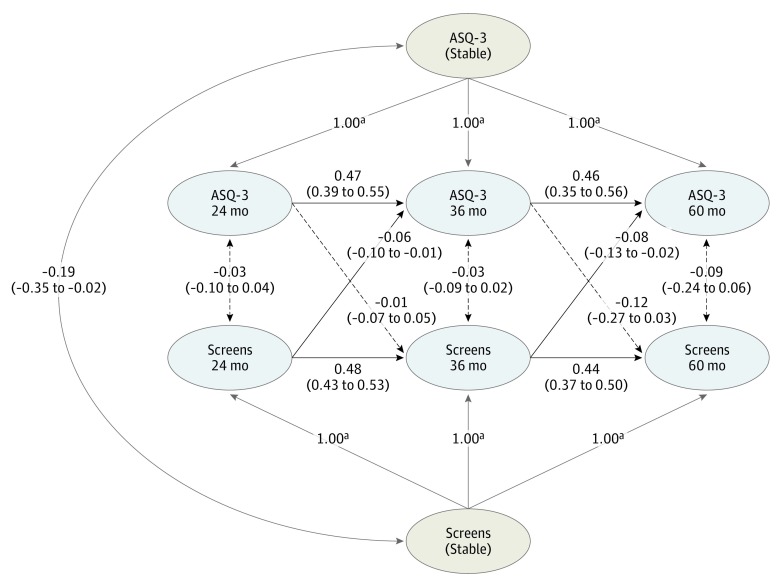
Results: Of the 2441 children included in the analysis, 1227 (50.2%) were boys. A random-intercepts, cross-lagged panel model revealed that higher levels of screen time at 24 and 36 months were significantly associated with poorer performance on developmental screening tests at 36 months (β, -0.06; 95% CI, -0.10 to -0.01) and 60 months (β, -0.08; 95% CI, -0.13 to -0.02), respectively. These within-person (time-varying) associations statistically controlled for between-person (stable) differences.
Conclusions and relevance: The results of this study support the directional association between screen time and child development. Recommendations include encouraging family media plans, as well as managing screen time, to offset the potential consequences of excess use.
Conflict of interest statement
Figures
References
-
- Janus M, Offord DR. Development and psychometric properties of the Early Development Instrument (EDI): a measure of children’s school readiness. Can J Behav Sci. 2007;39(1):1-22. doi: 10.1037/cjbs2007001 - DOI
-
- Browne DT, Wade M, Prime H, Jenkins JM. School readiness amongst urban Canadian families: risk profiles and family mediation. J Educ Psychol. 2018;110(1):133-146. doi: 10.1037/edu0000202 - DOI
-
- Stanovich KE. Matthew effects in reading—some consequences of individual-differences in the acquisition of literacy. Read Res Q. 1986;21(4):360-407. doi: 10.1598/RRQ.21.4.1 - DOI
-
- Browne DT, Rokeach A, Wiener J, Hoch JS, Meunier JC, Thurston S. Examining the family-level and economic impact of complex child disabilities as a function of child hyperactivity and service integration. J Dev Phys Disabil. 2013;25(2):181-201. doi: 10.1007/s10882-012-9295-z - DOI