


Acute Vascular Ischemic Events in Patients With Central Retinal Artery Occlusion in the United States: A Nationwide Study 2003-2014
- PMID: 30689989
- PMCID: PMC6542256
- DOI: 10.1016/j.ajo.2019.01.009
Acute Vascular Ischemic Events in Patients With Central Retinal Artery Occlusion in the United States: A Nationwide Study 2003-2014
Abstract
Purpose: Central retinal artery occlusion (CRAO) confers a high risk of acute vascular ischemic events, including stroke and myocardial infarction (MI). Understanding the burden and risk factor profile of these ischemic events can serve as a valuable guide for ophthalmologists in the management and appropriate referral of these patients.
Design: Retrospective cross-sectional study.
Methods: The Nationwide Inpatient Sample (NIS) was queried to identify all inpatient admissions with a diagnosis of CRAO in the United States between the years 2003 and 2014. The primary outcome measure was the incidence of in-hospital acute vascular ischemic events.
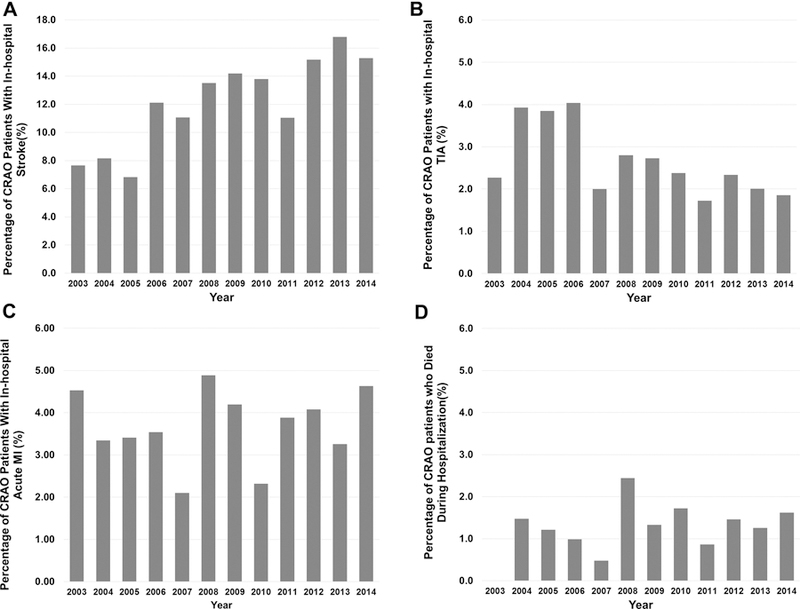
Results: There were an estimated 17 117 CRAO inpatient admissions. The mean age was 68.4 ± 0.1 years and 53% of patients were female. The incidence of in-hospital stroke and acute MI were 12.9% and 3.7%. The incidence of stroke showed an increasing trend over the years, almost doubling in 2014 in comparison to 2003 (15.3% vs 7.7%). The combined risk of in-hospital stroke, transient ischemic attack, acute MI, or mortality was 19%. Female sex, hypertension, carotid artery stenosis, aortic valve disease, smoking, and alcohol dependence or abuse were positive predictors of in-hospital stroke.
Conclusion: There is a significant burden of vascular risk factors, associated with an increased risk of in-hospital stroke, acute MI, and death in CRAO patients. The risk of CRAO-associated stroke is highest in women and in those with a history of hypertension, carotid artery stenosis, aortic valve disease, smoking, or alcohol abuse.
Copyright © 2019 Elsevier Inc. All rights reserved.
Figures
References
-
- Hayreh SS, Zimmerman MB. Central retinal artery occlusion: visual outcome. Am J Ophthalmol 2005;140(3):376–391. - PubMed
-
- Savino PJ, Glaser JS, Cassady J. Retinal stroke. Is the patient at risk? Arch Ophthalmol 1977;95(7):1185–1189. - PubMed
-
- Schumacher M, Schmidt D, Jurklies B, et al. Central retinal artery occlusion: local intra-arterial fibrinolysis versus conservative treatment, a multicenter randomized trial. Ophthalmology 2010;117(7):1367–1375.e1361. - PubMed
-
- Chen CS, Lee AW, Campbell B, et al. Efficacy of intravenous tissue-type plasminogen activator in central retinal artery occlusion: report from a randomized, controlled trial. Stroke 2011;42(8):2229–2234. - PubMed
MeSH terms
Grants and funding
LinkOut - more resources
Full Text Sources
Medical
