


Measuring growth and medium- and longer-term outcomes in malnourished children
- PMID: 30690903
- PMCID: PMC7199054
- DOI: 10.1111/mcn.12790
Measuring growth and medium- and longer-term outcomes in malnourished children
Abstract
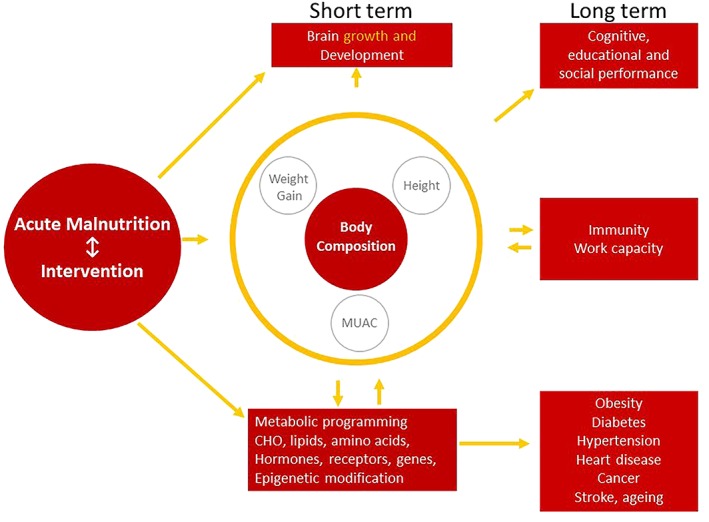
Severe and moderate acute malnutrition are among the leading causes of mortality among children in low- and middle-income countries. There is strong evidence that growth assessed anthropometrically from conception to 2 years of age marks later risk of ill health. This is central to the concept of the developmental origins of adult disease and is presumed to be related to modification of developmental processes during critical "window(s)" of vulnerability. Interventions to treat acute malnutrition have resulted in dramatic increase in the number of affected children surviving. Ensuring that these children thrive to fulfil their full physical and cognitive potential is a new challenge. Integral to this challenge is the need to be able to measure how earlier insults relate to the ability to survive and thrive to productive adulthood. Despite its obvious value, routine anthropometry does not adequately indicate how earlier adverse exposures affect more refined aspects of growth. Anthropometry is inadequate for predicting how disruption of healthy growth might modulate risk of disease or any subsequent interventions that correct this risk. A clear characterisation of healthy child growth is needed for determining which component best predicts later outcomes. The extent to which postnatal acute malnutrition is a consequence of maternal factors acting preconception or in utero and their relationship to postnatal health and long-term risk of non-communicable diseases is not clear. Body-composition measurement has significant untapped potential allowing us to translate and better understand the relationship between early insults and interventions on early growth in the short-term and long-term health outcomes.
Keywords: DoHaD; acute malnutrition; assessment of nutritional status; body composition; chronic disease; growth.
© 2019 John Wiley & Sons Ltd.
Conflict of interest statement
The authors declare that they have no conflicts of interest.
Figures
References
-
- Angood, C . (2014). Review of the links between wasting and stunting (WaSt). Retrieved from http://www.ennonline.net/ourwork/reviews/wastingstunting
-
- Arnold, B. , Null, C. , Luby, S. P. , & Colford, J. M. Jr. (2018). Implications of WASH benefits trials for water and sanitation. Lancet, 6, e616–e617. - PubMed
Publication types
MeSH terms
Grants and funding
LinkOut - more resources
Full Text Sources
Medical
