Review
. 2019 Jan 26;11(2):145.
doi: 10.3390/cancers11020145.

Calcium Signaling in Brain Cancers: Roles and Therapeutic Targeting

Affiliations
Review

Calcium Signaling in Brain Cancers: Roles and Therapeutic Targeting

Ahmed Maklad et al. Cancers (Basel). .

Abstract

Calcium signaling, in addition to its numerous physiological roles, is also implicated in several pathological conditions including cancer. An increasing body of evidence suggest critical roles of calcium signaling in the promotion of different aspects of cancer, including cell proliferation, therapy resistance and metastatic-related processes. In many cases, this is associated with altered expression and/or activity of some calcium channels and pumps. Brain cancers have also been the subject of many of these studies. In addition to diverse roles of calcium signals in normal brain function, a number of proteins involved in calcium transport are implicated to have specific roles in some brain cancers including gliomas, medulloblastoma, neuroblastoma and meningioma. This review discusses research that has been conducted so far to understand diverse roles of Ca2+-transporting proteins in the progression of brain cancers, as well as any attempts to target these proteins towards a therapeutic approach for the control of brain cancers. Finally, some knowledge gaps in the field that may need to be further considered are also discussed.

Keywords: brain cancers; calcium signaling; therapeutic targeting.


Conflict of interest statement

The authors declare no conflict of interest.

Figures
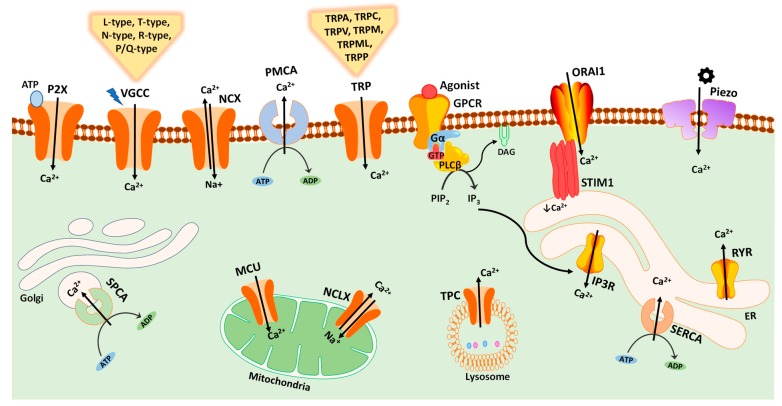
Figure 1
Figure 1
Schematic representation of major calcium channels, pumps, exchangers and sensors in mammalian cells. Ca2+ influx is mediated by plasma membrane channels including transient receptor potential (TRP) channels, voltage-gated calcium channels (VGCC), ligand-gated ionotropic P2X receptors, mechanosensitive Piezo channels, and store-operated Ca2+ entry pathway mediated by stromal interaction molecule 1 (STIM1) sensor and ORAI1 channels. Distribution of Ca2+ against a chemical gradient across cell compartments is regulated by Ca2+ pumps including the plasma membrane Ca2+-ATPase (PMCA), Sarcoplasmic/endoplasmic reticulum Ca2+-ATPase (SERCA), and Golgi network secretory pathway Ca2+/Mn2+-ATPase (SPCA). The endoplasmic reticulum (ER) Ca2+ channels include ryanodine receptor (RYR) and inositol 1,4,5-trisphosphate (IP3) receptor (IP3R); the latter is activated by IP3 ligand produced by the plasma membrane G protein-coupled receptor (GPCR) via Gaq and phospholipase C-β (PLCβ) proteins. Two-pore channels (TPC) regulate Ca2+ release from the endolysosomal system. Mitochondrial Ca2+ levels are controlled by mitochondrial calcium uniporter (MCU) complex, and mitochondrial Na+/Ca2+ exchanger (NCLX).
Figure 2
Figure 2
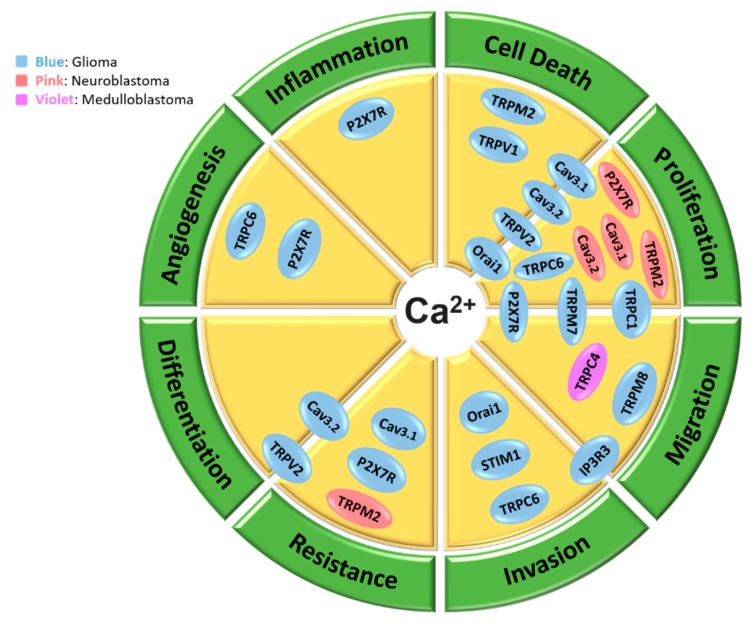
Schematic representation of biological processes that are promoted by Ca2+ signaling proteins in brain cancer cells. Several Ca2+ channels are shown to contribute to various pro-tumor processes in glioma cells (blue color), neuroblastoma cells (pink color) and medulloblastoma cells (violet color). These processes include proliferation, migration, invasion, therapy resistance/therapy sensitivity, differentiation, angiogenesis, inflammation and cell death. Proteins that are positioned on the borders of two processes, contribute to both processes.

References

    1. Prevarskaya N., Ouadid-Ahidouch H., Skryma R., Shuba Y. Remodelling of Ca2+ transport in cancer: How it contributes to cancer hallmarks? Philos. Trans. R. Soc. B. 2014;369 doi: 10.1098/rstb.2013.0097. - DOI - PMC - PubMed
    1. Berridge M.J., Bootman M.D., Roderick H.L. Calcium signalling: Dynamics, homeostasis and remodelling. Nat. Rev. Mol. Cell Biol. 2003;4:517–529. doi: 10.1038/nrm1155. - DOI - PubMed
    1. Monteith G.R., Prevarskaya N., Roberts-Thomson S.J. The calcium-cancer signalling nexus. Nat. Rev. Cancer. 2017;17:367–380. doi: 10.1038/nrc.2017.18. - DOI - PubMed
    1. Monteith G.R., Davis F.M., Roberts-Thomson S.J. Calcium channels and pumps in cancer: Changes and consequences. J. Biol. Chem. 2012;287:31666–31673. doi: 10.1074/jbc.R112.343061. - DOI - PMC - PubMed
    1. Roderick H.L., Cook S.J. Ca2+ signalling checkpoints in cancer: Remodelling Ca2+ for cancer cell proliferation and survival. Nat. Rev. Cancer. 2008;8:361–375. doi: 10.1038/nrc2374. - DOI - PubMed

LinkOut - more resources