Review
. 2019 Jan 27;8(2):90.
doi: 10.3390/cells8020090.

Aquaporin-4 Water Channel in the Brain and Its Implication for Health and Disease

Affiliations
Review

Aquaporin-4 Water Channel in the Brain and Its Implication for Health and Disease

Simone Mader et al. Cells. .

Abstract

Aquaporin-4 (AQP4) is a water channel expressed on astrocytic endfeet in the brain. The role of AQP4 has been studied in health and in a range of pathological conditions. Interest in AQP4 has increased since it was discovered to be the target antigen in the inflammatory autoimmune disease neuromyelitis optica spectrum disorder (NMOSD). Emerging data suggest that AQP4 may also be implicated in the glymphatic system and may be involved in the clearance of beta-amyloid in Alzheimer's disease (AD). In this review, we will describe the role of AQP4 in the adult and developing brain as well as its implication for disease.

Keywords: aquaporin-4; autoantibodies; development; disease; glymphatic system; neuromyelitis optica spectrum disorder.


Conflict of interest statement

The authors declare no conflict of interest.

Figures
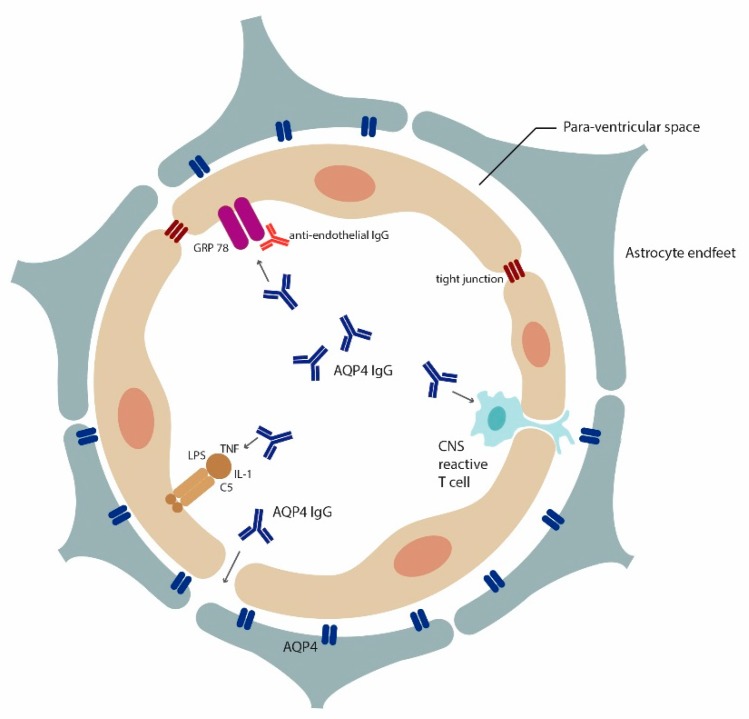
Figure 1
Figure 1
Multiple mechanisms for AQP4-IgG access to the brain: Insights from rodent models. Cross section of a blood vessel demonstrating how AQP4-IgG can enter the brain according to findings from rodent models. BBB breach can occur through encephalitogenic CNS reactive T cells [59,60], inflammatory agents [67] (LPS, TNF alpha, IL-1) and antibodies that alter endothelial cells functional (e.g., anti-GRP78 antibodies [64]). Recently, it was postulated that high affinity AQP4-IgG could enter the brain through circumventricular organs and meningeal or even parenchymal blood vessels without prior BBB insult [65].
Figure 2
Figure 2
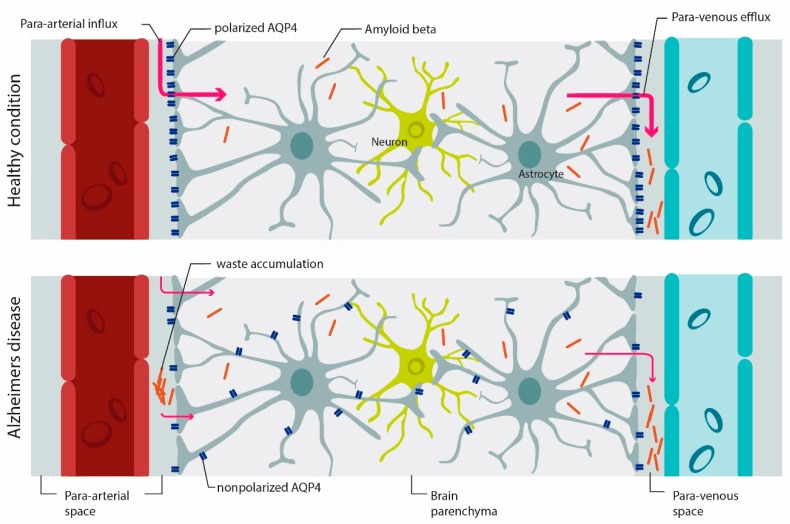
AQP4 mediates-waste clearance through the glymphatic system. In the healthy brain, AQP4 is mainly expressed on astrocyte endfeet (polarized AQP4 expression). CSF circulates through the para-arterial system (para-arterial influx) into the brain parenchyma and then into the veins (para-arterial efflux). With aging, and even more so under pathologic conditions, AQP4 polarization is reduced and there is more expression of AQP4 on parenchymal processes (AQP4 depolarization), which affects the efficiency of the glymphatic system in waste clearance such as beta-amyloid. Accumulation of beta-amyloid is a hallmark of AD [98]. Image modified from [100,101].

References

    1. Badaut J., Brunet J.F., Regli L. Aquaporins in the brain: From aqueduct to “multi-duct”. Metab. Brain Dis. 2007;22:251–263. doi: 10.1007/s11011-007-9057-2. - DOI - PubMed
    1. Rash J.E., Yasumura T., Hudson C.S., Agre P., Nielsen S. Direct immunogold labeling of aquaporin-4 in square arrays of astrocyte and ependymocyte plasma membranes in rat brain and spinal cord. Proc. Natl. Acad. Sci. USA. 1998;95:11981–11986. doi: 10.1073/pnas.95.20.11981. - DOI - PMC - PubMed
    1. Nielsen S., Nagelhus E.A., Amiry-Moghaddam M., Bourque C., Agre P., Ottersen O.P. Specialized membrane domains for water transport in glial cells: High-resolution immunogold cytochemistry of aquaporin-4 in rat brain. J. Neurosci. 1997;17:171–180. doi: 10.1523/JNEUROSCI.17-01-00171.1997. - DOI - PMC - PubMed
    1. Hasegawa H., Ma T., Skach W., Matthay M.A., Verkman A.S. Molecular cloning of a mercurial-insensitive water channel expressed in selected water-transporting tissues. J. Biol. Chem. 1994;269:5497–5500. - PubMed
    1. Jung J.S., Bhat R.V., Preston G.M., Guggino W.B., Baraban J.M., Agre P. Molecular characterization of an aquaporin cDNA from brain: Candidate osmoreceptor and regulator of water balance. Proc. Natl. Acad. Sci. USA. 1994;91:13052–13056. doi: 10.1073/pnas.91.26.13052. - DOI - PMC - PubMed

Publication types

LinkOut - more resources