Review
. 2019 Jan 27:70:151-166.
doi: 10.1146/annurev-med-120417-091431.

DNA Methylation and Susceptibility to Autism Spectrum Disorder

Affiliations
Review

DNA Methylation and Susceptibility to Autism Spectrum Disorder

Martine W Tremblay et al. Annu Rev Med. .

Abstract

The prevalence of autism spectrum disorder (ASD) has been increasing steadily over the last 20 years; however, the molecular basis for the majority of ASD cases remains unknown. Recent advances in next-generation sequencing and detection of DNA modifications have made methylation-dependent regulation of transcription an attractive hypothesis for being a causative factor in ASD etiology. Evidence for abnormal DNA methylation in ASD can be seen on multiple levels, from genetic mutations in epigenetic machinery to loci-specific and genome-wide changes in DNA methylation. Epimutations in DNA methylation can be acquired throughout life, as global DNA methylation reprogramming is dynamic during embryonic development and the early postnatal period that corresponds to the peak time of synaptogenesis. However, technical advances and causative evidence still need to be established before abnormal DNA methylation and ASD can be confidently associated.

Keywords: DNA methylation; autism spectrum disorder; epimutation.


Figures
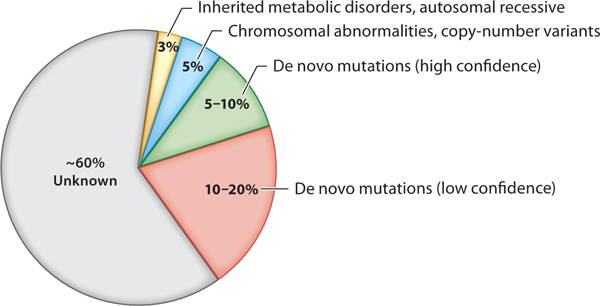
Figure 1
Figure 1
Genetic breakdown of autism spectrum disorder (ASD) (–9). Although the cause of most ASD cases is unknown, ASD has a strong genetic component. Approximately 40% of cases can be attributed to genetic abnormalities, which can include mutations inherited from a parent (autosomal recessive mutations, yellow), large-scale chromosomal rearrangements or copy-number variants (blue), and de novo mutations in the coding regions of the genome. Approximately 5–10% of de novo mutations are high confidence (green); however, this number may grow in the future as causative evidence of putative mutations is established and understanding of non-protein-coding variants expands (red).
Figure 2
Figure 2
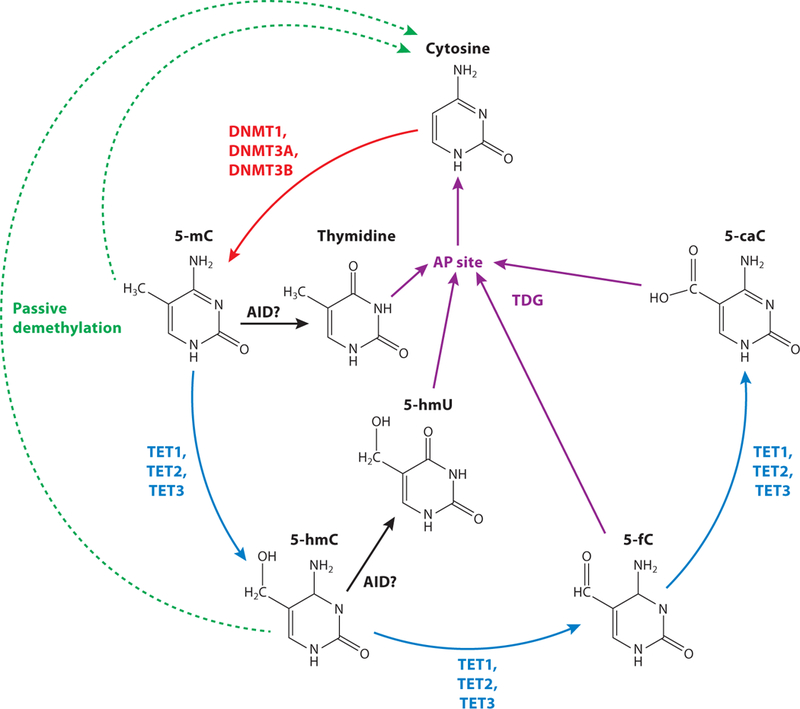
DNA methylation pathway (27, 28, 32). Cytosine can be methylated by DNA methyltransferases (DNMT, red) to create 5-methylcytosine (5mC). The ten-eleven translocation (TET) family of proteins (blue) catalyze the stepwise oxidation of 5mC to create 5-hydroxymethylcytosine (5-hmC), 5-formylcytosine (5-fC), and 5-carboxylcytosine (5-caC). Methylated DNA can be passively demethylated (green dashed arrows) through cell division. 5-mC and 5-hmC are proposed to be deaminated by activation-induced cytidine deaminase (AID, black) and APOBEC proteins (not shown) to form thymidine and 5-hydroxymethyluracil (5-hmU), respectively. Thymidine, 5-hmU, 5-fC, and 5-CaC can all be excised by thymidine DNA glycosylase (TDG) to create an abasic site (AP site), which is repaired through the base excision repair pathway (purple).
Figure 3
Figure 3
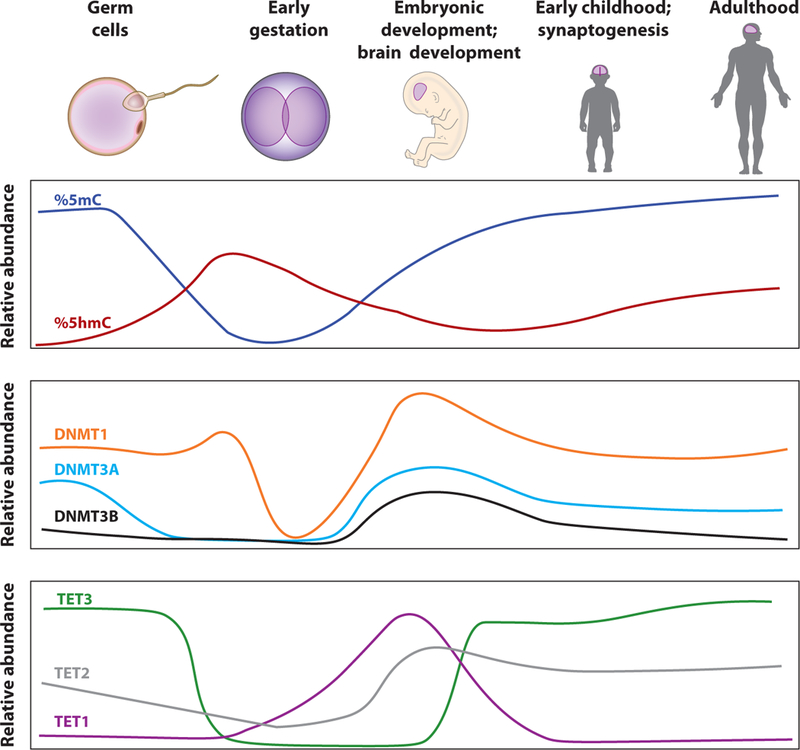
DNA methylation dynamics during brain development (–42). Levels of 5mC, 5hmC, DNMTs, and TETs fluctuate during development. Although most knowledge of this process has come from mouse models, the overall process is believed to be highly conserved in humans. Relative abundances of 5mC and 5hmC not drawn to scale.
Figure 4
Figure 4
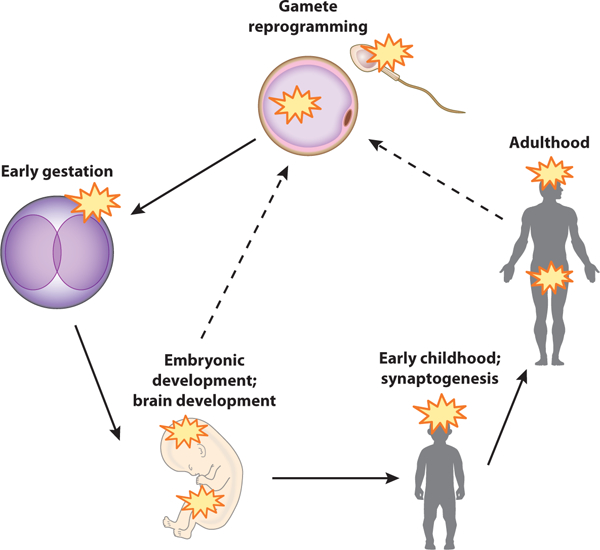
Proposed epimutation hot spot model. DNA methylation epimutations can be acquired at multiple time points in the life cycle. Epimutation hot spots (yellow stars) include pronuclear reprogramming following fertilization, primordial germ cell reprogramming and brain development in the embryo, early childhood and postgestational synaptogenesis, and adult maintenance of synapse function and plasticity. Transgenerational inheritance of epimutations from parental germ cells has also been proposed (dashed lines).

References

    1. American Psychiatric Association. 2013. Diagnostic and Statistical Manual of Mental Disorders: DSM-5. Washington, DC: Am. Psychiatr. Assoc.
    1. Baio J, Wiggins L, Christensen DL, et al. 2018. Prevalence of autism spectrum disorder among children aged 8 years—Autism and Developmental Disabilities Monitoring Network, 11 sites, United States, 2014. MMWR Surveill. Summ. 67:1–23 - PMC - PubMed
    1. Folstein SE, Rosen-Sheidley B. 2001. Genetics of autism: complex aetiology for a heterogeneous disorder. Nat. Rev. Genet. 2:943–55 - PubMed
    1. Jiang YH, Wang Y, Xiu X, et al. 2014. Genetic diagnosis of autism spectrum disorders: the opportunity and challenge in the genomics era. Crit. Rev. Clin. Lab. Sci. 51:249–62 - PMC - PubMed
    1. Willsey AJ, State MW. 2015. Autism spectrum disorders: from genes to neurobiology. Curr. Opin. Neurobiol. 30C:92–99 - PMC - PubMed

Publication types