. 2019 Jan 28;19(1):9.
doi: 10.1186/s12896-019-0501-2.

CRISPR-Cas9 mediated targeted disruption of FAD2-2 microsomal omega-6 desaturase in soybean (Glycine max.L)

Affiliations

CRISPR-Cas9 mediated targeted disruption of FAD2-2 microsomal omega-6 desaturase in soybean (Glycine max.L)

Noor Al Amin et al. BMC Biotechnol. .

Erratum in

Abstract

Background: Recent innovation in the field of genome engineering encompasses numerous levels of plant genome engineering which attract the substantial excitement of plant biologist worldwide. RNA-guided CRISPR Cas9 system has appeared a promising tool in site-directed mutagenesis due to its innovative utilization in different branches of biology. CRISPR-Cas9 nuclease system have supersedes all previously existed strategies and their associated pitfalls encountered with site-specific mutagenesis.

Results: Here we demonstrated an efficient sequence specific integration/mutation of FAD2-2 gene in soybean using CRISPR-Cas9 nuclease system. A single guided RNA sequence was designed with the help of a number of bioinformatics tools aimed to target distinct sites of FAD2-2 loci in soybean. The binary vector (pCas9-AtU6-sgRNA) has been successfully transformed into soybean cotyledon using Agrobacterium tumafacien. Taken together our findings complies soybean transgenic mutants subjected to targeted mutation were surprisingly detected in our target gene. Furthermore, the detection of Cas9 gene, BAR gene, and NOS terminator were carried out respectively. Southern blot analysis confirmed the stable transformation of Cas9 gene into soybean. Real time expression with qRT-PCR and Sanger sequencing analysis confirmed the efficient CRISPR-Cas9/sgRNA induced mutation within the target sequence of FAD2-2 loci. The integration of FAD2-2 target region in the form of substitution, deletions and insertions were achieved with notably high frequency and rare off-target mutagenesis.

Conclusion: High frequent mutation efficiency was recorded as 21% out of all transgenic soybean plants subjected to targeted mutagenesis. Furthermore, Near-infrared spectroscopy (NIR) indicates the entire fatty acid profiling obtained from the mutants seeds of soybean. A considerable modulation in oleic acid content up to (65.58%) whereas the least level of linoleic acid is (16.08%) were recorded. Based on these finding CRISPR-Cas9 system can possibly sum up recent development and future challenges in producing agronomically important crops.

Keywords: CRISPR-Cas9; FAD2–2; Oleic acid; Soybean; Targeted mutagenesis.


Conflict of interest statement

Ethics approval and consent to participate

Not applicable.

Consent for publication

Not applicable.

Competing interests

The authors declare that they have no competing interests.

Publisher’s Note

Springer Nature remains neutral with regard to jurisdictional claims in published maps and institutional affiliations.

Figures

Fig. 1
Fig. 1
The schematic diagram of CRISPR-Cas9 binary vector (BGK041). This system includes 19 bp long Synthetic guide RNA (sgRNA), NOS terminator: NOS terminator is used for the termination signal of the gene expression, small U6 expression cassettes derived from soybean, CaMV 35S: promoter used to express the glufosinate resistant gene, BAR gene: A reporter herbicide resistance gene, LB: left border and RB: right border
Fig. 2
Fig. 2
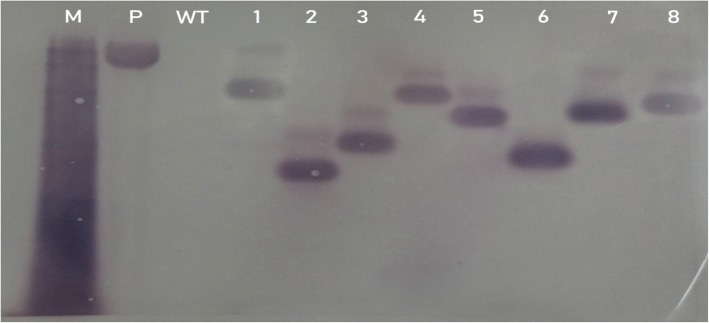
Detection of transgenic soybean plants. a Detection of CRISPR-Cas9 binary vector in Agrobacterium strain (EH105) using CRISPR specific primers where M: represents Marker or ladder and lanes 1–6 represents positive colons. b PCR analysis of BAR gene in transgenic plants of soybean, where wild type DNA (WT) and our constructed plasmid (P) were taken as negative and positive control. From 1 to 8 revealed different positive soybean plants. c Detection of NOS terminator in soybean transgenic plants. We used plasmid as positive control while (WT) represent negative, Lanes 1 to 8 indicates NOS terminator existence in soybean transformed plants. Based on these outcomes we confirmed the existence of the binary vector in soybean transgenic plants
Fig. 3
Fig. 3
Southern blot hybridization of transgenic plants with BAR probe. The genomic DNA of 8 transgenic plants selected for detection followed by digestion of genomic DNA with restriction enzymes (HindIII and Tengo buffer). Where M represents marker, (P) positive control of plasmid, (W): Wild-type DNA, and from 1 to 8 demonstrate different transgenic plants
Fig. 4
Fig. 4
Detection of targeted mutation in transgenic soybean plants using CRISPR-Cas9 system. a PCR Detection of Cas9 gene in different soybean transgenic plants. We used plasmid DNA (P) as positive control and wild type DNA as negative (WT). The Series of 1 to 8 express different soybean transgenic plants. b The PCR product analysis of target gene (FAD2–2) of the independent transgenic plants, which is successfully cloned and subjected to sequence analysis for mutation detection. Sequences analysis revealed efficient targeted genome editing using CRISPR-Cas9 system. Red letters in the sequence indicate mutation where, S: indicate substitution, +: represent addition or insertion while/−: indicate deletion. The letters on right side show the number of transgenic plants where the mutations occurred in transgenic lines with the same type. . c Sequencing chromatograms of soybean transgenic plant. The blue color alphabets represent nucleotide substitution
Fig. 5
Fig. 5
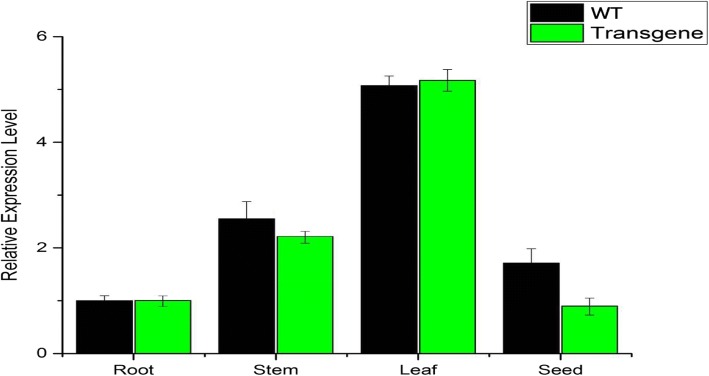
Tissue specific Quantitative real time expression analysis of CRISPR-Cas9 induced FAD2–2 gene. The relative expression level of mutant FAD2–2 gene in four different tissues of soybean including root, stem, leaf and seed. The abundance of mutant FAD2–2 transcripts was found in the leaf tissue of transgenic soybean lines. The data was normalized to that of GmActin gene (NM_001289231)
Fig. 6
Fig. 6
Agrobacterium mediated stable transformation of soybean. From A to F showed the series of different media to acquired stable transgenic soybean plants. a Sterilized soybean seeds were germinated on germination medium.b After infection with agrobacterium the seeds were planted in co-culture medium under controlled environment. c Collection of transgenic plants on a selective medium comprising 6 mg l−1glufosinate where left side medium indicates sensitivity while right side showed resistance to herbicide (glufosinate). d Glufosinate resistant seedlings were incubated on shoot elongation medium after 2 weeks. e Establishment of rootswere observed after 2 weeks of incubation on rooting medium. f A full flourish plant was shifted to sterile soil in a growth chamber

References

    1. Smith NA, Singh SP, Wang MB, Stoutjesdijk PA, Green AG, Waterhouse PM. Total silencing by intron-spliced hairpin RNAs. Nature. 2000;407:319–320. doi: 10.1038/35030305. - DOI - PubMed
    1. Girija M, Dhanavel D, Gnanamurthy S. Gamma Rays and EMS Induced Flower Color and Seed Mutants in Cowpea (Vignaunguiculata L. Walp) Advances in Applied Science Research. 2013;4:134–139.
    1. Sun X, et al. Targeted mutagenesis in soybean using the CRISPR-Cas9 system. Sci. Rep. 2015;5:10,342. doi: 10.1038/srep10342. - DOI - PMC - PubMed
    1. Feng Z, Mao Y, Xu N, Zhang B, Wei P, Yang DL, Wang Z, Zhang Z, Zheng R, Yang L, et al. Multigeneration analysis reveals the inheritance, specificity, and patterns of CRISPR/Cas-induced gene modifications in Arabidopsis. Proc. Natl. Acad. Sci. USA. 2014;111:4632–4637. doi: 10.1073/pnas.1400822111. - DOI - PMC - PubMed
    1. Zhang H, Zhang J, Wei P, Zhang B, Gou F, Feng Z, Mao Y, Yang L, Zhang H, Xu N, et al. The CRISPR/Cas9 system produces specific and homozygous targeted gene editing in rice in one generation. Plant Biotechnol J. 2014;12:797–807. doi: 10.1111/pbi.12200. - DOI - PubMed

Publication types

Substances

LinkOut - more resources