


The Neuropsychological Syndrome of Agenesis of the Corpus Callosum
- PMID: 30691545
- PMCID: PMC7989584
- DOI: 10.1017/S135561771800111X
The Neuropsychological Syndrome of Agenesis of the Corpus Callosum
Abstract
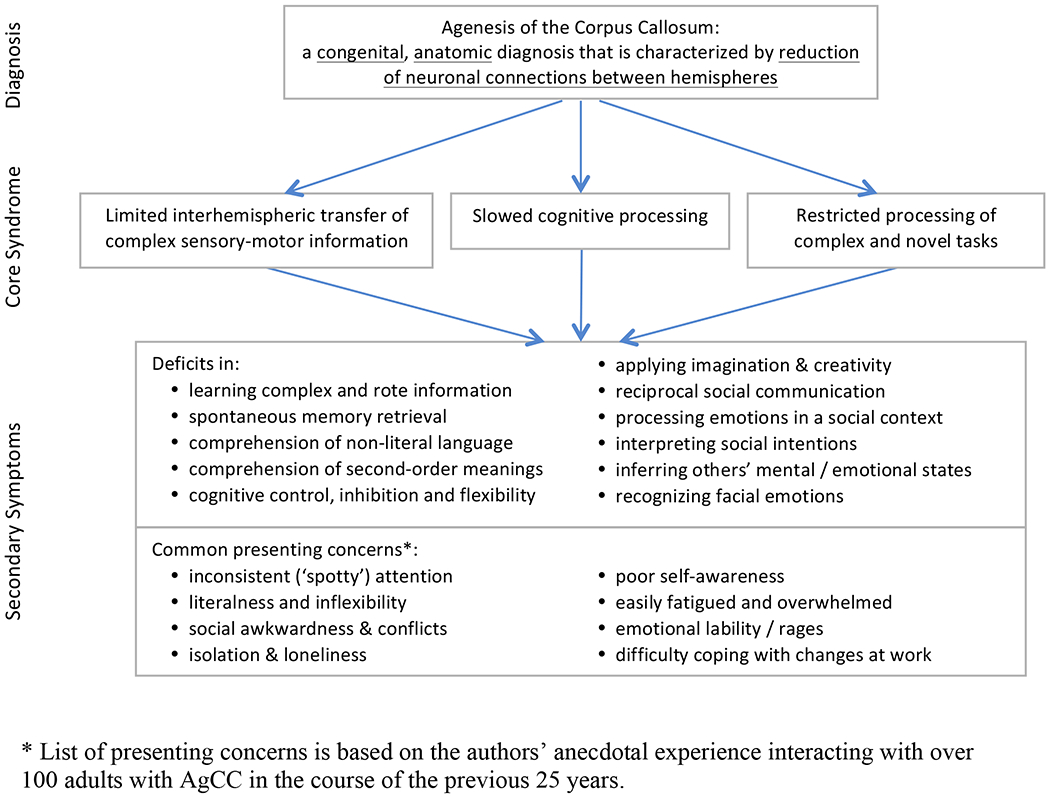
Background: Agenesis of the corpus callosum (AgCC) involves congenital absence of all or part of the corpus callosum. Because the disorder can only be firmly diagnosed via neuroradiology, it has a short research history, and only recently has the cognitive syndrome become clear.
Purpose: Our purpose is to review the primary deficits in AgCC that constitute the core syndrome.
Conclusions: The cores syndrome includes: (1) reduced interhemispheric transfer of sensory-motor information; (2) reduced cognitive processing speed; and (3) deficits in complex reasoning and novel problem-solving. These domains do not appear to reflect different neuroanatomical abnormalities, but rather different domains of expression of reduced interhemispheric communication from callosal absence.
Implications: These core deficits are expressed across various domains of cognitive, behavioral, and social functioning. The impact of these deficits varies across development and may be moderated by individual factors such as co-occurrence of other neurodevelopmental conditions, general intellectual capacity, and environmental support. (JINS, 2019, 25, 324-330).
Keywords: Agenesis of the corpus callosum; Corpus callosum.
Figures
References
-
- Bogen J, & Frederiks J (1985). Split-brain syndromes. Handbook of Clinical Neurology (Vol. 45, pp. 99–106). Amsterdam, Netherlands: Elsevier Science Publishing Co.
-
- Brown WS (1991). The Bimanual Coordination Test: Version 1. The Travis Research Institute Papers.
Publication types
MeSH terms
Grants and funding
LinkOut - more resources
Full Text Sources
