


Molecular Profiling of Appendiceal Adenocarcinoma and Comparison with Right-sided and Left-sided Colorectal Cancer
- PMID: 30692096
- PMCID: PMC6886223
- DOI: 10.1158/1078-0432.CCR-18-3388
Molecular Profiling of Appendiceal Adenocarcinoma and Comparison with Right-sided and Left-sided Colorectal Cancer
Abstract
Purpose: The natural history and prognosis of appendiceal adenocarcinomas differ from those of adenocarcinomas arising in other large bowel sites. We aimed to compare the molecular profiles exhibited by appendiceal adenocarcinomas and colorectal cancers, or between the histopathologic subtypes of appendiceal adenocarcinoma.
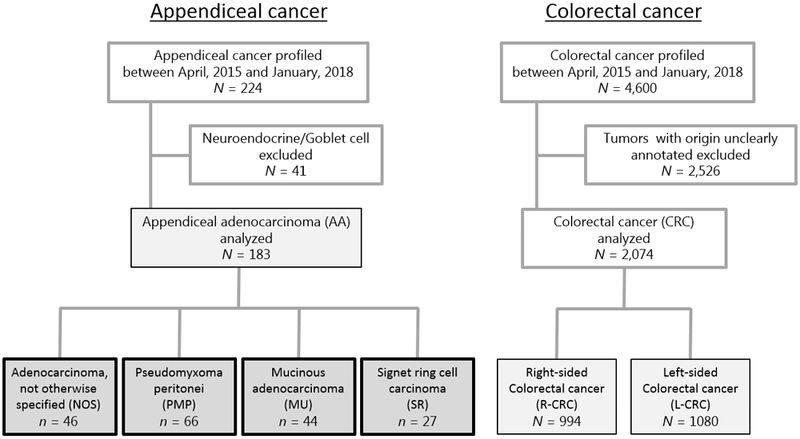
Experimental design: A total of 183 samples from appendiceal adenocarcinoma [46 adenocarcinoma, not otherwise specified (NOS), 66 pseudomyxoma peritonei (PMP), 44 mucinous adenocarcinoma (MU), and 27 signet ring cell carcinoma (SR)], 994 from right-sided colorectal cancer (R-CRC), and 1,080 from left-sided CRC (L-CRC) were analyzed by next-generation sequencing (NGS) and IHC markers. Microsatellite instability (MSI) and tumor mutational burden (TMB) were tested by NGS, and programmed death ligand 1 (PD-L1) by IHC.
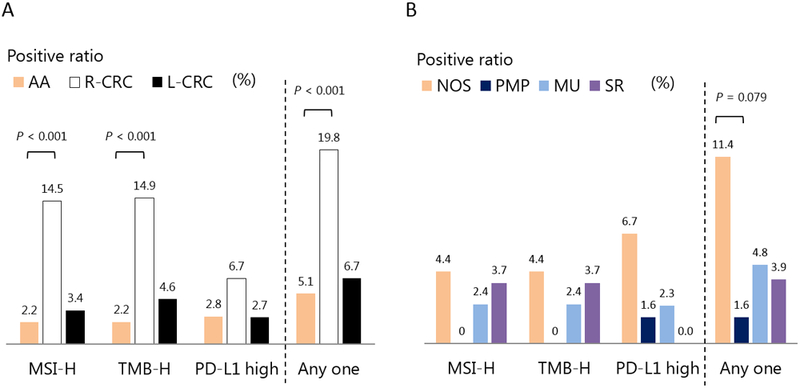
Results: We observed high mutation rates in appendiceal adenocarcinoma samples for KRAS (55%), TP53 (40%), GNAS (31%), SMAD4 (16%), and APC (10%). Appendiceal adenocarcinoma exhibited higher mutation rates in KRAS and GNAS, and lower mutation rates in TP53, APC, and PIK3CA (6%) than colorectal cancers. PMP exhibited much higher mutation rates in KRAS (74%) and GNAS (63%), and much lower mutation rates in TP53 (23%), APC (2%), and PIK3CA (2%) than NOS. Alterations associated with immune checkpoint inhibitor response (MSI-high, TMB-high, PD-L1 expression) showed similar frequency in appendiceal adenocarcinoma compared with L-CRC, but not R-CRC, and those of NOS were higher than other subtypes of appendiceal adenocarcinoma and L-CRC.
Conclusions: Molecular profiling of appendiceal adenocarcinoma revealed different molecular characteristics than noted in R-CRC and L-CRC, and molecular heterogeneity among the histopathologic subtypes of appendiceal adenocarcinoma. Our findings may be critical to developing an individualized approach to appendiceal adenocarcinoma treatment.
©2019 American Association for Cancer Research.
Conflict of interest statement
Figures
References
-
- Compton C, Fenoglio-Preiser CM, Pettigrew N, Fielding LP. American Joint Committee on Cancer Prognostic Factors Consensus Conference: Colorectal Working Group. Cancer. 2000;88:1739–57. - PubMed
-
- Turaga KK, Pappas SG, Gamblin T. Importance of histologic subtype in the staging of appendiceal tumors. Ann Surg Oncol. 2012;19:1379–85. - PubMed
-
- Carr NJ, Finch J, Ilesley IC, Chandrakumaran K, Mohamed F, Mirnezami A, et al. Pathology and prognosis in pseudomyxoma peritonei: a review of 274 cases. J Clin Pathol. 2012;65:919–23. - PubMed
-
- Carr NJ, Bibeau F, Bradley RF, Dartigues P, Feakins RM, Geisinger KR, et al. The histopathological classification, diagnosis and differential diagnosis of mucinous appendiceal neoplasms, appendiceal adenocarcinomas and pseudomyxoma peritonei. Histopathology. 2017;71:847–58. - PubMed
Publication types
MeSH terms
Substances
Grants and funding
LinkOut - more resources
Full Text Sources
Other Literature Sources
Medical
Research Materials
Miscellaneous
