


Fighting misinformation on social media using crowdsourced judgments of news source quality
- PMID: 30692252
- PMCID: PMC6377495
- DOI: 10.1073/pnas.1806781116
Fighting misinformation on social media using crowdsourced judgments of news source quality
Abstract
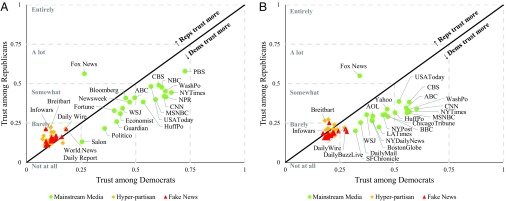
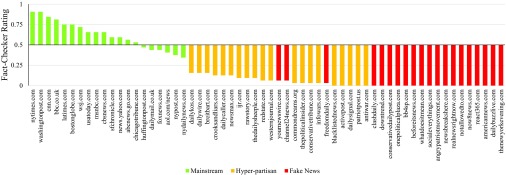
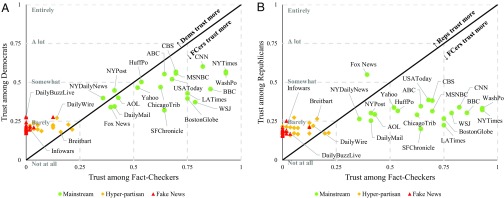
Reducing the spread of misinformation, especially on social media, is a major challenge. We investigate one potential approach: having social media platform algorithms preferentially display content from news sources that users rate as trustworthy. To do so, we ask whether crowdsourced trust ratings can effectively differentiate more versus less reliable sources. We ran two preregistered experiments (n = 1,010 from Mechanical Turk and n = 970 from Lucid) where individuals rated familiarity with, and trust in, 60 news sources from three categories: (i) mainstream media outlets, (ii) hyperpartisan websites, and (iii) websites that produce blatantly false content ("fake news"). Despite substantial partisan differences, we find that laypeople across the political spectrum rated mainstream sources as far more trustworthy than either hyperpartisan or fake news sources. Although this difference was larger for Democrats than Republicans-mostly due to distrust of mainstream sources by Republicans-every mainstream source (with one exception) was rated as more trustworthy than every hyperpartisan or fake news source across both studies when equally weighting ratings of Democrats and Republicans. Furthermore, politically balanced layperson ratings were strongly correlated (r = 0.90) with ratings provided by professional fact-checkers. We also found that, particularly among liberals, individuals higher in cognitive reflection were better able to discern between low- and high-quality sources. Finally, we found that excluding ratings from participants who were not familiar with a given news source dramatically reduced the effectiveness of the crowd. Our findings indicate that having algorithms up-rank content from trusted media outlets may be a promising approach for fighting the spread of misinformation on social media.
Keywords: fake news; media trust; misinformation; news media; social media.
Copyright © 2019 the Author(s). Published by PNAS.
Conflict of interest statement
The authors declare no conflict of interest.
Figures
References
-
- Gottfried J, Shearer E. 2016 News use across social media platforms 2016. Pew Research Center. Available at www.journalism.org/2016/05/26/news-use-across-social-media-platforms-2016/. Accessed March 2, 2017.
-
- Lazer D, et al. The science of fake news. Science. 2018;359:1094–1096. - PubMed
-
- Guess A, Nyhan B, Reifler J. 2018 Selective exposure to misinformation: Evidence from the consumption of fake news during the 2016 US presidential campaign. Available at www.dartmouth.edu/∼nyhan/fake-news-2016.pdf. Accessed February 1, 2018.
-
- Lewandowsky S, Ecker UKH, Seifert CM, Schwarz N, Cook J. Misinformation and its correction: Continued influence and successful debiasing. Psychol Sci Public Interest. 2012;13:106–131. - PubMed
-
- Ecker U, Hogan J, Lewandowsky S. Reminders and repetition of misinformation: Helping or hindering its retraction? J Appl Res Mem Cogn. 2017;6:185–192.
Publication types
MeSH terms
LinkOut - more resources
Full Text Sources
Miscellaneous
