. 2019 Mar;22(3):353-361.
doi: 10.1038/s41593-018-0320-0. Epub 2019 Jan 28.

A genome-wide association study of shared risk across psychiatric disorders implicates gene regulation during fetal neurodevelopment

Affiliations

A genome-wide association study of shared risk across psychiatric disorders implicates gene regulation during fetal neurodevelopment

Andrew J Schork et al. Nat Neurosci. 2019 Mar.

Abstract

There is mounting evidence that seemingly diverse psychiatric disorders share genetic etiology, but the biological substrates mediating this overlap are not well characterized. Here we leverage the unique Integrative Psychiatric Research Consortium (iPSYCH) study, a nationally representative cohort ascertained through clinical psychiatric diagnoses indicated in Danish national health registers. We confirm previous reports of individual and cross-disorder single-nucleotide polymorphism heritability for major psychiatric disorders and perform a cross-disorder genome-wide association study. We identify four novel genome-wide significant loci encompassing variants predicted to regulate genes expressed in radial glia and interneurons in the developing neocortex during mid-gestation. This epoch is supported by partitioning cross-disorder single-nucleotide polymorphism heritability, which is enriched at regulatory chromatin active during fetal neurodevelopment. These findings suggest that dysregulation of genes that direct neurodevelopment by common genetic variants may result in general liability for many later psychiatric outcomes.


Conflict of interest statement

Competing Interests Statement

The authors declare no competing interests.

Figures
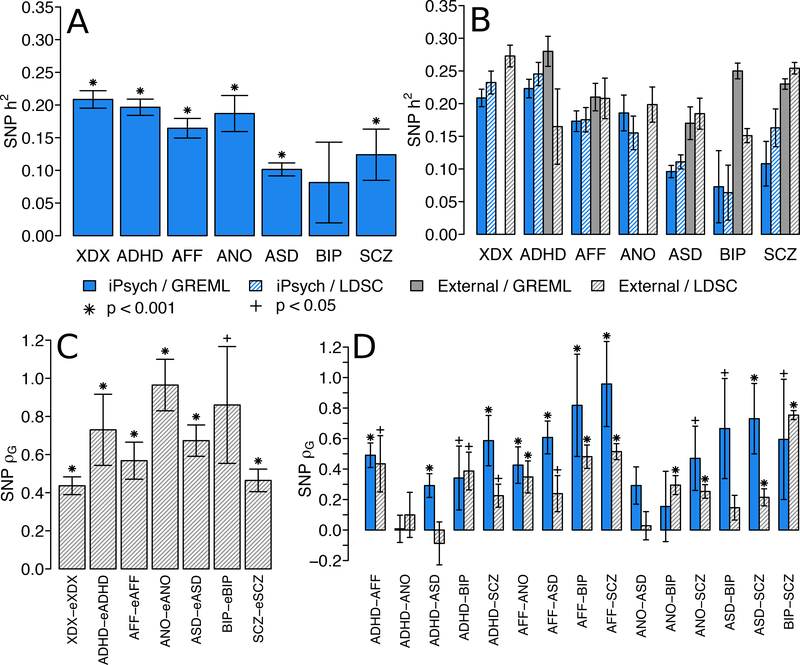
Figure 1.
Figure 1.
SNP heritability and genetic correlation estimates for iPSYCH indications. (A) Liability scale genetic restricted maximum likelihood (GREML) SNP-heritability estimates of iPSYCH indications according to Danish population lifetime risk. Significance determined by likelihood ratio test (LRT), one tailed p-value. Sample sizes and statistics in Supplementary Table 3. (B) Liability scale SNP-heritability estimates according to typical lifetime risk estimates for each disorder are estimated in iPSYCH and taken from external studies, using both GREML and LD-score regression (LDSC). Sample sizes and statistics in Supplementary Table 4. (C) LDSC SNP-based genetic correlations between iPSYCH and external studies for the same disorders. Significance determined by two-sided z-test. Sample sizes and statistics in Supplementary Table 5. (D) SNP-based genetic correlations among iPSYCH indications estimated via GREML and among external studies estimated via LDSC. For GREML, significance determined by one-sided LRT with sample sizes and statistics in Supplementary Table 6. For LDSC, significance determined by two-sided z-test with sample sizes and statistics in Supplementary Table 8. All error bars denote estimate standard errors of estimates. Bar color denotes data source and shading denotes estimation method. Star symbols denote significance after Bonferroni correction for 44 variance component estimates (p < 0.001). Cross symbols denote nominal significance (p < 0.05).XDX, cross-diagnosis; ADHD, attention-deficit, hyperactivity disorder; AFF, affective disorder; ANO, anorexia; ASD, autism-spectrum disorder; BIP, bipolar disorder; SCZ, schizophrenia; OTH, other indications not falling within individual disorder categories.
Figure 2.
Figure 2.
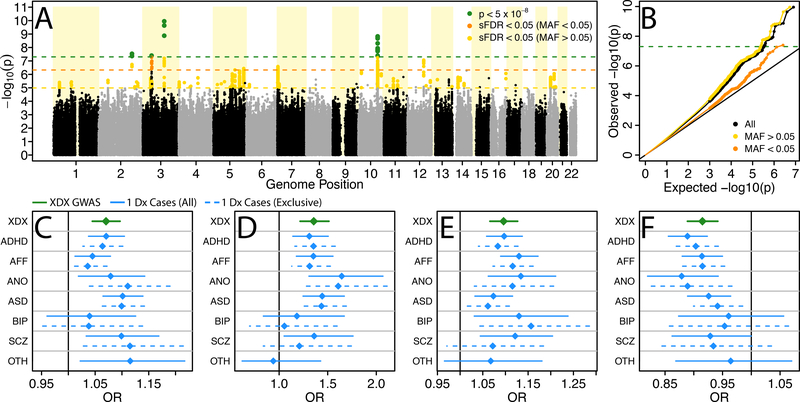
Cross-diagnosis genome-wide association study results. (A) Manhattan plot depicting −log10 of two-tailed p-values from case-control logistic regression association tests at 8,018,013 imputed SNP dosages in 46,008 cases and 19,526 controls identifies four genome-wide significant loci (green) and 46 suggestive loci (gold, orange). (B) QQ-plot comparing the distribution of -log10 association p-values to that expected under the global null hypothesis. For each genome-wide significant locus, 1 (C), 2 (D), 3 (E), and 4 (F), ordered as in the Manhattan plot, the odds ratio (OR) and approximate 95% confidence interval (CI) for the SNP from the XDX GWAS (green) is similar in sign and magnitude to ORs from associations with single indication case groups (blue). Sample sizes for single indication GWAS cohorts described in Supplementary Table 1 and full association statistics in Supplementary Tables 10–11. sFDR, stratified false discovery rate; MAF, minor allele frequency; Dx, diagnosis; XDX, cross-diagnosis; ADHD, attention-deficit, hyperactivity disorder; AFF, affective disorder; ANO, anorexia; ASD, autism-spectrum disorder; BIP, bipolar disorder; SCZ, schizophrenia; OTH, other indications not falling within individual disorder categories.
Figure 3.
Figure 3.
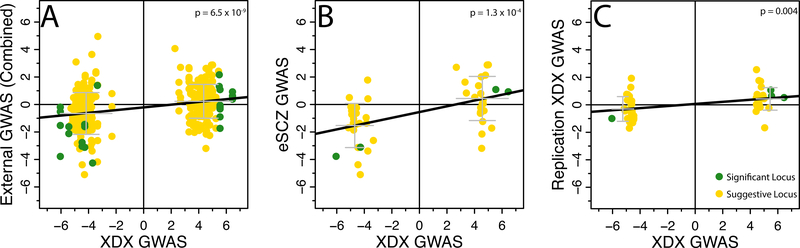
Consistency of effects in Independent studies. (A) iPSYCH XDX GWAS z-scores are associated with z-scores of the best proxy SNP in eADHD, eAFF, eANO, eASD, eBIP, eSCZ, eSR-MDD, and eXDX in aggregation (N=350 z-score pairs; linear regression: β = 0.10, s.e. = 0.02; t = 5.95; Supplementary Table 13), (B) iPSYCH XDX GWAS z-scores are associated with z-scores of the best proxy SNP in eSCZ only (N=50 z-score pairs; linear regression: β = 0.21, s.e. = 0.05; t = 4.16), and (C) iPSYCH XDX GWAS z-scores are associated with iPSYCH internal replication z-scores (N=50 z-score pairs; linear regression: β = 0.08, s.e. = 0.03; t = 3.01; Supplementary Table 14). Black lines show regression fit. Grey bars depict the mean and one standard deviation interval of replication effects for SNPs with positive or negative effects in the XDX GWAS. Bonferroni correction for 10 concordance tests, p < 0.005.
Figure 4.
Figure 4.
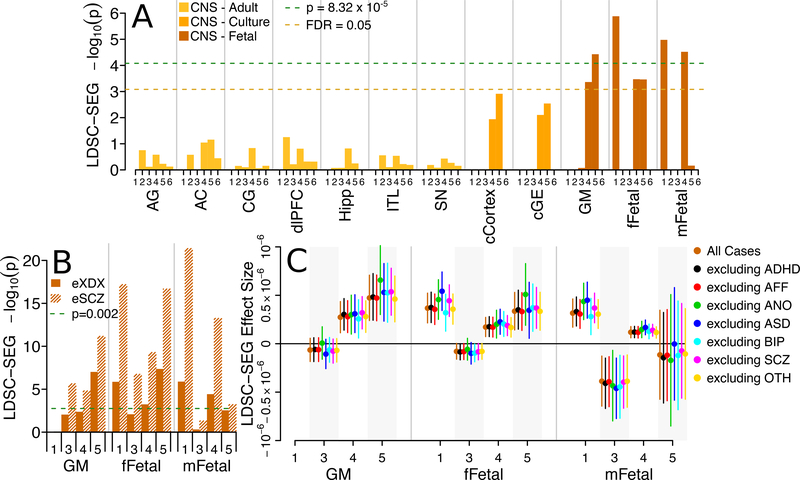
LDSC-SEG heritability partitioning. (A) −log10 one-sided p-values from LDSC-SEG enrichment tests for the iPSYCH XDX GWAS (n=46,008 cases, 19,526 controls) highlight significant (two-tailed p < 8.32×10⁻⁵, Bonferroni correction for 601 LDSC-SEG enrichment tests) and/or suggestive (FDR < 0.05) enrichment for heritability in SNP sets related to gene regulation in fetal brain tissue. Exact p-values and effect sizes in Supplementary Table 17. (B) −log10 one-sided LDSC-SEG enrichment test p-values for the same fetal brain SNP sets in the eSCZ (n=34,241 cases, 45,604 controls) and eXDX (n=33,332 cases, 27,888 controls) GWAS replicate enrichments (two-tailed p < 0.002, Bonferroni correction for 24 replication enrichment tests). Exact p-values and effect sizes in Supplementary Table 19. (C) The magnitude of LDSC-SEG enrichment effect estimates for fetal brain tissues in the XDX GWAS (orange) are not qualitatively different when excluding single case groups (non-orange). Grey shading denotes bunches of estimate replicates. Bars denote 95% confidence intervals. Exact effect sizes and sample sizes in Supplementary Table 20. CNS, central nervous system; Axis numbers (A,B,C) denote SNPs sets defined by narrow peaks of 1, DNase, DNase I Hypersensitivity; 2, H3K27ac, Histone H3, Lysine 27 acetylation; 3, H3K36me3, Histone H3, Lysine 36 tri-methylation; 4, H3K4me, Histone H3, Lysine 4 methylation; 5, H3K4me3, Histone H3, Lysine 4 tri-methylation; 6, H3K9ac, Histone H3, Lysine 9 acetylation. AG, Adult Angular Gyrus; AC, Adult Anterior Caudate; CG, Adult Cingulate Gyrus; dlPFC, Adult Dorsolateral Prefrontal Cortex; Hipp, Adult Hippocampus; ITL, Adult Inferior Temporal Lobe; SN, Adult Substantia Nigra; cCortex, Cortex Derived Cultured Neurospheres; cGE, Ganglion Eminence Derived Cultured Neurospheres; GM, Gemrinal Matrix; fFetal, female Fetal Brain; mFetal, male Fetal Brain; eXDX, external cross-disorder GWAS; eSCZ, external schizophrenia GWAS; ADHD, attention-deficit, hyperactivity disorder; AFF, affective disorder; ANO, anorexia; ASD, autism-spectrum disorder; BIP, bipolar disorder; SCZ, schizophrenia; OTH, other indications not falling within individual disorder categories.
Figure 5.
Figure 5.
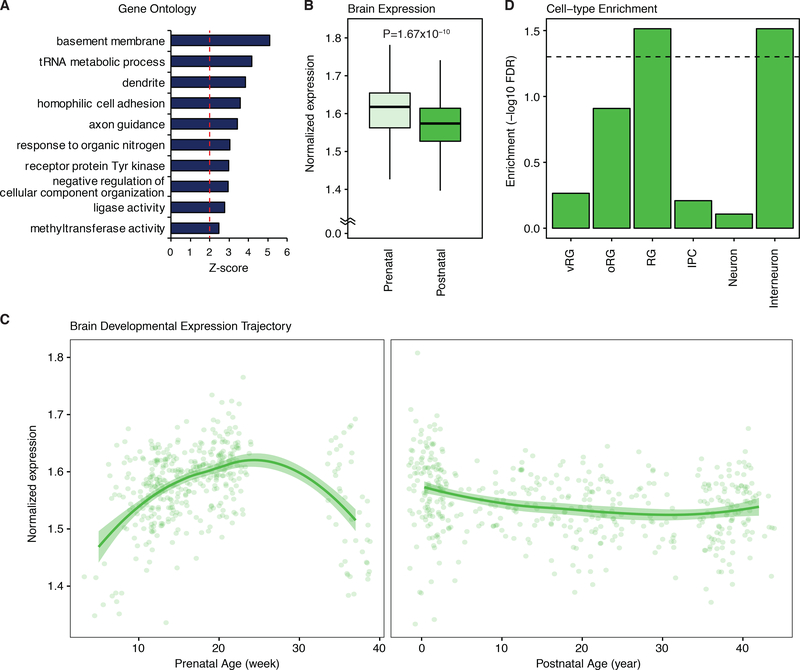
Candidate gene set enrichments for neurodevelopmental processes. (A) Top ten gene ontology categories significantly enriched among the 281 XDX candidate genes. (B) The XDX candidate genes have higher average cortical expression in the prenatal stage. P-value calculated by two-sided t-test. Box center is the median, box border denotes 1st–3rd quartiles (Q), the lower whisker, Q1 – 1.5 × interquartile range (IQR), and the upper whisker, Q3 + 1.5 × IQR. (C) The average cortical expression trajectory for XDX candidate genes peaks during midgestation. LOESS smooth curve with shading showing 95% confidence bands. N=410 and 453 for prenatal and postnatal samples, respectively (B and C). (D) The XDX candidate genes are enriched for genes with specific expression in developing radial glia and interneurons. XDX, cross-diagnosis. RG, radial glia; vRG, ventricular radial glia; oRG, outer radial glia; IPC, intermediate progenitor cells.

Comment in

References

    1. Robins E & Guze SB Establishment of diagnostic validity in psychiatric illness: its application to schizophrenia. Am J Psychiatry 126, 983–987, doi: 10.1176/ajp.126.7.983 (1970). - DOI - PubMed
    1. Kendell R & Jablensky A Distinguishing between the validity and utility of psychiatric diagnoses. Am J Psychiatry 160, 4–12, doi: 10.1176/appi.ajp.160.1.4 (2003). - DOI - PubMed
    1. Krystal JH & State MW Psychiatric disorders: diagnosis to therapy. Cell 157, 201–214, doi: 10.1016/j.cell.2014.02.042 (2014). - DOI - PMC - PubMed
    1. O’Donovan MC & Owen MJ The implications of the shared genetics of psychiatric disorders. Nature medicine 22, 1214–1219, doi: 10.1038/nm.4196 (2016). - DOI - PubMed
    1. Doherty JL & Owen MJ Genomic insights into the overlap between psychiatric disorders: implications for research and clinical practice. Genome Med 6, 29, doi: 10.1186/gm546 (2014). - DOI - PMC - PubMed

References (Methods Only)

    1. Pedersen CB The Danish Civil Registration System. Scand J Public Health 39, 22–25, doi: 10.1177/1403494810387965 (2011). - DOI - PubMed
    1. Lynge E, Sandegaard JL & Rebolj M The Danish National Patient Register. Scand J Public Health 39, 30–33, doi: 10.1177/1403494811401482 (2011). - DOI - PubMed
    1. Mors O, Perto GP & Mortensen PB The Danish Psychiatric Central Research Register. Scand J Public Health 39, 54–57, doi: 10.1177/1403494810395825 (2011). - DOI - PubMed
    1. Norgaard-Pedersen B & Hougaard DM Storage policies and use of the Danish Newborn Screening Biobank. J Inherit Metab Dis 30, 530–536, doi: 10.1007/s10545-007-0631-x (2007). - DOI - PubMed
    1. Cross-Disorder Group of the Psychiatric Genomics Consortium. Identification of risk loci with shared effects on five major psychiatric disorders: a genome-wide analysis. Lancet 381, 1371–1379, doi: 10.1016/S0140-6736(12)62129-1 (2013). - DOI - PMC - PubMed

Publication types