


Unravelling the Interplay between Extracellular Acidosis and Immune Cells
- PMID: 30692870
- PMCID: PMC6332927
- DOI: 10.1155/2018/1218297
Unravelling the Interplay between Extracellular Acidosis and Immune Cells
Abstract
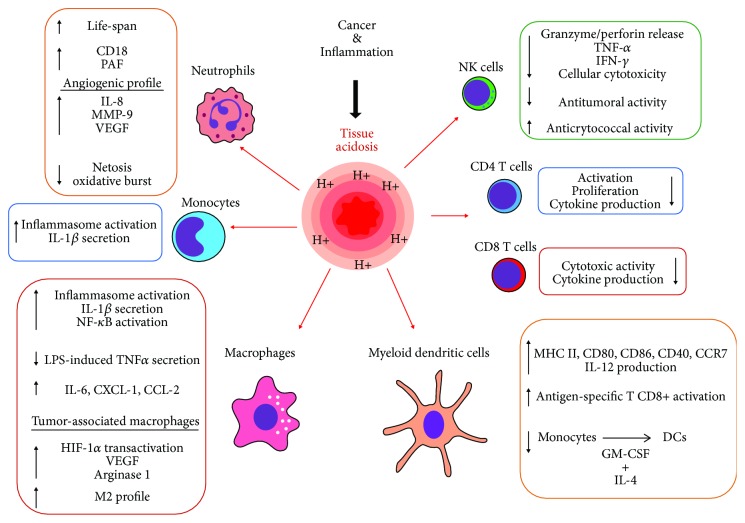
The development of an acidic tissue environment is a hallmark of a variety of inflammatory processes and solid tumors. However, little attention has been paid so far to analyze the influence exerted by extracellular pH on the immune response. Tissue acidosis (pH 6.0 to 7.0) is usually associated with the course of infectious processes in peripheral tissues. Moreover, it represents a prominent feature of solid tumors. In fact, values of pH ranging from 5.7 to 7.0 are usually found in a number of solid tumors such as breast cancer, brain tumors, sarcomas, malignant melanoma, squamous cell carcinomas, and adenocarcinomas. Both the innate and adaptive arms of the immune response appear to be finely regulated by extracellular acidosis in the range of pH values found at inflammatory sites and tumors. Low pH has been shown to delay neutrophil apoptosis, promoting their differentiation into a proangiogenic profile. Acting on monocytes and macrophages, it induces the activation of the inflammasome and the production of IL-1β, while the exposure of conventional dendritic cells to low pH promotes the acquisition of a mature phenotype. Overall, these observations suggest that high concentrations of protons could be recognized by innate immune cells as a danger-associated molecular pattern (DAMP). On the other hand, by acting on T lymphocytes, low pH has been shown to suppress the cytotoxic response mediated by CD8+ T cells as well as the production of IFN-γ by TH1 cells. Interestingly, modulation of tumor microenvironment acidity has been shown to be able not only to reverse anergy in human and mouse tumor-infiltrating T lymphocytes but also to improve the antitumor immune response induced by checkpoint inhibitors. Here, we provide an integrated view of the influence exerted by low pH on immune cells and discuss its implications in the immune response against infectious agents and tumor cells.
References
-
- Abbot N. C., Spence V. A., Swanson Beck J., Carnochan F. M. T., Gibbs J. H., Lowe J. G. Assessment of the respiratory metabolism in the skin from transcutaneous measurements of pO2 and pCO2: potential for non-invasive monitoring of response to tuberculin skin testing. Tubercle. 1990;71(1):15–22. doi: 10.1016/0041-3879(90)90055-D. - DOI - PubMed
Publication types
MeSH terms
Substances
LinkOut - more resources
Full Text Sources
Other Literature Sources
Research Materials
