Review
. 2019 Jan 23;5(1):13-28.
doi: 10.1021/acscentsci.8b00698. Epub 2018 Dec 18.

Heme and Nonheme High-Valent Iron and Manganese Oxo Cores in Biological and Abiological Oxidation Reactions

Affiliations
Review

Heme and Nonheme High-Valent Iron and Manganese Oxo Cores in Biological and Abiological Oxidation Reactions

Mian Guo et al. ACS Cent Sci. .

Abstract

Utilization of O2 as an abundant and environmentally benign oxidant is of great interest in the design of bioinspired synthetic catalytic oxidation systems. Metalloenzymes activate O2 by employing earth-abundant metals and exhibit diverse reactivities in oxidation reactions, including epoxidation of olefins, functionalization of alkane C-H bonds, arene hydroxylation, and syn-dihydroxylation of arenes. Metal-oxo species are proposed as reactive intermediates in these reactions. A number of biomimetic metal-oxo complexes have been synthesized in recent years by activating O2 or using artificial oxidants at iron and manganese centers supported on heme or nonheme-type ligand environments. Detailed reactivity studies together with spectroscopy and theory have helped us understand how the reactivities of these metal-oxygen intermediates are controlled by the electronic and steric properties of the metal centers. These studies have provided important insights into biological reactions, which have contributed to the design of biologically inspired oxidation catalysts containing earth-abundant metals like iron and manganese. In this Outlook article, we survey a few examples of these advances with particular emphasis in each case on the interplay of catalyst design and our understanding of metalloenzyme structure and function.


Conflict of interest statement

The authors declare no competing financial interest.

Figures
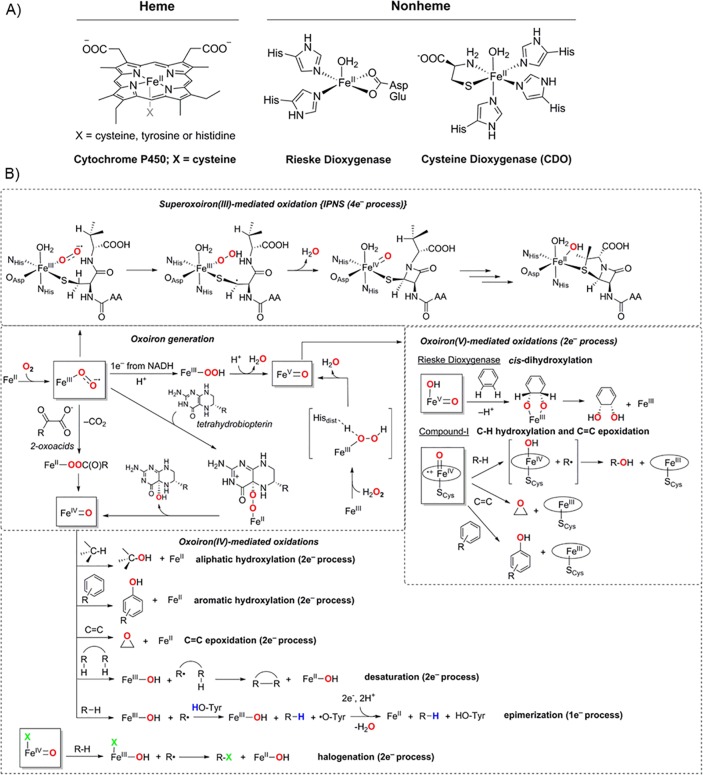
Figure 1
Figure 1
(A) Structures of mononuclear heme and nonheme active sites for dioxygen activation. (B) Mechanisms of dioxygen activation for one-, two-, and four-electron substrate oxidation processes.
Figure 2
Figure 2
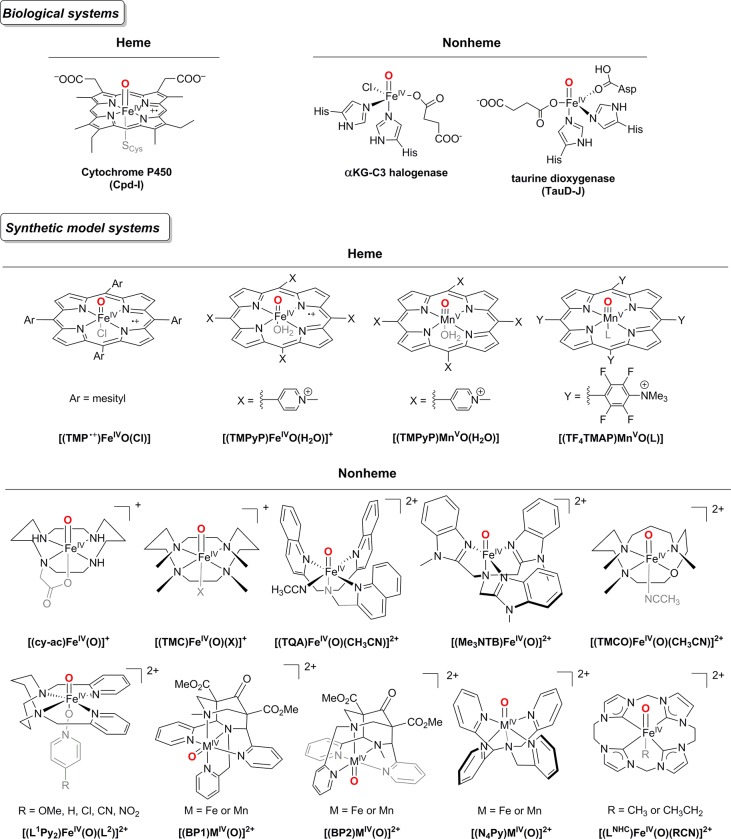
Examples of heme and nonheme intermediates containing oxoiron and oxomanganese cores in biological and synthetic model systems.
Figure 3
Figure 3
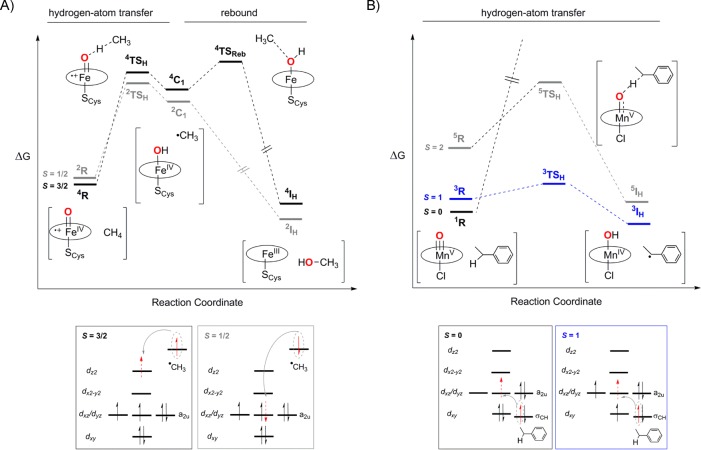
(A) Energy profile and reaction coordinate for the methane hydroxylation reaction by an oxoiron(IV) porphyrin π-cation radical species. Reprinted with permission from ref (58). Copyright 2017 Springer Nature. (B) Energy profile and reaction coordinate for the C–H activation by an oxomanganese(V) porphyrin complex. Reprinted with permission from ref (13). Copyright 2018 American Chemical Society.
Figure 4
Figure 4
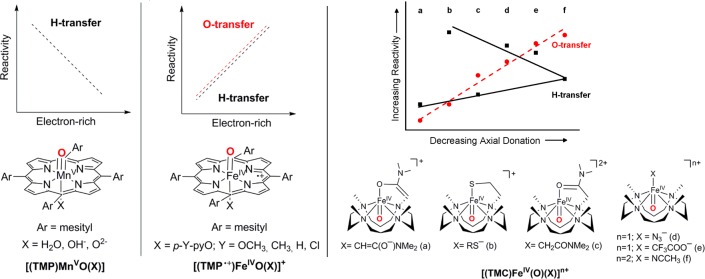
Axial ligand effects on the O-transfer and H-transfer reactions by [(TMP)MnV(O)(X)], [(TMP+•)FeIV(O)(X)]+, and [(TMC)FeIV(O)(X)]n+. Reprinted with permission from refs ( and 67). Copyright 2016 and 2009 WILEY-VCH Verlag GmbH, respectively.
Figure 5
Figure 5
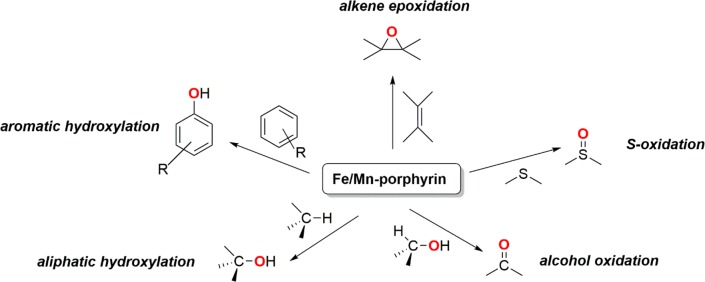
Oxidation reactions catalyzed by heme Fe/Mn models.
Figure 6
Figure 6
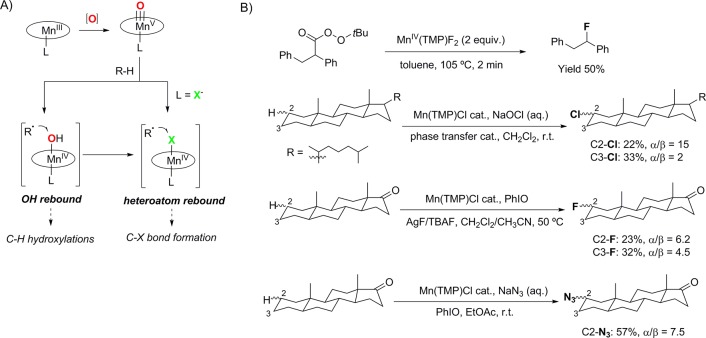
(A) Concept of manganese-catalyzed C–H hydroxylation and halogenation reactions via an oxygen-rebound or X-rebound mechanism. (B) Mn-catalyzed C–H halogenation and aziridination reactions.
Figure 7
Figure 7
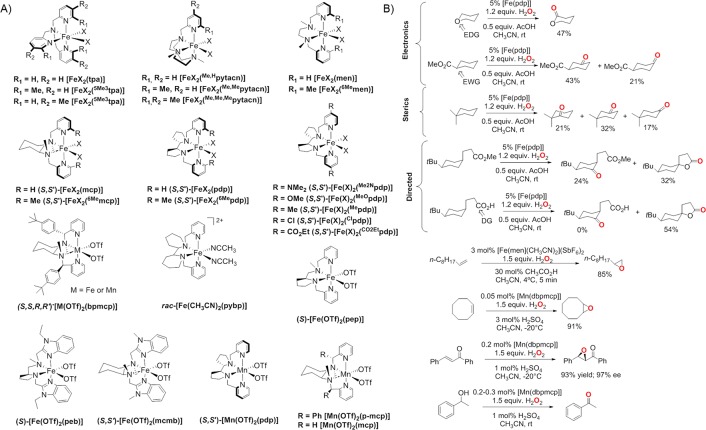
(A) Bioinspired Fe- and Mn-based nonheme catalysts. (B) Some examples showing the alkane hydroxylation, olefin epoxidation, and alcohol oxidation by nonheme iron and manganese catalysts and using H2O2 as an oxidant. Reprinted with permission from ref (140). Copyright 2017 Springer Nature.
Figure 8
Figure 8
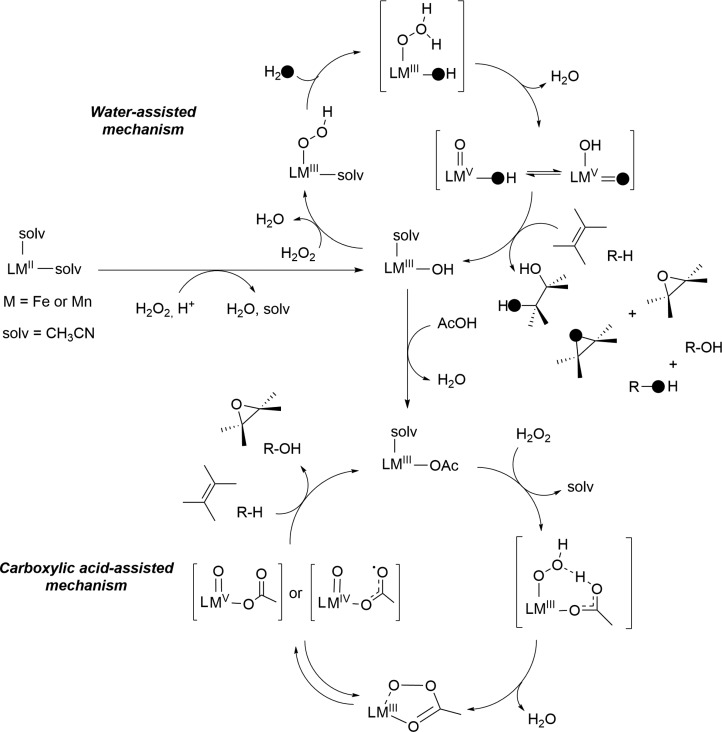
Proposed mechanisms for the nonheme iron and manganese complex-catalyzed oxidation reactions, such as water-assisted mechanism and carboxylic acid-assisted mechanism. Reprinted with permission from ref (140). Copyright 2017 Springer Nature.
Figure 9
Figure 9
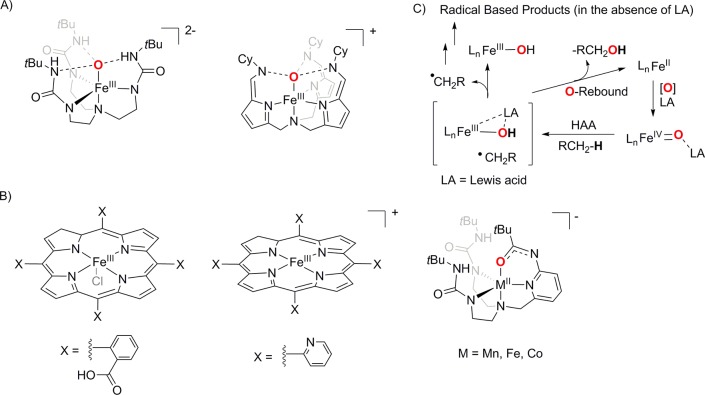
(A) Examples of intramolecular static H-bonding in the secondary coordination sphere leading to the stabilization of oxoiron(III) complexes. (B) Examples of complexes where intramolecular dynamic H-bonding interaction in the secondary sphere leads to the selective reduction of dioxygen to water. (C) Possible role of Lewis acids (LA) in ensuring oxoiron(IV) mediated catalytic C–H bond oxidation reactions.

References

    1. Sahu S.; Goldberg D. P. Activation of Dioxygen by Iron and Manganese Complexes: A Heme and Nonheme Perspective. J. Am. Chem. Soc. 2016, 138, 11410–11428. 10.1021/jacs.6b05251. - DOI - PMC - PubMed
    1. Kovaleva E. G.; Lipscomb J. D. Versatility of Biological Non-Heme Fe(II) Centers in Oxygen Activation Reactions. Nat. Chem. Biol. 2008, 4, 186–193. 10.1038/nchembio.71. - DOI - PMC - PubMed
    1. Pau M. Y. M.; Lipscomb J. D.; Solomon E. I. Substrate Activation for O2 Reactions by Oxidized Metal Centers in Biology. Proc. Natl. Acad. Sci. U. S. A. 2007, 104, 18355–18362. 10.1073/pnas.0704191104. - DOI - PMC - PubMed
    1. Jones R. D.; Summerville D. A.; Basolo F. Synthetic Oxygen Carriers Related to Biological Systems. Chem. Rev. 1979, 79, 139–179. 10.1021/cr60318a002. - DOI
    1. Wood P. M. The Potential Diagram for Oxygen at pH 7. Biochem. J. 1988, 253, 287–289. 10.1042/bj2530287. - DOI - PMC - PubMed