


Hydrophobic Organic Pollutants in Soils and Dusts at Electronic Waste Recycling Sites: Occurrence and Possible Impacts of Polybrominated Diphenyl Ethers
- PMID: 30696044
- PMCID: PMC6388296
- DOI: 10.3390/ijerph16030360
Hydrophobic Organic Pollutants in Soils and Dusts at Electronic Waste Recycling Sites: Occurrence and Possible Impacts of Polybrominated Diphenyl Ethers
Abstract
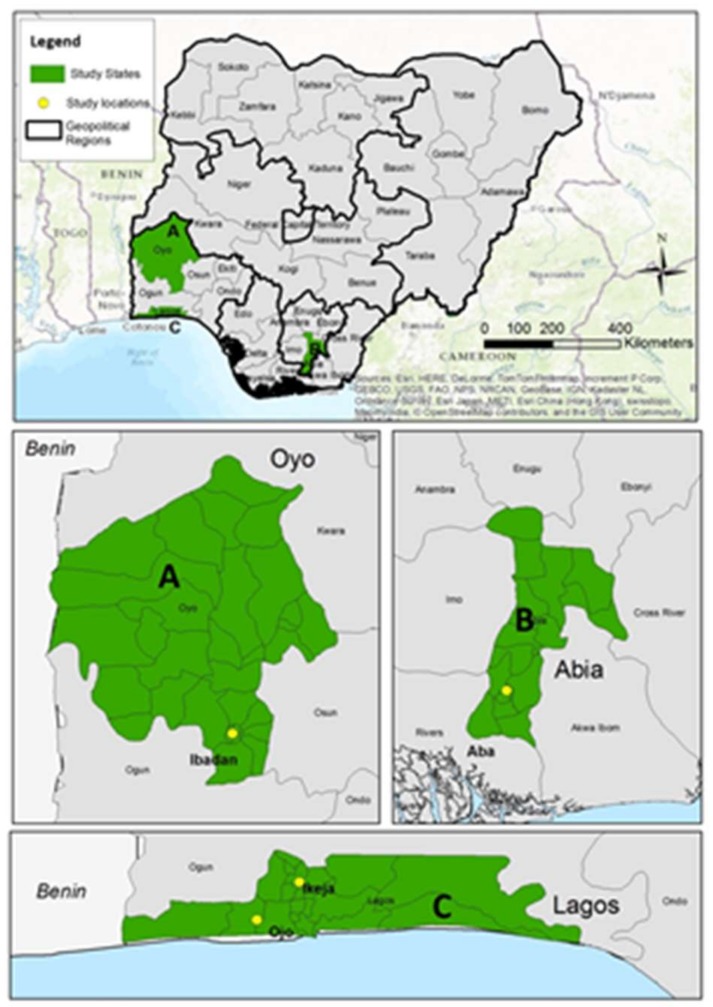
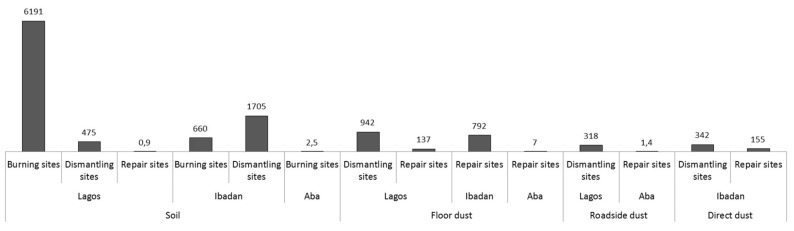
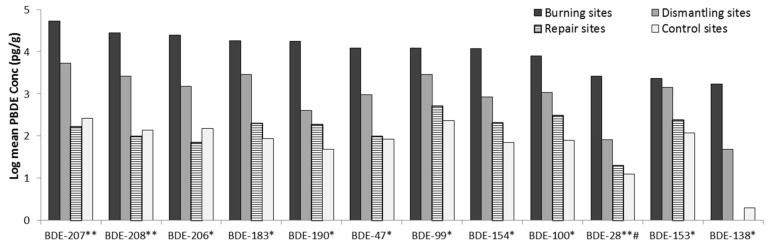
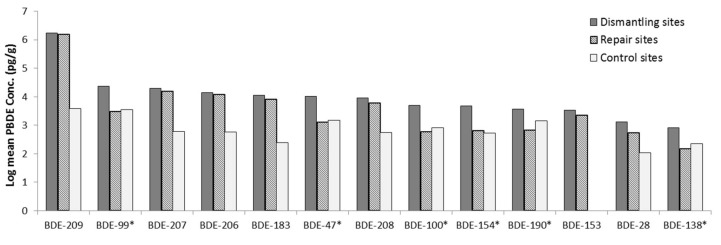
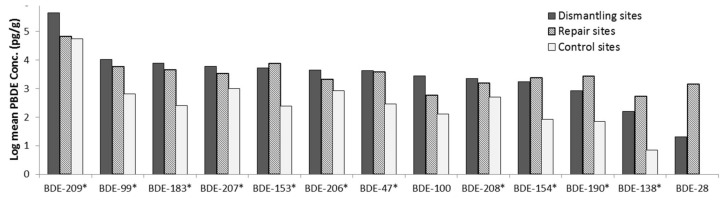
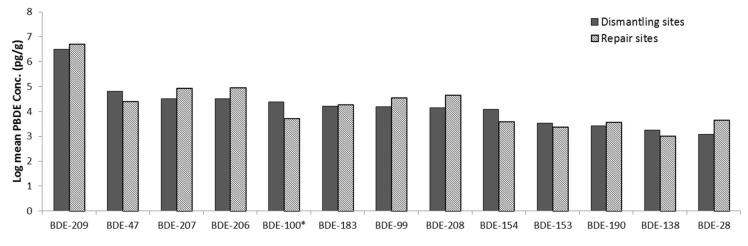
Concerns about the adverse consequences of informal electronic waste (e-waste) recycling is increasing, because e-waste contains some hazardous substances such as polybrominated diphenyl ethers (PBDEs) which is used as flame retardants in electronics. There is dearth of information on the concentrations of PBDEs and the pattern of distribution at the various e-waste recycling sites in Nigeria. This study therefore measured the concentrations of 13 PBDE congeners, in top soils (0⁻10 cm) and in various dust samples from different e-waste recycling sites (burning, dismantling, repair). PBDE concentrations at e-waste sites were compared with the concentrations in samples from corresponding control sites in three study locations in Nigeria (Lagos, Ibadan, and Aba). There were significant differences in the level of PBDEs congeners between each of the e-waste recycling sites and the corresponding control sites. The levels of PBDEs at the e-waste recycling sites exceeded the levels at the controls sites by a factor of 100 s to 1000 s. In general, PBDE concentrations at the e-waste sites decreased with the intensity of the e-waste recycling activities: burning sites > dismantling sites > repair sites > control sites. Our results suggest that the informal e-waste recycling has negative impacts on the enviroment and human health.
Keywords: Nigeria; PBDEs; dust; electronic waste; informal recycling; soil.
Conflict of interest statement
The authors declare no conflict of interest. The founding sponsors had no role in the design of the study; in the collection, analyses, or interpretation of data; in the writing of the manuscript, and in the decision to publish the results.
Figures

References
-
- Baldé C.P., Wang F., Kuehr R., Huisman J. The Global E-Waste Monitor—2014. United Nations University; Bonn, Germany: 2015.
-
- Baldé C.P., Gray V., Forti V., Kuehr R., Stegmann P. The Global E-waste Monitor 2017. United Nations University (UNU); Bonn, Germany: International Telecommunication Union (ITU); Geneva, Switzerland: International Solid Waste Association (ISWA); Vienna, Austria: 2017.
-
- United Nations Environmental Programme, Division of Technology I and E, International Environmental Technology . E-Waste Volume I: Inventory Assessment Manual. United Nations Environmental Programme; Osaka, Japan: 2007.
-
- Widmer R., Oswald-Krapf H., Sinha-Khetriwal D., Schnellmann M., Böni H. Global perspectives on e-waste. Environ. Impact Assess. Rev. 2005;25:436–458. doi: 10.1016/j.eiar.2005.04.001. - DOI
Publication types
MeSH terms
Substances
LinkOut - more resources
Full Text Sources
Molecular Biology Databases
