


Associations between dietary patterns and the risk of breast cancer: a systematic review and meta-analysis of observational studies
- PMID: 30696460
- PMCID: PMC6352362
- DOI: 10.1186/s13058-019-1096-1
Associations between dietary patterns and the risk of breast cancer: a systematic review and meta-analysis of observational studies
Abstract
Background: Epidemiologic evidence suggests that certain dietary patterns were associated with breast cancer risk, but the results have been inconclusive. We assessed the associations between different dietary patterns and the risk of breast cancer by conducting a meta-analysis of observational studies.
Methods: Relevant articles were searched in PubMed, Embase, and Cochrane library databases through September 2017. Multivariable-adjusted relative risks (RRs) and 95% confidence intervals (CIs) comparing the highest and lowest categories of Western and prudent dietary patterns were combined by using the random-effects meta-analyses.
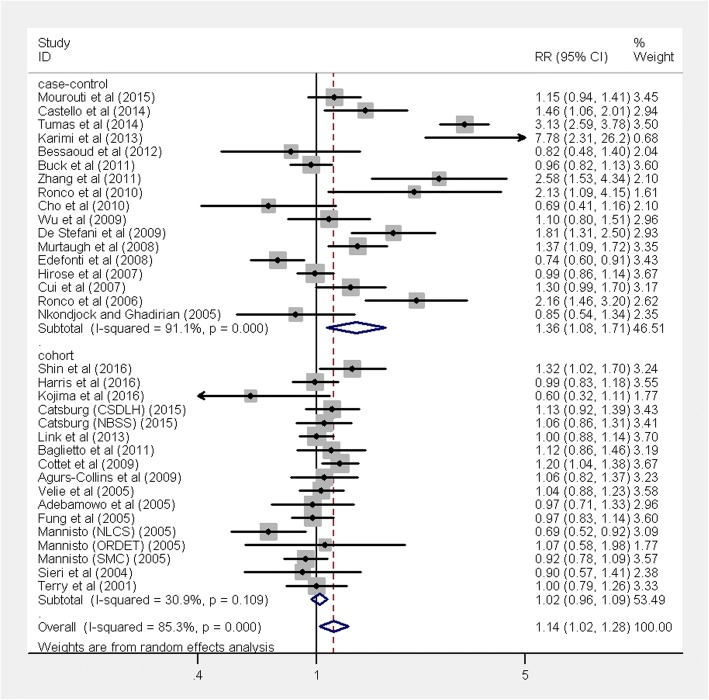
Results: We identified 32 eligible articles including 14 cohort and 18 case-control studies (34 Western and 35 prudent studies). The pooled analyses found that a Western dietary pattern was associated with a 14% increased risk (RR 1.14, 95% CI 1.02, 1.28), whereas a prudent dietary pattern was associated with an 18% reduced risk of breast cancer (RR 0.82, 95% CI 0.75, 0.89). In addition, sub-group analyses showed that the positive association between a Western dietary pattern and breast cancer risk was significant among postmenopausal (RR 1.20, 95% CI 1.06, 1.35), but not premenopausal women (RR 1.18, 95% CI 0.99, 1.40), and significant for hormone receptor-positive tumors (RR 1.18, 95% CI 1.04, 1.33), but not receptor-negative tumors (RR 0.97, 95% CI 0.83, 1.12). In contrast, the inverse association between a prudent dietary pattern and breast cancer was significant in premenopausal (RR 0.77, 95% CI 0.61, 0.98), but not postmenopausal women (RR 0.88, 95% CI 0.74, 1.03), and significant for both hormone receptor-positive and receptor-negative tumors.
Conclusions: The results of the current meta-analysis suggest a possible increased risk of breast cancer associated with a Western dietary pattern and a reduced risk with a prudent dietary pattern. Large-scale cohort studies with a high quality need to be conducted to further confirm the findings of the current meta-analysis. As dietary patterns are modifiable, these findings may provide viable strategies for breast cancer prevention through changes in dietary intake.
Keywords: Breast cancer; Dietary patterns; Meta-analysis; Observational studies.
Conflict of interest statement
Ethics approval and consent to participate
Not applicable
Consent for publication
Not applicable
Competing interests
The authors declare that they have no competing interests.
Publisher’s Note
Springer Nature remains neutral with regard to jurisdictional claims in published maps and institutional affiliations.
Figures



References
Publication types
MeSH terms
LinkOut - more resources
Full Text Sources
Medical
Research Materials
