. 2019 Jan 29;10(1):e02566-18.
doi: 10.1128/mBio.02566-18.

Dynamics of Human Gut Microbiota and Short-Chain Fatty Acids in Response to Dietary Interventions with Three Fermentable Fibers

Affiliations

Dynamics of Human Gut Microbiota and Short-Chain Fatty Acids in Response to Dietary Interventions with Three Fermentable Fibers

Nielson T Baxter et al. mBio. .

Abstract

Production of short-chain fatty acids (SCFAs), especially butyrate, in the gut microbiome is required for optimal health but is frequently limited by the lack of fermentable fiber in the diet. We attempted to increase butyrate production by supplementing the diets of 174 healthy young adults for 2 weeks with resistant starch from potatoes (RPS), resistant starch from maize (RMS), inulin from chicory root, or an accessible corn starch control. RPS resulted in the greatest increase in total SCFAs, including butyrate. Although the majority of microbiomes responded to RPS with increases in the relative abundance of bifidobacteria, those that responded with an increase in Ruminococcus bromii or Clostridium chartatabidum were more likely to yield higher butyrate concentrations, especially when their microbiota were replete with populations of the butyrate-producing species Eubacterium rectale RMS and inulin induced different changes in fecal communities, but they did not generate significant increases in fecal butyrate levels.IMPORTANCE These results reveal that not all fermentable fibers are equally capable of stimulating SCFA production, and they highlight the importance of the composition of an individual's microbiota in determining whether or not they respond to a specific dietary supplement. In particular, R. bromii or C. chartatabidum may be required for enhanced butyrate production in response to RS. Bifidobacteria, though proficient at degrading RS and inulin, may not contribute to the butyrogenic effect of those fermentable fibers in the short term.

Keywords: Ruminococcus; SCFA; bifidobacteria; butyrate; microbiome; prebiotic.


Figures

FIG 1
FIG 1
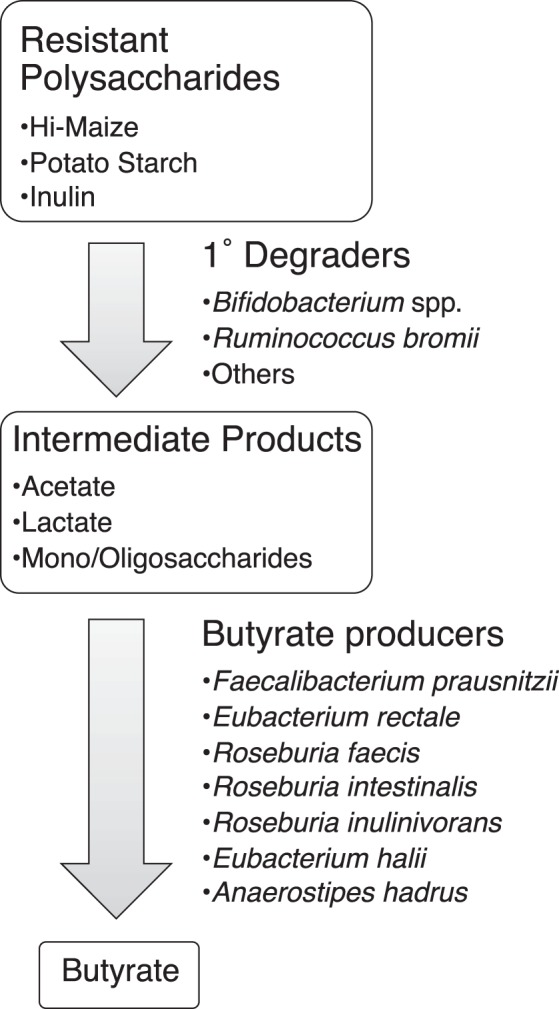
Proposed model of metabolites and microbes that catalyze the flow of carbon from resistant polysaccharides to butyrate. There are cultivated strains from the gut microbiome that possess the metabolic activities proposed for the species listed.
FIG 2
FIG 2
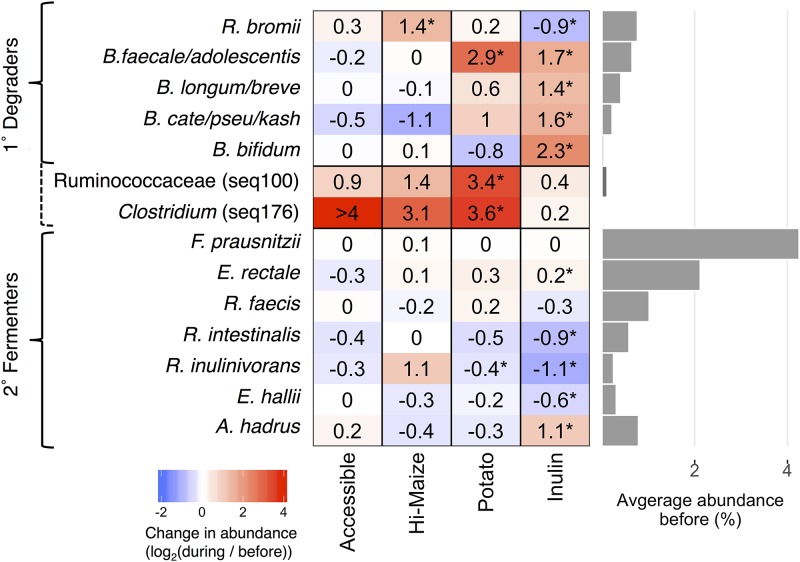
Average fold changes in the relative abundance of sequences representing selected primary (1°) degraders of resistant polysaccharides and secondary (2°) butyrate fermenters in response to dietary supplements (*, P < 0.05 by paired Wilcoxon test). Seq100 represents an unknown species in the family Ruminococcaceae, while seq176 is 98.8% identical to Clostridium chartatabidum. Both are inferred to be primary degraders (dashed bracket) based on the dynamics of their response to dietary supplements. The bar plot to the right shows the average relative abundance of each species prior to fiber supplementation.
FIG 3
FIG 3
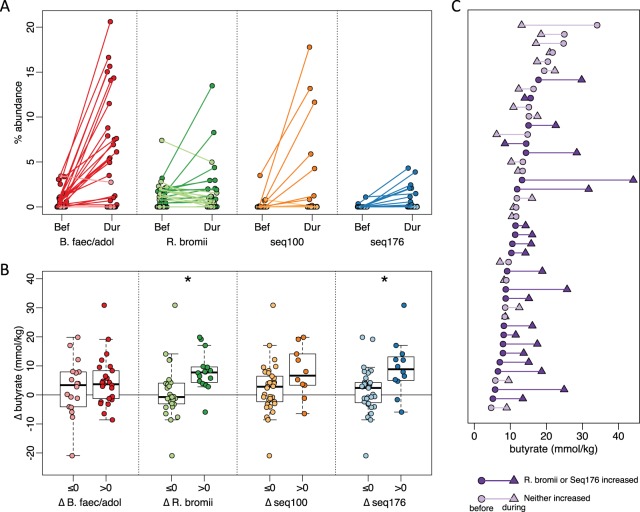
Associations between primary degraders and changes in fecal butyrate concentrations in response to dietary supplementation with resistant potato starch (RPS). For all panels, darker shades indicate an increase in abundance or concentration, and lighter shades indicate a decrease or no change. (A) Average relative abundance of putative primary degraders in each individual before (Bef) and during (Dur) RPS supplementation. (B) Change in fecal butyrate in individuals grouped on whether a primary degrader increased (Δ > 0) or did not increase (Δ ≤ 0) in relative abundance in response to RPS supplementation (*, P < 0.05 by t test). (C) Butyrate concentrations for each individual before (circles) and during (triangles) RPS supplementation. Subjects are sorted by initial butyrate concentration.
FIG 4
FIG 4
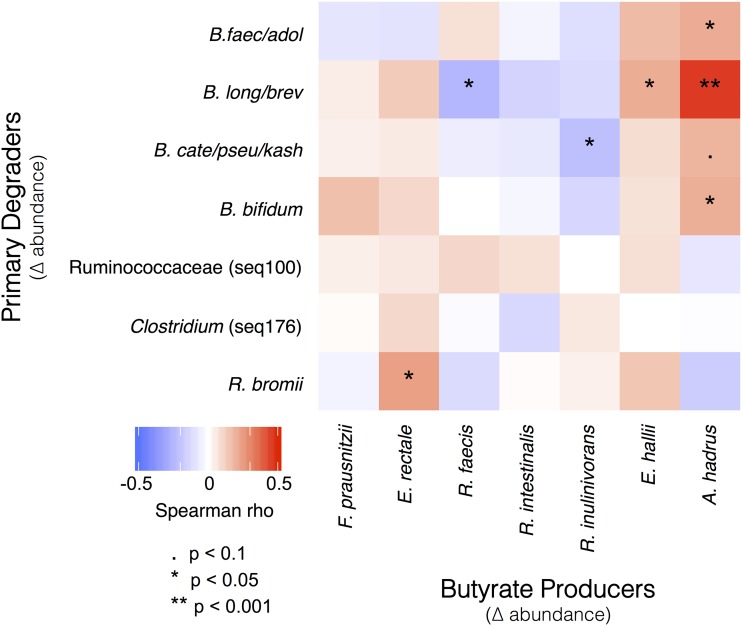
Pairs of microbes that consistently responded in concert either positively (red) or negatively (blue) to dietary supplementation. Correlations between changes in the abundance of primary degraders and butyrate producers were calculated using the combined data set that includes responses to all supplements.
FIG 5
FIG 5
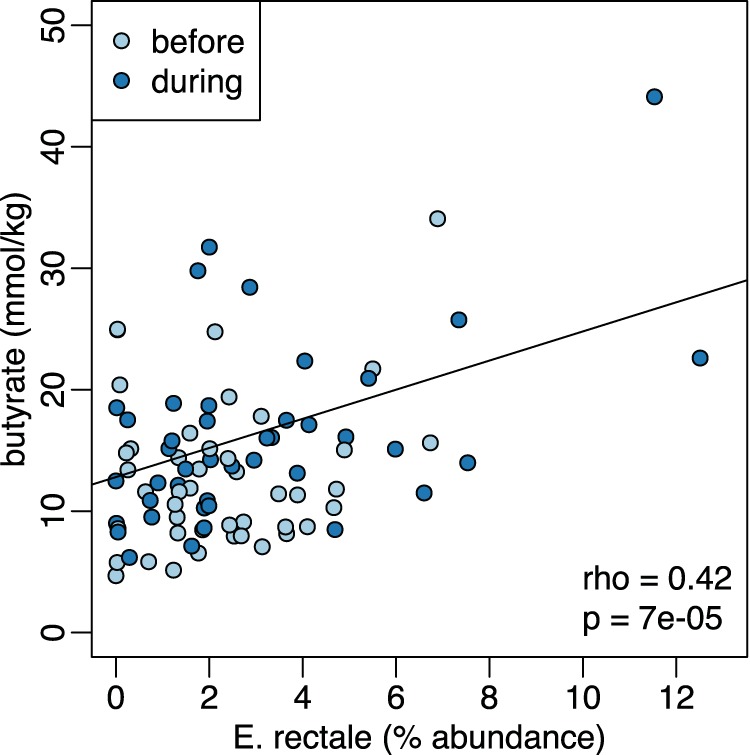
Positive relationship between fecal butyrate concentrations and the relative abundance of sequences characterized as E. rectale both before and during dietary supplementation with RPS.

References

    1. Furusawa Y, Obata Y, Fukuda S, Endo TA, Nakato G, Takahashi D, Nakanishi Y, Uetake C, Kato K, Kato T, Takahashi M, Fukuda NN, Murakami S, Miyauchi E, Hino S, Atarashi K, Onawa S, Fujimura Y, Lockett T, Clarke JM, Topping DL, Tomita M, Hori S, Ohara O, Morita T, Koseki H, Kikuchi J, Honda K, Hase K, Ohno H. 2013. Commensal microbe-derived butyrate induces the differentiation of colonic regulatory T cells. Nature 504:446–450. doi: 10.1038/nature12721. - DOI - PubMed
    1. Peng L, Li ZR, Green RS, Holzman IR, Lin J. 2009. Butyrate enhances the intestinal barrier by facilitating tight junction assembly via activation of AMP-activated protein kinase in Caco-2 cell monolayers. J Nutr 139:1619–1625. doi: 10.3945/jn.109.104638. - DOI - PMC - PubMed
    1. Ruemmele FM, Schwartz S, Seidman EG, Dionne S, Levy E, Lentze MJ. 2003. Butyrate induced Caco-2 cell apoptosis is mediated via the mitochondrial pathway. Gut 52:94–100. doi: 10.1136/gut.52.1.94. - DOI - PMC - PubMed
    1. Mikkelsen KH, Frost M, Bahl MI, Licht TR, Jensen US, Rosenberg J, Pedersen O, Hansen T, Rehfeld JF, Holst JJ, Vilsboll T, Knop FK. 2015. Effect of antibiotics on gut microbiota, gut hormones and glucose metabolism. PLoS One 10:e0142352. doi: 10.1371/journal.pone.0142352. - DOI - PMC - PubMed
    1. Wang L, Luo HS, Xia H. 2009. Sodium butyrate induces human colon carcinoma HT-29 cell apoptosis through a mitochondrial pathway. J Int Med Res 37:803–811. doi: 10.1177/147323000903700323. - DOI - PubMed

Publication types