. 2019 Jan 29;9(1):860.
doi: 10.1038/s41598-018-36165-x.

Biodegradation of naphthalene, BTEX, and aliphatic hydrocarbons by Paraburkholderia aromaticivorans BN5 isolated from petroleum-contaminated soil

Affiliations

Biodegradation of naphthalene, BTEX, and aliphatic hydrocarbons by Paraburkholderia aromaticivorans BN5 isolated from petroleum-contaminated soil

Yunho Lee et al. Sci Rep. .

Abstract

To isolate bacteria responsible for the biodegradation of naphthalene, BTEX (benzene, toluene, ethylbenzene, and o-, m-, and p-xylene), and aliphatic hydrocarbons in petroleum-contaminated soil, three enrichment cultures were established using soil extract as the medium supplemented with naphthalene, BTEX, or n-hexadecane. Community analyses showed that Paraburkholderia species were predominant in naphthalene and BTEX, but relatively minor in n-hexadecane. Paraburkholderia aromaticivorans BN5 was able to degrade naphthalene and all BTEX compounds, but not n-hexadecane. The genome of strain BN5 harbors genes encoding 29 monooxygenases including two alkane 1-monooxygenases and 54 dioxygenases, indicating that strain BN5 has versatile metabolic capabilities, for diverse organic compounds: the ability of strain BN5 to degrade short chain aliphatic hydrocarbons was verified experimentally. The biodegradation pathways of naphthalene and BTEX compounds were bioinformatically predicted and verified experimentally through the analysis of their metabolic intermediates. Some genomic features including the encoding of the biodegradation genes on a plasmid and the low sequence homologies of biodegradation-related genes suggest that biodegradation potentials of strain BN5 may have been acquired via horizontal gene transfers and/or gene duplication, resulting in enhanced ecological fitness by enabling strain BN5 to degrade all compounds including naphthalene, BTEX, and short aliphatic hydrocarbons in contaminated soil.


Conflict of interest statement

The authors declare no competing interests.

Figures
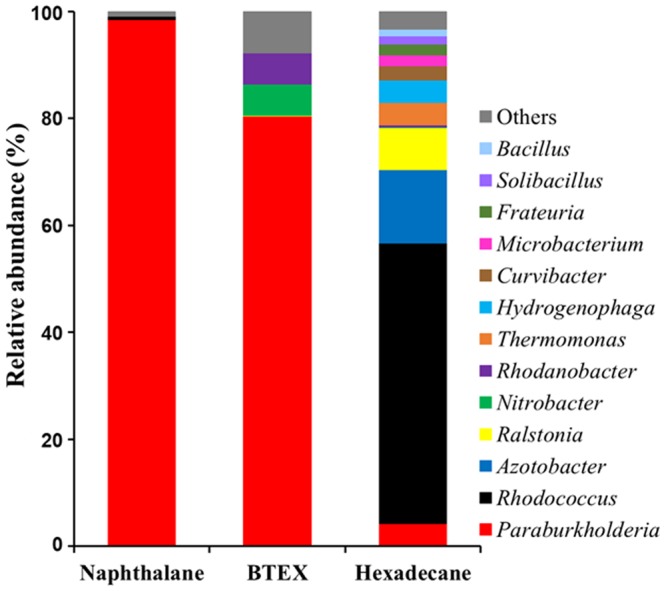
Figure 1
Figure 1
Bacterial community compositions of the final enrichment cultures supplemented with naphthalene, BTEX mixture (benzene, toluene, ethyl benzene, and o-, m-, p-xylene xy1:1:1:1:1:1), and hexadecane. The bacterial 16S rRNA gene sequences were classified at the genus level using the mothur software against the SILVA Gold reference database. “Others” represents taxa that comprised <1% of the total reads in three samples.
Figure 2
Figure 2
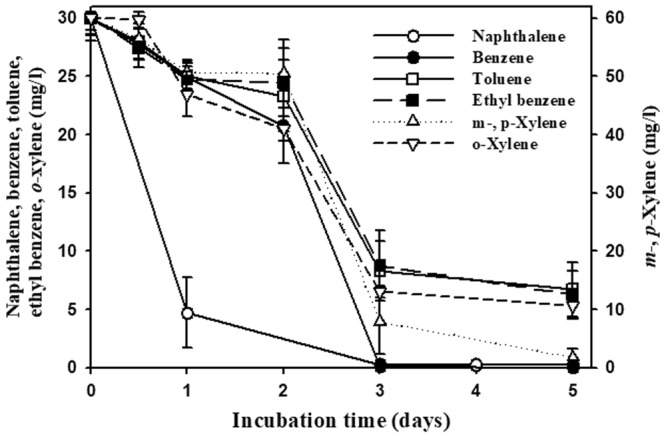
Biodegradation of naphthalene and BTEX (benzene, toluene, ethyl benzene, and o-, m-, p-xylene xy1:1:1:1:1:1) compounds by strain BN5 in serum bottles containing naphthalene (30 mg/l) or BTEX mixture (initial concentration of each BTEX compounds, 30 mg/l) in MSB media. Serum bottles without the inoculation of strain BN5 were used as negative controls; naphthalene and BTEX decreases in the negative controls were negligible (not shown). The symbols represent averages of triplicate experiments and the error bars indicate their corresponding standard deviations.
Figure 3
Figure 3
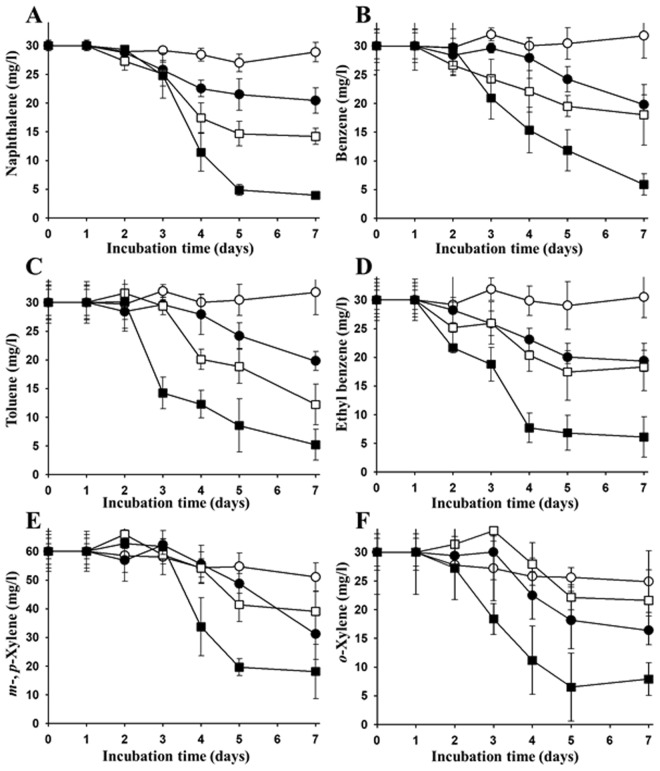
Biodegradation of naphthalene (A), benzene (B), toluene (C), ethyl benzene (D), m-, p-xylene (E), and o-xylene (F) by strain BN5 in soil slurry systems. Symbols in the figures are as follows: untreated (-○-), treated with nutrients (-●-), treated with strain BN5 (-□-), and treated with nutrients and strain BN5 (-■-). Unsterilized freshwater and soil were used for the setting of the soil slurry systems. The symbols represent averages of triplicate experiments and the error bars indicate their corresponding standard deviations.
Figure 4
Figure 4
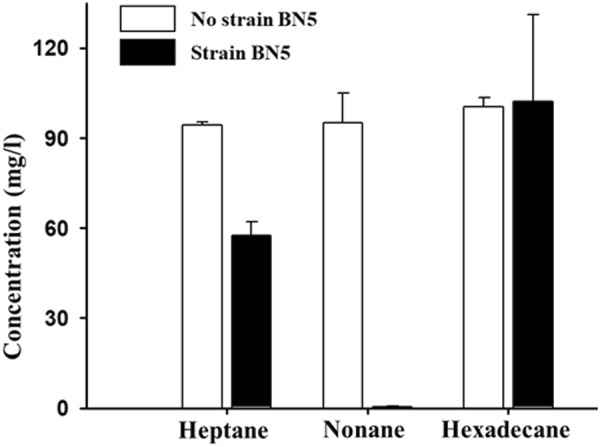
Biodegradation of heptane, nonane, and hexadecane by strain BN5 in serum bottles containing heptane, nonane or hexadecane (100 mg/l) in MSB media. Serum bottles without the inoculation of strain BN5 were used as negative controls and the concentrations of heptane, nonane, and hexadecane were measured after five days of incubation at 30 °C. The bars represent averages of triplicate experiments and the error bars indicate their corresponding standard deviations.
Figure 5
Figure 5
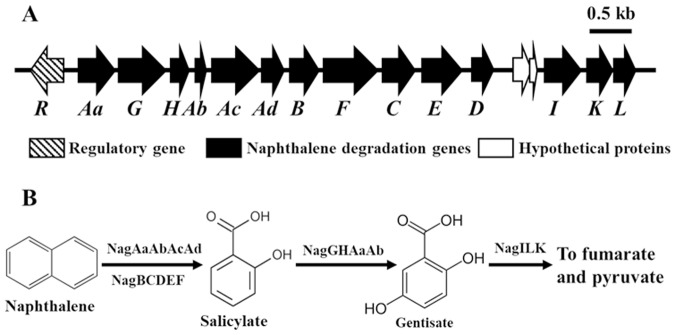
Physical map of naphthalene degradation genes located on the plasmid pBN2 of strain BN5 (A) and a proposed biochemical pathway of naphthalene degradation (B). The putative functions of the naphthalene biodegradation genes were predicted and are presented in Table S1.
Figure 6
Figure 6
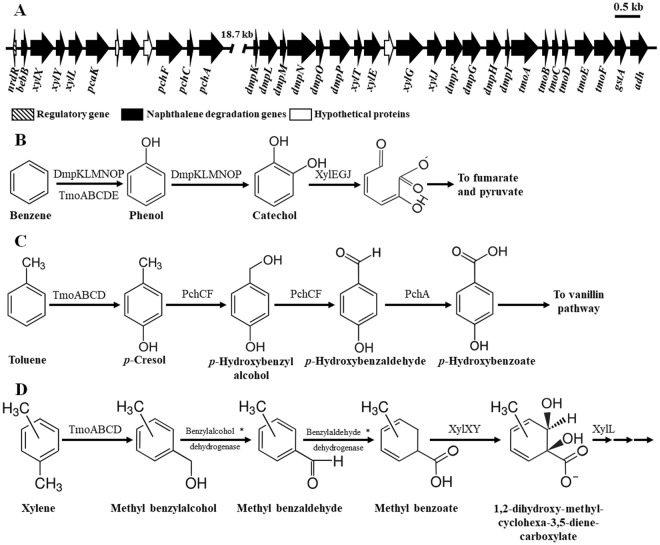
Physical maps of the metabolic genes probably responsible for benzene, toluene, and xylene degradation located on the plasmid pBN2 of strain BN5 (A). The metabolic genes are split into two gene clusters with a distance of approximately 18.7 kb and their putative functions were predicted and presented in Supplementary Table S2. Based on the predicted functions of the metabolic genes and the confirmation through GC/MS analysis of the metabolites, the biochemical pathways of benzene (B), toluene (C), and xylene (D) degradation in strain BN5 were proposed. Genes encoding the enzymes with asterisks were not identified in the genome of strain BN5 by bioinformatics analysis. The putative functions of the naphthalene biodegradation genes were predicted and presented in Table S2.

References

    1. Naidu R. Recent advances in contaminated site remediation. Water Air Soil Poll. 2013;224:1705. doi: 10.1007/s11270-013-1705-z. - DOI
    1. Namkoong W, Park JS, VanderGheynst JS. Biofiltration of gasoline vapor by compost media. Environ Pollut. 2003;121:181–187. doi: 10.1016/S0269-7491(02)00223-3. - DOI - PubMed
    1. Biswas B, Sarkar B, Rusmin R, Naidu R. Bioremediation of PAHs and VOCs: Advances in clay mineral-microbial interaction. Environ Int. 2015;85:168–181. doi: 10.1016/j.envint.2015.09.017. - DOI - PubMed
    1. Cheng HF, Hu ED, Hu YA. Impact of mineral micropores on transport and fate of organic contaminants: A review. J Contam Hydrol. 2012;129:80–90. doi: 10.1016/j.jconhyd.2011.09.008. - DOI - PubMed
    1. Samanta SK, Singh OV, Jain RK. Polycyclic aromatic hydrocarbons: environmental pollution and bioremediation. Trends Biotechnol. 2002;20:243–248. doi: 10.1016/S0167-7799(02)01943-1. - DOI - PubMed

Publication types

Supplementary concepts