


Using host species traits to understand the Wolbachia infection distribution across terrestrial beetles
- PMID: 30696916
- PMCID: PMC6351630
- DOI: 10.1038/s41598-018-38155-5
Using host species traits to understand the Wolbachia infection distribution across terrestrial beetles
Abstract
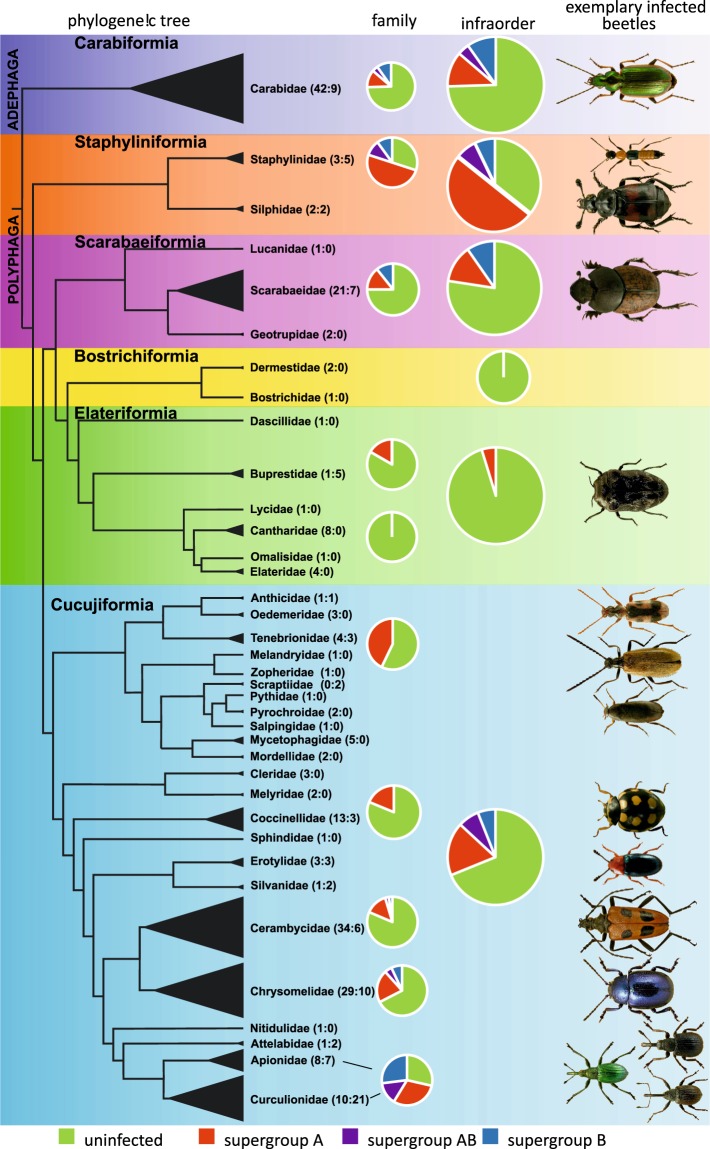
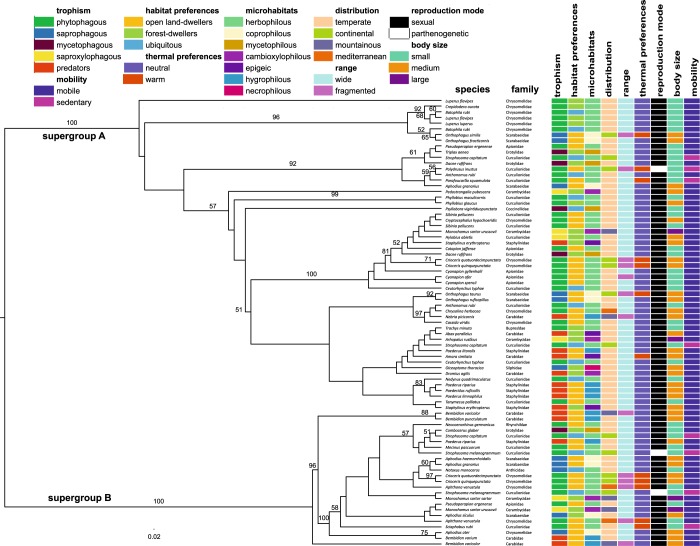
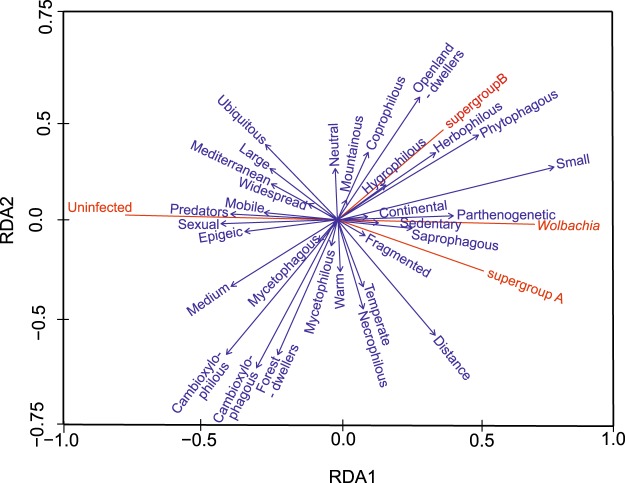
Knowledge of Wolbachia prevalence with respect to its hosts is restricted mainly to taxonomic/phylogenetic context. In contrast, relations between infection and most host's ecological and biological traits are poorly understood. This study aimed to elaborate on relations between bacteria and its beetle hosts in taxonomic and the ecological contexts. In particular, the goal is to verify which ecological and biological traits of beetles could cause them to be prone to be infected. Verification of Wolbachia infection status across 297 beetle taxa showed that approximately 27% of taxa are infected by supergroups A and B. Only minor support for coevolution between bacteria and its beetle hosts was observed in some genera of beetles, but in general coevolution between beetles and Wolbachia was rejected. Some traits of beetles were found to be unrelated to Wolbachia prevalence (type of range and thermal preferences); some traits were related with ambiguous effects (habitats, distribution, mobility and body size); some were substantially related (reproduction mode and trophy). The aforementioned summary does not show obvious patterns of Wolbachia prevalence and diversity in relation to host taxonomy, biology, and ecology. As both Wolbachia and Coleoptera are diverse groups, this lack of clear patterns is probably a reflection of nature, which is characterised by highly diversified and probably unstable relations.
Conflict of interest statement
The authors declare no competing interests.
Figures
References
-
- Hertig M. The Rickettsia, Wolbachia pipientis (gen. et sp.n.) and Associated Inclusions of the Mosquito, Culex pipiens. Parasitology. 1936;28:453–486. doi: 10.1017/S0031182000022666. - DOI
-
- Ramirez-Puebla, S. T. et al. Species in Wolbachia? Proposal for the designation of ‘Candidatus Wolbachia bourtzisii’, ‘Candidatus Wolbachia onchocercicola’, ‘Candidatus Wolbachia blaxteri’, ‘Candidatus Wolbachia brugii’, ‘Candidatus Wolbachia taylori’, ‘Candidatus Wolbachia collembolicola’ and ‘Candidatus Wolbachia multihospitum’ for the different species within Wolbachia supergroups. Syst. Appl. Microbiol.38, 390–399 (2015). - PubMed
Publication types
MeSH terms
LinkOut - more resources
Full Text Sources
Medical
Research Materials
