Review
. 2019 Feb 15;14(2):142-163.
doi: 10.1021/acschembio.8b01022. Epub 2019 Jan 30.

Biosynthesis and Chemical Applications of Thioamides

Affiliations
Review

Biosynthesis and Chemical Applications of Thioamides

Nilkamal Mahanta et al. ACS Chem Biol. .

Abstract

Thioamidation as a posttranslational modification is exceptionally rare, with only a few reported natural products and exactly one known protein example (methyl-coenzyme M reductase from methane-metabolizing archaea). Recently, there has been significant progress in elucidating the biosynthesis and function of several thioamide-containing natural compounds. Separate developments in the chemical installation of thioamides into peptides and proteins have enabled cell biology and biophysical studies to advance the current understanding of natural thioamides. This review highlights the various strategies used by Nature to install thioamides in peptidic scaffolds and the potential functions of this rare but important modification. We also discuss synthetic methods used for the site-selective incorporation of thioamides into polypeptides with a brief discussion of the physicochemical implications. This account will serve as a foundation for the further study of thioamides in natural products and their various applications.


Figures

Figure 1:
Figure 1:
Structures of non-ribosomal natural products bearing a thiocarbonyl group.
Figure 2:
Figure 2:
Structures of thioamidated ribosomal natural products.
Figure 3:
Figure 3:
(A) Biosynthetic gene cluster of closthioamide from Ruminiclostridium cellulolyticum DSM 5812. (B) Proposed NRPS biosynthetic pathway for closthioamide that contains six thioamide groups (PCP: peptidyl carrier protein, PHBA: p-hydroxybenzoic acid, DAP: diaminopropane, AANH: alpha-adenine nucleotide hydrolase).
Figure 4:
Figure 4:
(A) Biosynthetic gene cluster of 6-thioguanine (ycf) from Erwinia amylovora. (B) Proposed mechanistic model for sulfur mobilization and delivery during the thioamide formation mediated by YcfA/YcfC bipartite enzyme system (AANH: alpha-adenine nucleotide hydrolase; PLP: pyridoxal phosphate)
Figure 5:
Figure 5:
Proposed mechanisms for 4-thiouridine (s4U) formation in Escherichia coli. (A) The persulfide group on Cys456 of ThiI acts as a nucleophile to attack the activated uridine. (B) The persulfide group on Cys456 is used as a source of bisulfide (HS-), which nucleophilically attacks the activated uridine residue (Ado: adenosine). In both the cases, the Cys456 persulfide forms at the expense of the active site persulfide group on IscS (not shown).
Figure 6:
Figure 6:
Sulfur relay mechanism mediated by Tus proteins during 2-thiouridine (s2U) formation in Escherichia coli. Sulfur from cysteine is activated by cysteine desulfurase IscS to form the persulfide group on a conserved Cys residue on IscS. Reactive bisulfide group (HS-) is then transferred to MnmA via TusA, TusB/C/D complex and TusE. MnmA that forms complex with tRNA finally transfers it to the activated uridine at position 2, to finally form s2U.
Figure 7:
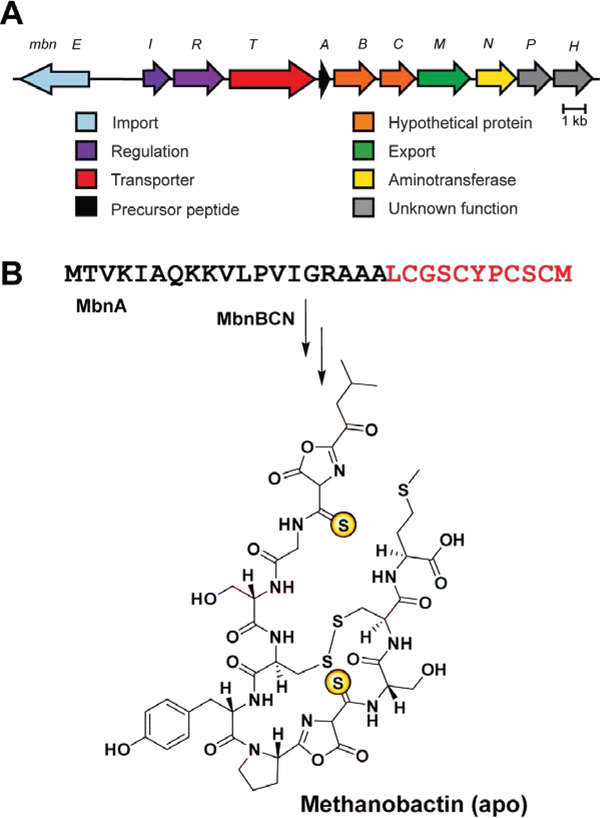
Figure 7:
(A) Methanobactin biosynthetic gene cluster (mbn) from Methylosinus trichosporium OB3b. (B) Core region (shown in red) of the precursor peptide MbnA is converted to mature methanobactin that contain two oxazolone- thioamide groups by the downstream biosynthetic enzymes MbnB, MbnC, and MbnN.
Figure 8:
Figure 8:
(A) Thioviridamide biosynthetic gene cluster (tva) from Streptomyces olivoviridis NA05001. (B) Core region (shown in red) of the precursor peptide TvaA is converted to thioviridamide that contain five thioamide groups by the downstream biosynthetic enzymes (adapted from Burkhart, B.J. et al Chem. Rev. 2017, 117, 5389).,
Figure 9:
Figure 9:
Comparison of reactions catalyzed by YcaO enzymes. (A) Biochemically characterized YcaO proteins involved in the biosynthesis of azol(in)e-containing ribosomal natural products catalyze the ATP-dependent cyclodehydration of cysteine, serine, and threonine. Shown is the transformation of peptidic cysteine to thiazoline which proceeds via an O-phosphorylated hemiorthoamide intermediate. (B) An analogous reaction is proposed for the biosynthesis of thioamides on peptidic backbones (in thioviridamide and MCR), with an exogenous source of sulfide (Na2S) acting as the nucleophile in place of the adjacent cysteine.
Figure 10:
Figure 10:
Thioamidated thiopeptide Saalfelduracin (A) Saalfelduracin biosynthetic gene cluster from Amycolatopsis saalfeldensis NRRL B-24474. (B) Predicted precursor peptide of saalfelduracin (with the predicted core peptide in red) and the proposed structure (adapted from Schwalen, C.J. et al, J. Am. Chem. Soc., 2018, 140, 9494).
Figure 11:
Figure 11:
A view of the MCR active site with the thioglycine involved in several stabilizing interactions using the crystal structure of Methanosarcina barkeri (PDB code: 1E6Y), (adapted from Nayak, D.D. et al, eLife, 2017, 6, e29218).
Figure 12.
Figure 12.
Site-specific incorporation of thioamides using solid phase peptide synthesis (SPPS). (A) Thioacylbenzotriazole monomers can be synthesized in three steps from Fmoc-protected amino acids using Lawesson’s Reagent or P4S10 to thionate. (B) The thioacylbenzotriazoles can be used to introduce the thioamide during SPPS with minor modifications of standard coupling, deprotection, and cleavage protocols.
Figure 13.
Figure 13.
Controlling bioactivity though thioamide photoisomerization. (A) Insect kinin-derived thioamide pentapeptide can undergo UV-induced photoisomerization. When exposed to cockroach hindgut extract in an ex vivo myotropic contraction assay, the irradiated cis peptide (adopting a 1–4 β-turn) shows higher activity than the trans peptide. (B) Titration of isolated cis or trans peptide to determine EC50 values. The cis peptide shows a 4-fold lower EC50 (adapted from Huang, Y. et al, J. Peptide Sci., 2008, 14, 262).
Figure 14.
Figure 14.
Glucagon-like peptide 1 (GLP-1) is stabilized by thioamide incorporation. (A) Incorporation of a thioamide into GLP-1 at the X1 or X2 positions prevents dipeptidyl peptidase 4 (DPP-4) degradation of GLP-1. (B) An image of the DPP-4 (cyan) active site with a GLP-1 N-terminal fragment (purple) bound, modeled based on the neuropeptide Y bound DPP-4 structure (PDB code: 1R9N). The X1, X2, and X3 carbonyl oxygens are highlighted as green, orange, and grey spheres, respectively. Key interactions with DPP-4 are shown as dashed lines. (C) In vitro degradation assay shows that incorporation of a thioamide at X1 and X2, but not X3, can effectively prevent proteolysis by DPP-4 (adapted from Chen, X. S. et al, J. Am. Chem. Soc., 2017, 139, 16688).
Figure 15.
Figure 15.
Thioamide incorporation increases activity of integrin agonist RGD peptides. (A) Chemical structures of RGD peptide macrocycles, including therapeutic candidate cilengitide and two matched amide/thioamide pairs. (B) NMR structures of the Thio-f (orange) and Thio-F (cyan) peptides are shown overlaid on the structure of cilengitide bound to αvβ3 integrin (PDB code: 1L5G). (C) Summary of peptide serum stability (t1/2) and activity (IC50 for binding to breast cancer cells and for glioblastoma cells). Macrocycles Thio-f and Thio-F show higher stability and activity than the corresponding amide peptides. Thio-F is superior to cilengitide in all assays. Figures reproduced with permission from Verma et al., Chem. Sci. 9, 2443 (2018) - published by The Royal Society of Chemistry.
Figure 16.
Figure 16.
Traceless ligation to synthesize thioamide-containing proteins. (A) Thioamide-containing thioester peptides (blue) are synthesized from acylhydrazide precursors by oxidation to form an acylazide which is displaced with thiophenol. (B) N-terminal cysteine fragments (red) are synthesized or recombinantly expressed. Synthetic peptides can contain β-, γ- or δ-thiol cysteine analogs (n = 1, 2, or 3) which can be converted to native amino acids after ligation. (C) Ligation can be performed without special precautions for the thioamide. (D) Masking of the ligation site can occur through: Desulfurization – thiol-selective radical desulfurization using sacrificial thioacetamide, Met Masking – methylation of homocysteine, homoGln Masking and Lys masking– alkylation of cysteine with iodoacetamide or bromoethylamine, respectively.

References

    1. Patani GA; LaVoie EJ Bioisosterism: A Rational Approach in Drug Design. Chem. Rev 1996, 96 (8), 3147–3176. - PubMed
    1. Lee H-J; Choi Y-S; Lee K-B; Park J; Yoon C-J Hydrogen Bonding Abilities of Thioamide. J. Phys. Chem. A 2002, 106 (30), 7010–7017.
    1. Reiner A; Wildemann D; Fischer G; Kiefhaber T Effect of Thioxopeptide Bonds on α-Helix Structure and Stability. J. Am. Chem. Soc 2008, 130 (25), 8079–8084. - PubMed
    1. Chen X; Mietlicki-Baase EG; Barrett TM; McGrath LE; Koch-Laskowski K; Ferrie JJ; Hayes MR; Petersson EJ Thioamide Substitution Selectively Modulates Proteolysis and Receptor Activity of Therapeutic Peptide Hormones. J. Am. Chem. Soc 2017, 139 (46), 16688–16695. - PMC - PubMed
    1. Verma H; Khatri B; Chakraborti S; Chatterjee J Increasing the Bioactive Space of Peptide Macrocycles by Thioamide Substitution. Chem. Sci 2018, 9 (9), 2443–2451. - PMC - PubMed

Publication types

MeSH terms

LinkOut - more resources