Association of Polygenic Liabilities for Major Depression, Bipolar Disorder, and Schizophrenia With Risk for Depression in the Danish Population
- PMID: 30698613
- PMCID: PMC6495355
- DOI: 10.1001/jamapsychiatry.2018.4166
Association of Polygenic Liabilities for Major Depression, Bipolar Disorder, and Schizophrenia With Risk for Depression in the Danish Population
Abstract
Importance: Although the usefulness of polygenic risk scores as a measure of genetic liability for major depression (MD) has been established, their association with depression in the general population remains relatively unexplored.
Objective: To evaluate whether polygenic risk scores for MD, bipolar disorder (BD), and schizophrenia (SZ) are associated with depression in the general population and explore whether these polygenic liabilities are associated with heterogeneity in terms of age at onset and severity at the initial depression diagnosis.
Design, setting, and participants: Participants were drawn from the Danish iPSYCH2012 case-cohort study, a representative sample drawn from the population of Denmark born between May 1, 1981, and December 31, 2005. The hazard of depression was estimated using Cox regressions modified to accommodate the case-cohort design. Case-only analyses were conducted using linear and multinomial regressions. The data analysis was conducted from February 2017 to June 2018.
Exposures: Polygenic risk scores for MD, BD, and SZ trained using the most recent genome-wide association study results from the Psychiatric Genomics Consortium.
Main outcomes and measures: The main outcome was first depressive episode (International Statistical Classification of Diseases and Related Health Problems, Tenth Revision [ICD-10] code F32) treated in hospital-based psychiatric care. Severity at the initial diagnosis was measured using the ICD-10 code severity specifications (mild, moderate, severe without psychosis, and severe with psychosis) and treatment setting (inpatient, outpatient, and emergency).
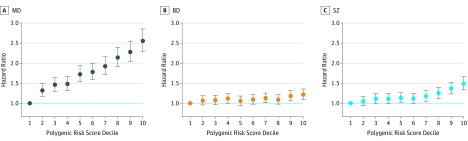
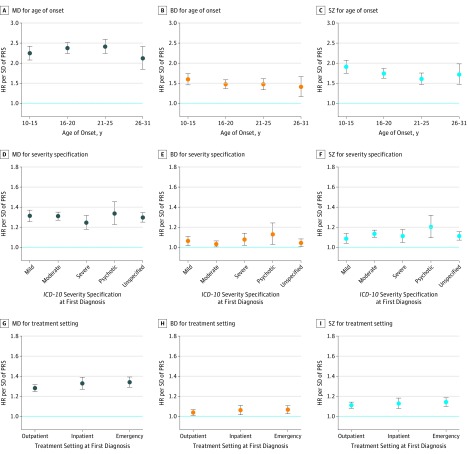
Results: Of 34 573 participants aged 10 to 31 years at censoring, 68% of those with depression were female compared with 48.9% of participants without depression. Each SD increase in polygenic liability for MD, BD, and SZ was associated with 30% (hazard ratio [HR], 1.30; 95% CI, 1.27-1.33), 5% (HR, 1.05; 95% CI, 1.02-1.07), and 12% (HR, 1.12; 95% CI, 1.09-1.15) increases in the hazard of depression, respectively. Among cases, a higher polygenic liability for BD was associated with earlier depression onset (β = -.07; SE = .02; P = .002).
Conclusions and relevance: Polygenic liability for MD is associated with first depression in the general population, which supports the idea that these scores tap into an underlying liability for developing the disorder. The fact that polygenic risk for BD and polygenic risk for SZ also were associated with depression is consistent with prior evidence that these disorders share some common genetic overlap. Variations in polygenic liability may contribute slightly to heterogeneity in clinical presentation, but these associations appear minimal.
Conflict of interest statement
Figures
Comment in
-
Progressing Polygenic Medicine in Psychiatry Through Electronic Health Records.JAMA Psychiatry. 2019 May 1;76(5):470-472. doi: 10.1001/jamapsychiatry.2018.3975. JAMA Psychiatry. 2019. PMID: 30698626 No abstract available.
References
-
- Lee SH, Ripke S, Neale BM, et al. ; Cross-Disorder Group of the Psychiatric Genomics Consortium; International Inflammatory Bowel Disease Genetics Consortium (IIBDGC) . Genetic relationship between five psychiatric disorders estimated from genome-wide SNPs. Nat Genet. 2013;45(9):984-994. doi: 10.1038/ng.2711 - DOI - PMC - PubMed
-
- Wray NR, Ripke S, Mattheisen M, et al. ; eQTLGen; 23andMe; Major Depressive Disorder Working Group of the Psychiatric Genomics Consortium . Genome-wide association analyses identify 44 risk variants and refine the genetic architecture of major depression. Nat Genet. 2018;50(5):668-681. doi: 10.1038/s41588-018-0090-3 - DOI - PMC - PubMed
Publication types
MeSH terms
Grants and funding
LinkOut - more resources
Full Text Sources
Other Literature Sources
Medical
Miscellaneous