


Plasmodium vivax Relapse Rates Following Plasmodium falciparum Malaria Reflect Previous Transmission Intensity
- PMID: 30698794
- PMCID: PMC6548896
- DOI: 10.1093/infdis/jiz052
Plasmodium vivax Relapse Rates Following Plasmodium falciparum Malaria Reflect Previous Transmission Intensity
Abstract
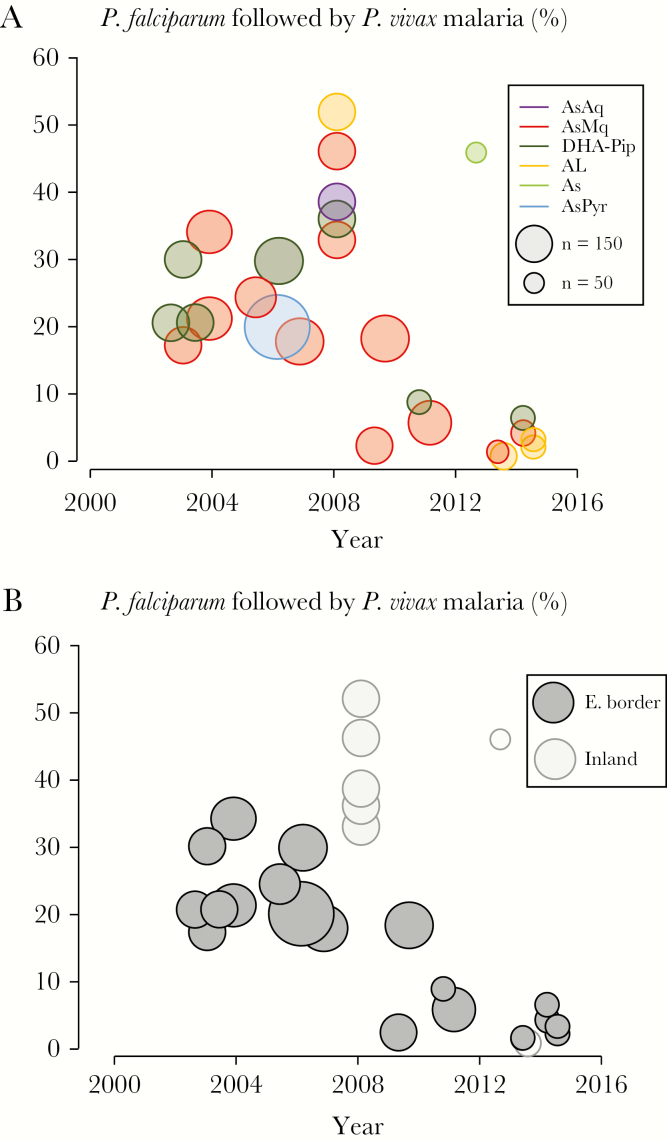
From 2003 through 2009, 687 of 2885 patients (23.8%) treated for Plasmodium falciparum malaria in clinical studies in Myanmar or on the Thailand-Myanmar border had recurrent Plasmodium vivax malaria within 63 days, compared with 18 of 429 patients (4.2%) from 2010 onward (risk ratio [RR], 0.176; 95% confidence interval, .112-.278; P < .0001). Corresponding data from 42 days of follow-up revealed that 820 of 3883 patients (21.1%) had recurrent P. vivax malaria before 2010, compared with 22 of 886 (2.5%) from 2010 onward (RR, 0.117; 95% CI, .077-.177; P < .0001). This 6-fold reduction suggests a recent decline in P. vivax transmission intensity and, thus, a substantial reduction in the proportion of individuals harboring hypnozoites.
Keywords: P. falciparum; P. vivax; Malaria; relapse.
© The Author(s) 2019. Published by Oxford University Press for the Infectious Diseases Society of America.
Figures
References
-
- Looareesuwan S, White NJ, Chittamas S, Bunnag D, Harinasuta T. High rate of Plasmodium vivax relapse following treatment of falciparum malaria in Thailand. Lancet 1987; 2:1052–5. - PubMed
