


Genomic Features and Clinical Management of Patients with Hereditary Pancreatic Cancer Syndromes and Familial Pancreatic Cancer
- PMID: 30699894
- PMCID: PMC6387417
- DOI: 10.3390/ijms20030561
Genomic Features and Clinical Management of Patients with Hereditary Pancreatic Cancer Syndromes and Familial Pancreatic Cancer
Abstract
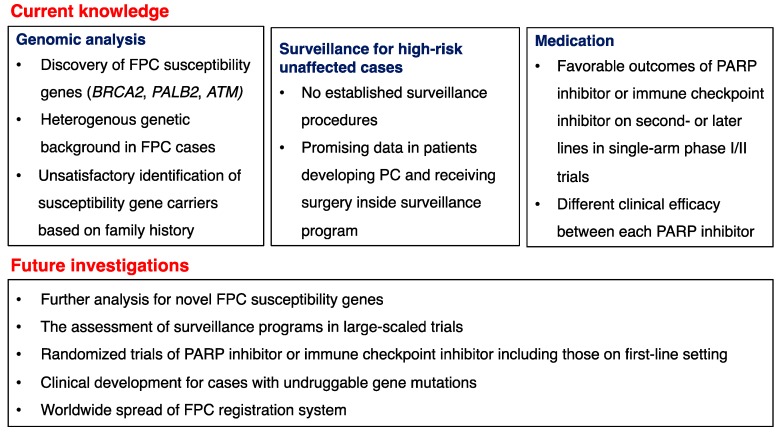
Pancreatic cancer (PC) is one of the most devastating malignancies; it has a 5-year survival rate of only 9%, and novel treatment strategies are urgently needed. While most PC cases occur sporadically, PC associated with hereditary syndromes or familial PC (FPC; defined as an individual having two or more first-degree relatives diagnosed with PC) accounts for about 10% of cases. Hereditary cancer syndromes associated with increased risk for PC include Peutz-Jeghers syndrome, hereditary pancreatitis, familial atypical multiple mole melanoma, familial adenomatous polyposis, Lynch syndrome and hereditary breast and ovarian cancer syndrome. Next-generation sequencing of FPC patients has uncovered new susceptibility genes such as PALB2 and ATM, which participate in homologous recombination repair, and further investigations are in progress. Previous studies have demonstrated that some sporadic cases that do not fulfil FPC criteria also harbor similar mutations, and so genomic testing based on family history might overlook some susceptibility gene carriers. There are no established screening procedures for high-risk unaffected cases, and it is not clear whether surveillance programs would have clinical benefits. In terms of treatment, poly (ADP-ribose) polymerase inhibitors for BRCA-mutated cases or immune checkpoint inhibitors for mismatch repair deficient cases are promising, and clinical trials of these agents are underway.
Keywords: Lynch syndrome; PARP inhibitor; familial pancreatic cancer; germline mutation; hereditary cancer syndrome; immune checkpoint inhibitor; next-generation sequencing; surveillance.
Conflict of interest statement
The authors declare no competing financial interests.
Figures
References
-
- American Cancer Society Five-Year Survival Rate Comes from SEER-9 Data. Cancer Facts & Figures 2018. [(accessed on 28 September 2018)]; Available online: https://www.pancan.org/facing-pancreatic-cancer/about-pancreatic-cancer/...
Publication types
MeSH terms
Supplementary concepts
LinkOut - more resources
Full Text Sources
Medical
Research Materials
Miscellaneous
