


Modification Effects of Population Expansion, Ageing, and Adaptation on Heat-Related Mortality Risks Under Different Climate Change Scenarios in Guangzhou, China
- PMID: 30699991
- PMCID: PMC6388188
- DOI: 10.3390/ijerph16030376
Modification Effects of Population Expansion, Ageing, and Adaptation on Heat-Related Mortality Risks Under Different Climate Change Scenarios in Guangzhou, China
Abstract
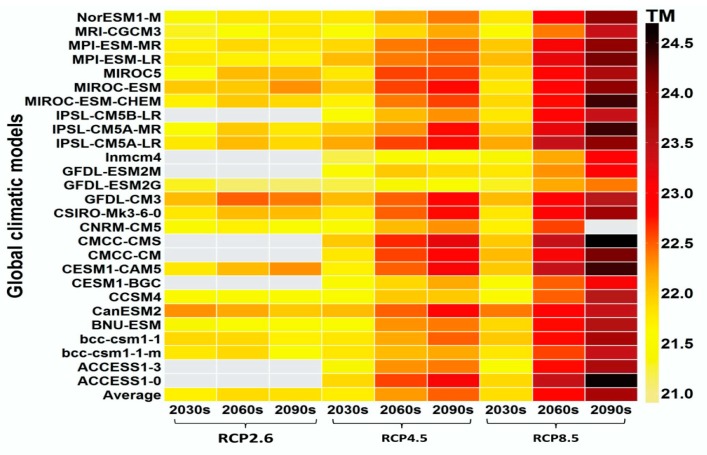
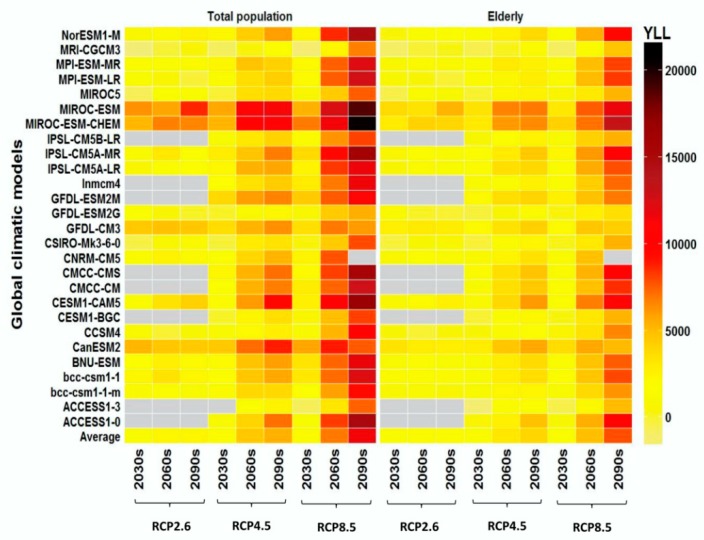
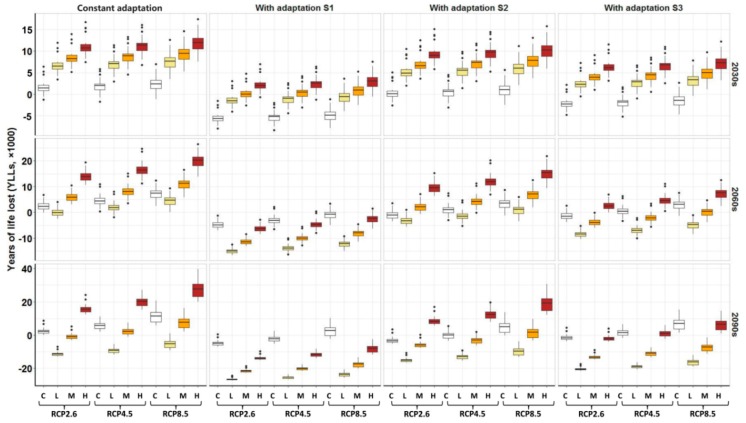
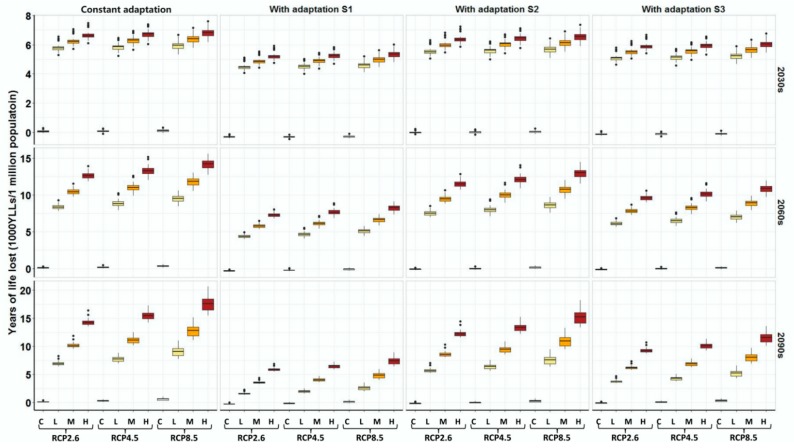
(1) Background: Although the health effects of future climate change have been examined in previous studies, few have considered additive impacts of population expansion, ageing, and adaptation. We aimed to quantify the future heat-related years of life lost (YLLs) under different Representative Concentration Pathways (RCP) scenarios and global-scale General Circulation Models (GCMs), and further to examine relative contributions of population expansion, ageing, and adaptation on these projections. (2) Methods: We used downscaled and bias-corrected projections of daily temperature from 27 GCMs under RCP2.6, 4.5, and 8.5 scenarios to quantify the potential annual heat-related YLLs in Guangzhou, China in the 2030s, 2060s, and 2090s, compared to those in the 1980s as a baseline. We also explored the modification effects of a range of population expansion, ageing, and adaptation scenarios on the heat-related YLLs. (3) Results: Global warming, particularly under the RCP8.5 scenario, would lead to a substantial increase in the heat-related YLLs in the 2030s, 2060s, and 2090s for the majority of the GCMs. For the total population, the annual heat-related YLLs under the RCP8.5 in the 2030s, 2060s, and 2090s were 2.2, 7.0, and 11.4 thousand, respectively. The heat effects would be significantly exacerbated by rapid population expansion and ageing. However, substantial heat-related YLLs could be counteracted by the increased adaptation (75% for the total population and 20% for the elderly). (4) Conclusions: The rapid population expansion and ageing coinciding with climate change may present an important health challenge in China, which, however, could be partially counteracted by the increased adaptation of individuals.
Keywords: adaptation; ageing; climate change; population expansion; population health; years of life lost.
Conflict of interest statement
The authors have declared that no competing interests exist.
Figures
References
-
- Stocker T.F., Qin D., Plattner G.-K., Tignor M., Allen S.K., Boschung J., Nauels A., Xia Y., Bex V., Midgley P.M. IPCC, 2013: Climate Change 2013: The Physical Science Basis. Cambridge University Press; Cambridge, UK: New York, NY, USA: 2013. Contribution of Working Group I to the Fifth Assessment Report of the Intergovernmental Panel on Climate Change.
-
- Guo Y., Gasparrini A., Armstrong B., Li S., Tawatsupa B., Tobias A., Lavigne E., de Sousa Zanotti Stagliorio Coelho M., Leone M., Pan X., et al. Global Variation in the Effects of Ambient Temperature on Mortality: A Systematic Evaluation. Epidemiology. 2014;25:781–789. doi: 10.1097/EDE.0000000000000165. - DOI - PMC - PubMed
-
- Gosling S.N., Lowe J.A., McGregor G.R., Pelling M., Malamud B.D. Associations between elevated atmospheric temperature and human mortality: A critical review of the literature. Clim. Chang. 2009;92:299–341. doi: 10.1007/s10584-008-9441-x. - DOI
Publication types
MeSH terms
LinkOut - more resources
Full Text Sources
Medical
