


Caregiver Burden and Desire for Institutional Placement-The Roles of Positive Aspects of Caregiving and Religious Coping
- PMID: 30700106
- PMCID: PMC10852480
- DOI: 10.1177/1533317519826217
Caregiver Burden and Desire for Institutional Placement-The Roles of Positive Aspects of Caregiving and Religious Coping
Abstract
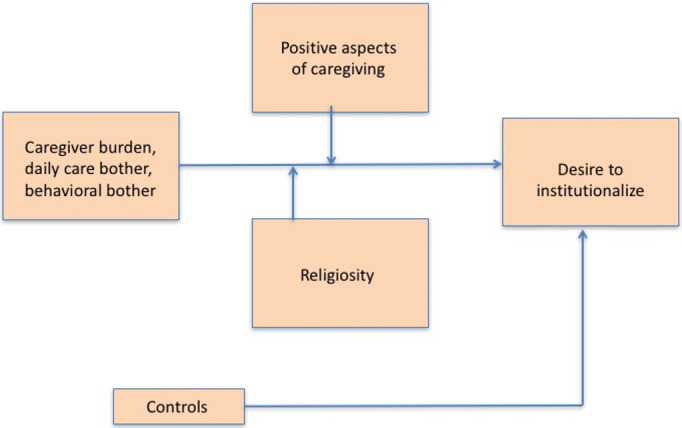
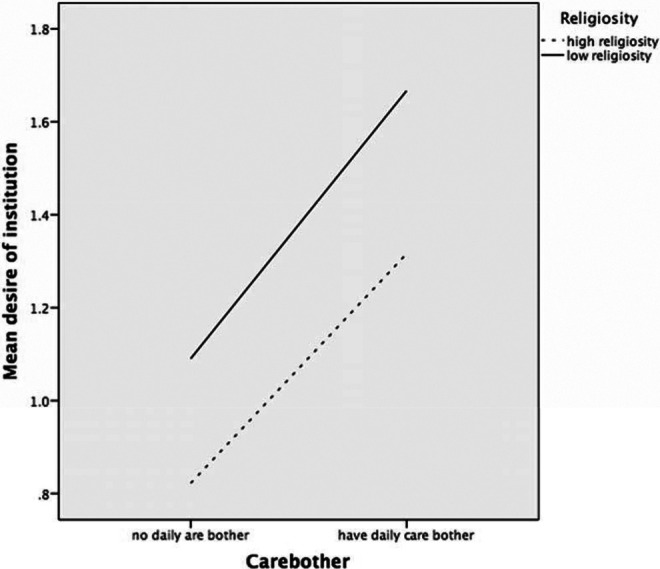
Based on stress coping theory, this study investigated whether and how positive aspects of caregiving (PAC) and religiosity buffered the association between caregiving burden and desire to institutionalize (DTI). Secondary data (N = 637) were drawn from the baseline assessment of the Resources for Enhancing Alzheimer's Caregiver Health II project. Descriptive analysis, bivariate correlation, and multiple linear regressions were conducted. The results indicated that higher levels of caregiver burden, daily care bother, and Revised Memory and Behavioral Problem Checklist bother were all significantly associated with higher level of DTI. Both PAC and religious coping were negatively associated with DTI; however, only PAC was significant. Only the interaction between daily care bother and religious coping was significant, which indicated that the harmful effect of daily care bother on DTI was significantly buffered among those who have religiosity. Study findings have important implications for policy makers and for providers who serve dementia family caregivers.
Keywords: caregiving burden; desire to institutionalize; positive aspects of caregiving; religiosity.
Conflict of interest statement
The authors declared no potential conflicts of interest with respect to the research, authorship, and/or publication of this article.
Figures
References
-
- ALZHEIMER’S DISEASE FACTS AND FIGURES. Alzheimer’s Association. 2018. Available at: https://www.alz.org/facts/ Accessed February 2, 2018.
-
- Arrighi H, Neumann P, Lieberburg I, Townsend R. Lethality of Alzheimer Disease and its impact on nursing home placement. Alzheimer Dis Assoc Disord. 2010;24(1):90–95. doi:10.1097/wad.0b013e31819fe7d1. - PubMed
-
- Gitlin L. Good news for dementia care: caregiver interventions reduce behavioral symptoms in people with dementia and family distress. Am J Psychiatry. 2012;169(9):894–897. doi:10.1176/appi.ajp.2012.12060774. - PubMed
-
- Brodaty H, Woodward M, Boundy K, Ames D, Balshaw R. Prevalence and predictors of burden in caregivers of people with dementia. Am J Geriatr Psychiatry. 2014;22(8):756–765. doi:10.1016/j.jagp.2013.05.004. - PubMed
-
- Kim H, Chang M, Rose K, Kim S. Predictors of caregiver burden in caregivers of individuals with dementia. J Adv Nurs. 2011;68(4):846–855. doi:10.1111/j.1365-2648.2011.05787.x. - PubMed
MeSH terms
LinkOut - more resources
Full Text Sources
Medical
