


TDP43 pathology in the brain, spinal cord, and dorsal root ganglia of a patient with FOSMN
- PMID: 30700593
- PMCID: PMC6404468
- DOI: 10.1212/WNL.0000000000007008
TDP43 pathology in the brain, spinal cord, and dorsal root ganglia of a patient with FOSMN
Erratum in
-
TDP43 pathology in the brain, spinal cord, and dorsal root ganglia of a patient with FOSMN.Neurology. 2019 Jul 9;93(2):e88. doi: 10.1212/WNL.0000000000007291. Neurology. 2019. PMID: 31285409 Free PMC article. No abstract available.
Abstract
Objective: To describe the histopathologic features of a case of facial-onset sensory and motor neuronopathy (FOSMN).
Methods: We describe a postmortem examination performed on a 54-year-old man with FOSMN associated with personality change.
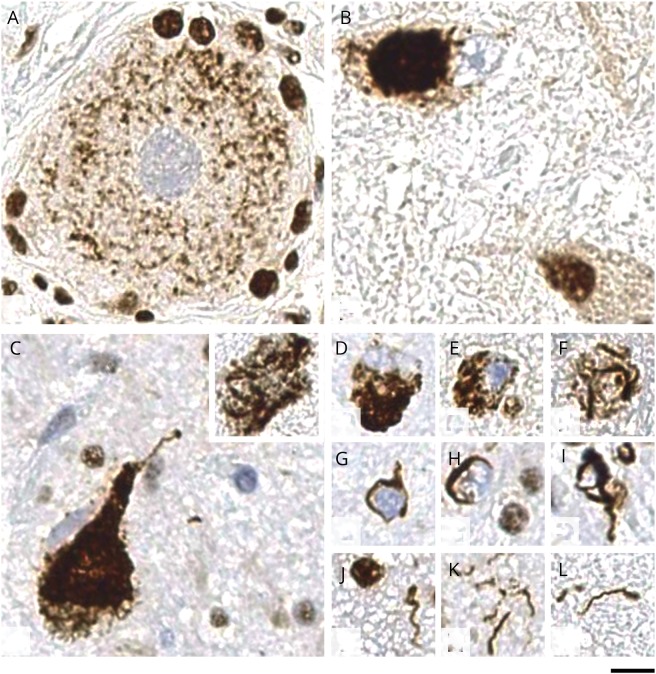
Results: Postmortem examination revealed TAR DNA-binding protein (TDP) 43 proteinopathy with widespread distribution. TDP43 pathology was seen in the neurons and glial cells and was most pronounced in the subthalamic nucleus followed by the spinal cord, including dorsal root ganglia, brainstem, and other deep cerebral nuclei. In the medial temporal lobe, neocortex and subcortical hemispheric white matter TDP43 pathologic inclusions were very rare. In contrast to TDP43 pathologies associated with typical amyotrophic lateral sclerosis (ALS) or frontotemporal dementia (FTD)-TDP, in this case, there were more frequent TDP43-positive oligodendroglial, coiled body-like cytoplasmic inclusions than neuronal inclusions. Neuronal cytoplasmic TDP43 inclusions with globular and skein-like morphology were seen in both anterior horn cells and dorsal root ganglia. No β-amyloid, α-synuclein, or significant hyperphosphorylated tau pathology was seen.
Conclusion: This case provides further evidence that FOSMN is a neurodegenerative disease characterized by TDP43 pathology. Despite minimal cortical TDP43 pathology, the clinical features of the behavioral variant of FTD in this patient suggest that FOSMN may fall within or overlap with the FTD-ALS spectrum.
Copyright © 2019 The Author(s). Published by Wolters Kluwer Health, Inc. on behalf of the American Academy of Neurology.
Figures
References
-
- Broad R, Leigh PN. Recognising facial onset sensory motor neuronopathy syndrome: insight from six new cases. Pract Neurol 2015;15:293–297. - PubMed
-
- Vucic S, Tian D, Chong PST, Cudkowicz ME, Hedley-Whyte ET, Cros D. Facial onset sensory and motor neuronopathy (FOSMN syndrome): a novel syndrome in neurology. Brain 2006;129:3384–3390. - PubMed
-
- Karakis I, Vucic S, Srinivasan J. Facial onset sensory and motor neuronopathy (FOSMN) of childhood onset. Muscle Nerve 2014;50:614–615. - PubMed
-
- Knopp M, Vaghela NN, Shanmugam SV, Rajabally YA. Facial onset sensory motor neuronopathy: an immunoglobulin-responsive case. J Clin Neuromuscul Dis 2013;14:176–179. - PubMed
Publication types
MeSH terms
Substances
Grants and funding
LinkOut - more resources
Full Text Sources
Miscellaneous
